




Volume 181 - Issue 11
A chilling thought for Christmas 2004: might the newborn Christ have been hypothermic?
Authors: Tieh-Hee Koh and Marion R Koh
Med J Aust 2004; 181 (11): 680-681. || doi: 10.5694/j.1326-5377.2004.tb06522.x
Published online: 6 December 2004
Published online: 6 December 2004
Christmas for us this year will be the usual 20-minute ferry trip across the azure waters from Townsville to nearby Magnetic Island (known locally as “Maggie”), while being entertained by frolicking dolphins. On arrival we will head straight to Alma Bay, blessed with its golden sands, Dom Perignon-clear waters and vibrant coral reef. My wife and I, however, still cling to the nostalgic concept of Christmas bedecked with snow, a thundering fireplace, allergenic mistletoes, an inviting bowl of punch, and a real Christmas tree bought as a last-minute bargain in the Arctic cold of Newcastle upon Tyne.
Temperatures at Christmas time in the northern hemisphere at any distance from the Equator are cold. Indeed, the temperature in Bethlehem at the time of the birth of Jesus Christ has been argued to be about 7°C.1 As we are experienced in looking after sick newborn babies, we have been impressed every year by the fact that, in depictions of the nativity scene on Christmas cards we receive, the newborn Jesus is almost always naked. There is good evidence that maintaining a normal temperature is one of the basic tenets of newborn care.2 We therefore undertook a study to either confirm or refute our impression that the newborn Jesus was indeed not clothed at birth.
Methods
The National Gallery in London houses one of the world’s great collections of European paintings. We accessed its website3 and typed the words “the nativity” into the search box.
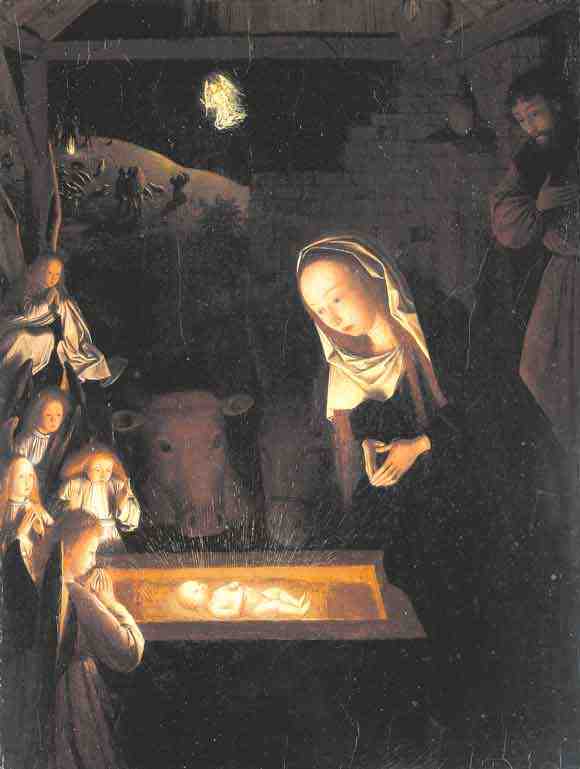
The Nativity at Night, by Geertgen tot Sint Jans, late 15th century. © National Gallery, London, UK.
Results
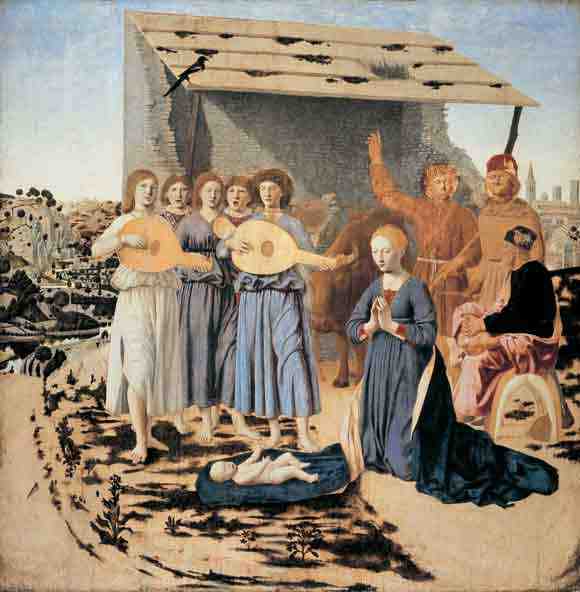
Our search yielded 25 “hits”. Of 25 paintings listed, two were not of the Nativity, and three paintings of the Nativity did not show the newborn Jesus clearly. Close analysis (independently by each author) of the 20 remaining paintings yielded the following.
Clothing and other means of protection: The newborn Jesus was naked in 11 paintings, lightly clothed in seven, and moderately clothed in two. The newborn Jesus had a halo in eight paintings.
Birth size: The newborn Jesus was large for gestational age in 11 paintings, appropriate for gestational age in six, and had a premature look in two.
Clothing of Mary, Joseph and onlookers: Mary was thickly clothed in all 20 paintings. Joseph was also thickly clothed in all of the 19 paintings depicting him. There were 56 onlookers (angels were excluded, as the authors only deal with mortals in their clinical practice) in 14 of the paintings; 47 were thickly clothed and 9 moderately clothed.
Position of the newborn Jesus: On the floor in 12 paintings, in Mary’s arms in four, and in a cot or basket in four.
In summary, the newborn Jesus was either naked or lightly clad in 90% of the Old Master paintings of the Nativity, was large for gestational age in 55% of the paintings, and placed on the floor in 60% of the paintings.
Discussion
We postulate that Jesus would have been hypothermic at birth, and very much so if also premature, had he been born on 25 December in a place with a temperature of 7°C.
There might, of course, be other explanations. The newborn Jesus being naked and placed on the floor may have a number of meanings. One, pragmatic interpretation is that he was born a normally formed, healthy baby, as evidenced by his being large for gestational age in 55% of the paintings. However, this explanation is thrown into doubt by two which depicted Jesus as being born small for gestational age or preterm.
Another potential meaning, more symbolic than pragmatic, is that he was born into this world without any earthly possessions. In similar vein, to the unscientifically inclined the halo and the pedigree of Jesus’ birth might suggest a neutral thermal zone, making the ambient temperature irrelevant.
One obvious explanation is that the painters got it all wrong — it may have been warmer than we are assuming. However, all of the Old Masters painted Mary and Joseph as wearing winter clothing, and 47 of 56 onlookers (84%) were in winter clothing and the remaining nine were moderately clothed.
An attractive explanation is that Jesus was not born in winter.1 In Luke 2.8, the Bible states: “Now there were in the same country shepherds living out in the fields, keeping watch over their flocks by night.” Keeping flocks in the field was common practice from April to September, but in the cold and rainy winter months shepherds took their flocks back home to shelter them. The Bible contains further evidence against December as the month of Jesus’ birth: “And it came to pass in those days that a decree went out from Caesar Augustus that all the world should be registered . . . So all went to be registered, everyone to his own city. Joseph also went up from Galilee, out of the city of Nazareth, into Judaea, to the city of David, which is called Bethlehem . . . to be registered with Mary, his betrothed wife, who was with child. So it was, that while they were there, the days were completed for her to be delivered. And she brought forth her firstborn Son . . .” (Luke 2: 1–7). The Roman rulers would have regarded taking a census in winter as impractical and unpopular. A census would have been more likely after the harvest season, around September or October, when the weather was good and the roads dry to facilitate travel.1 Accordingly, Christ’s birth would have been in September, when the temperature would allow the shepherds to tend their flocks by night, and also allow the newborn Jesus to be, as observed in our investigations, only lightly clothed or not swaddled.
Finally, 25 December as the date for Christmas was decreed in the 4th century ad by Pope Liberius, possibly to compete with pagan festivals celebrating the winter solstice.4
Come Christmas Day this year, when we are sipping our chilled chardonnay under the clear sapphire sky, we will not be able to help but wonder whether Jesus might yet have been born on 25 December, but in . . . in Maggie (or should that be Magi?) Island, adjacent to the glorious tropical coast off Townsville, north Queensland, by the Great Barrier Reef.
Competing interests
None identified.
References
- When was Jesus Born? Avaialble at: www.new-life.net/chrtms10.htm (accessed Oct 2004).
- Silverman WA, Fertig JW, Berger AP. The influence of the thermal environment upon the survival of newly born premature infants. Pediatrics 1958; 22: 876-886. i1085694
- National Gallery. Available at: www.nationalgallery.org.uk/ (accessed Oct 2004).
- Australian Government Culture and Recreation Portal. Christmas: a multicultural festival. Available at: www.cultureandrecreation.gov.au/articles/christmas (accessed Oct 2004).