




Volume 177 - Issue 11
Practical response to disaster
Author: Gordian W O Fulde
Med J Aust 2002 || doi: 10.5694/j.1326-5377.2002.tb04970.x
Published online: 15 October 2002
Published online: 15 October 2002
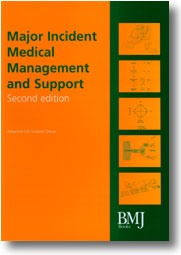
Major incident medical management and support. The practical approach. Advanced life support. 2nd edition.
Hodgetts TJ, Mackway-Jones K, editors. London: BMJ Books, 2002 (xv + 222 pp). ISBN 0 7279 1391 3.
The clinician will find that this approach is clearly explained. Aided by tables and diagrams, the reader is shown how to assess the scene, communicate appropriately with the services, use an accepted quick triage sieve (in the field using respiratory rate and capillary return), deal with the dead, and do practical procedures from airway management to femoral nerve blocks. Various topics, from media interaction to chemical and radiological incidents, are covered, although biological agents seem to have been forgotten.
The great strength of this work is that it is relevant and very practical. It is supplied in a loose-leaf folder so that it can be updated, and there are spaces to record specific local details. In spite of a respected Australian contributor it does have a British flavour, but the principles are universal.
In our fast-moving and troubled society, no doctor, whether a rural GP or a city doctor, can be sure he or she will escape being caught up in a major incident. Having medically responded to several of Australias major disasters I have done the MIMMS course, and I always take this excellent manual with me. Both are to be recommended most highly.
Gordian W O FuldeDirector, Emergency Medicine St Vincents Hospital, Sydney, NSW
‘Once Bitten’: A Case of Tetanus Following Snakebite in Australia
Adrian A. S. Doherty, Naomi N. E. Clarke, Sarah Fletcher, Sarah Huffam, Camille V. Awburn, Eugene Athan
Epidemiology and Quality of Care for Aboriginal and Torres Strait Islander Peoples Treated by Emergency Medical Services for Stroke in Victoria, Australia: Retrospective Analysis of Linked Data
Candice Menezes, Ziad Nehme, Luke J. Burchill, Tegwyn McManamny, Angela Dos Santos, Michelle Crilly, Luke P. Dawson, Benjamin Clissold, David Anderson, Emily Nehme
Intranasal Adrenaline Use for the Management of Insect Venom-Induced Anaphylaxis
Thomas J. Young, Wilhelmina R. F. Johnson, Braydon L. Pennington, Troy Wanandy, Wun Y. Lau, Thanh-Thao A. Le
Gabapentinoid Poisoning Presentations to Victorian Emergency Departments: A 15-Year Trend Analysis
Bishaal Tej Gurung, Amy McNeilage, Angus Skeen, Tina Lam, Joanna F. Dipnall, Jane Hayman, Suzanne Nielsen, Ting Xia
They Brought the Hospital to Me
Hugh N. Burrill
Predictors of Ambulance Transport to Hospital for Older People Living in Tasmanian Aged Care Facilities: A Retrospective Cohort Study
Sharon Andrews, Pieter F. Fouche, Belinda Flanagan, Michael McDermott, Melanie Greenwood