




Volume 177 - Issue 11
What a shocker! The effects of the M2 virus on the behaviour of young children
Author: Garry Walter
Med J Aust 2002; 177 (11): 680. || doi: 10.5694/j.1326-5377.2002.tb05015.x
Published online: 9 December 2002
Published online: 9 December 2002
On the Ides of March 2002, the "Magistrate 2" (M2) virus decimated my computer's hard drive. In one cruel fraction of a second, hundreds of files — not all backed up — representing countless hours of toil, were irreparably destroyed. My immediate sentiments were intense anger, directed at the faceless, malevolent inventor of M2, and despair over my loss.
Unbeknown to me at the time, while it was neutering my computer M2 was simultaneously forwarding virus-laden Word files from my hard drive to persons listed in my email address book. Addressees included many parents and teachers of my children's preschool. Further, as luck had it, most of the transmitted files were publications arising from one of my areas of research, namely the use of electroconvulsive therapy (ECT) in children and adolescents. 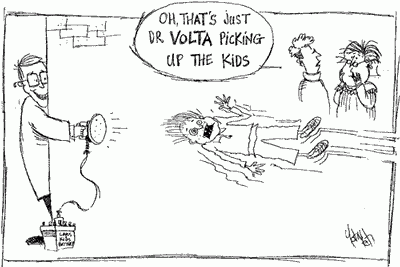 Thus, when they next checked their inbox, parents and teachers unexpectedly received one or more papers on the history of ECT in young people, an epidemiological study on ECT use in children and adolescents in New South Wales, studies on the opinions of teenage patients and parents regarding the treatment and, last but not least, a "user's guide" to how ECT should be administered to the young. Preschool parents and teachers had been oblivious to this particular interest of mine. Though I had nothing to be ashamed of — indeed, ECT can be a life-saving treatment for young people — it is still not an interest one advertises widely, nor mentions in the course of small talk at school meetings or social gatherings.
Now, it is probably OK by parents of preschoolers for one of their number to be a child psychiatrist. Indeed, this sometimes comes in handy for the mums and dads ("Has Sarah got ADHD?"; "Is it normal for Trevor to be hitting his baby brother over the head with a cricket bat?", etc). It is, however, clearly another matter if the parent happens to be an expert on the use of "shock treatment" in kids. "Not nice, Dr Walter!", I imagined them saying when the secret was out, "Surely not Garry!". And yet there might have been cause for them to be grateful because, from that time on, classroom behaviour seemed to improve, particularly whenever I was around — dropping off or collecting kids, attending class concerts, etc. Was it possible that the children had been warned about the consequences of not behaving well at school, that they had been told what "Dr Volta" might do? Of course, the kids need not have worried. It was not as though I carried an ECT machine or set of electrodes on me. Must have been the spark(le) in my eyes.
Co-Designed Best Practice Principles for the Care of Fathers and Non-Birthing Parents Exposed to Perinatal Trauma: A Participatory Action Research Study
Alka Kothari, Dale Trevor, Glen Quinn, Jane Geltch, Joel Dulhunty, Helen Skouteris, Leonie K. Callaway
Reorienting Allied Health Into Community-Based Care for People Experiencing Trauma and Social Disadvantage
Simon Rosenbaum, Grace McKeon, Gulsah Kurt, Oscar Lederman, Kemi Wright, Sabuj Kanti Mistry, Jackie E. Curtis, Philip B. Ward, Zachary Steel, Hamish Fibbins, Rachel Morell, Melissa C. Eaton, Andrew Watkins, Ben Harris-Roxas, Brendan Goodger, Eleanor Beck, Megan Teychenne, Joseph Firth, Davy Vancampfort, David Burns, Russell Roberts, Tristan Favaloro, Danielle Weber, Rosanna Barbero, Vasili Maroulis, Melissa Holmes, Stefan Mackenzie, Chiara Mastrogiovanni, Afsana Anwar, Uzma Choudhry, Catherine Sherrington, Jane Currie, Thomas Gadsden, Scott Teasdale
Stigmatising Attitudes Towards People With Depression, Bipolar Disorder, Borderline Personality, ADHD and Early and Long-Term/Untreated Schizophrenia: Representative Survey of Australian Adults
Amy J. Morgan, Anna M. Ross, Gayle McNaught, Rachel Green, Nicola J. Reavley
Psychosocial Hazards for Healthcare Workers: Supporting the Second Victim Also Helps the Primary Victims
Sarah Michael
Supporting Population Mental Health in the Wake of Mass Tragedies
Susan J. Rees, Derrick M. Silove