




Volume 219 - Issue 10
Vitamin C insufficiency in Australia: underrated and overlooked?
Authors: Jenny E Gunton and Nada Bechara
Med J Aust 2023; 219 (10): 463-464. || doi: 10.5694/mja2.52146
Published online: 20 November 2023
Published online: 20 November 2023
A formal investigation of the vitamin C status of Australians should be undertaken
Scurvy is an extreme manifestation of vitamin C deficiency;1 an estimated two million sailors died from scurvy during the age of sail,2 and it has often accompanied famines and war.1 Scurvy is now generally only of historical interest in developed countries, but vitamin C deficiency of various grades may be more common than generally appreciated.
Vitamin C is a co‐factor required for the synthesis of stable collagen, of bile acids from cholesterol, and of noradrenaline from dopamine, as well as for the production of tyrosine and tryptophan, and for recycling folic acid.3 The varied clinical manifestations of vitamin C deficiency include fatigue, gum disease (periodontitis), tooth loss, petechiae, bruising, corkscrew hairs, poor wound healing, joint pain, osteomalacia and fractures, haemorrhages (including cardiac and intracerebral haemorrhages), delirium, impaired cognitive function, and sudden death.4 The symptoms and signs of deficiency and scurvy take some weeks to develop; in an English study during the Second World War in which prisoners were deliberately fed vitamin C‐deficient diets, people developed signs of scurvy within four weeks.5
Vitamin C deficiency is common among people with diabetes and foot ulcers.4,6,7,8 Serum vitamin C levels were low in 50% of people at our Foot Wound Clinic at Westmead Hospital6 and 59% of those at a diabetic foot infection and vascular surgery centre in Melbourne;7 30% of people attending a periodontal clinic were vitamin C‐deficient,4 as were 21% of a cohort of 309 people referred to one Sydney surgeon.9 Further, almost 20% of a small group of healthy young men in New Zealand were found to be deficient in a 2012 study.10 However, no large scale epidemiological studies of community vitamin C status have been undertaken in Australia.
In this issue of the MJA, Bhattacharyya and colleagues11 report the results of vitamin C assessment at a central testing facility in Sydney over five years of almost 13000 people. As the referring clinicians believed that vitamin C assessment was warranted, the proportion of people in this group with vitamin C deficiency would be expected to be larger than in the general community; indeed, levels were insufficient (12–39μmol/L) in 29.9% of tested people and deficient (below 12μmol/L) in 24.5%.
Vitamin C deficiency is more common in men, older people and those living in areas of lower socio‐economic status, people who smoke cigarettes (we did not find information regarding vaping), drink alcohol excessively, have poor quality diets, and people with clinical mental health problems or renal failure.12 In their laboratory‐based study, Author and colleagues did not have information about most of these variables, but their findings regarding the associations of sex, age, and residential postcode‐based socio‐economic status and remoteness with vitamin C status were consistent with previous reports.12 The annual number of tests requested increased over the five years assessed, but the deficiency rate did not decline, suggesting undertesting of people at risk of vitamin C deficiency.11
Vitamin C is available in a variety of dietary sources. In Australia, the recommended daily vitamin C intake is 45mg for non‐pregnant adults and 60mg for pregnant women.13 Circulating vitamin C has a sigmoidal relationship with dietary intake. At a daily intake of 30mg, serum concentrations can remain deficient (under 12μmol/L); with greater intake, serum levels in healthy people increase to a plateau at 80–100μmol/L (with intake of at least 200mg/day), a limit imposed by the renal threshold for urinary vitamin C excretion.14
Based on the deficiency rates reported by Bhattacharyya and colleagues,11 as well as population studies in the United Kingdom15 and the United States,16 a daily intake of 45mg vitamin C is adequate for healthy people, but perhaps not for those in whom its absorption is impaired (eg, people undergoing bariatric surgery), its utilisation is increased (eg, with chronic wounds), or its excretion is increased by polyuria (eg, in people with diabetes).
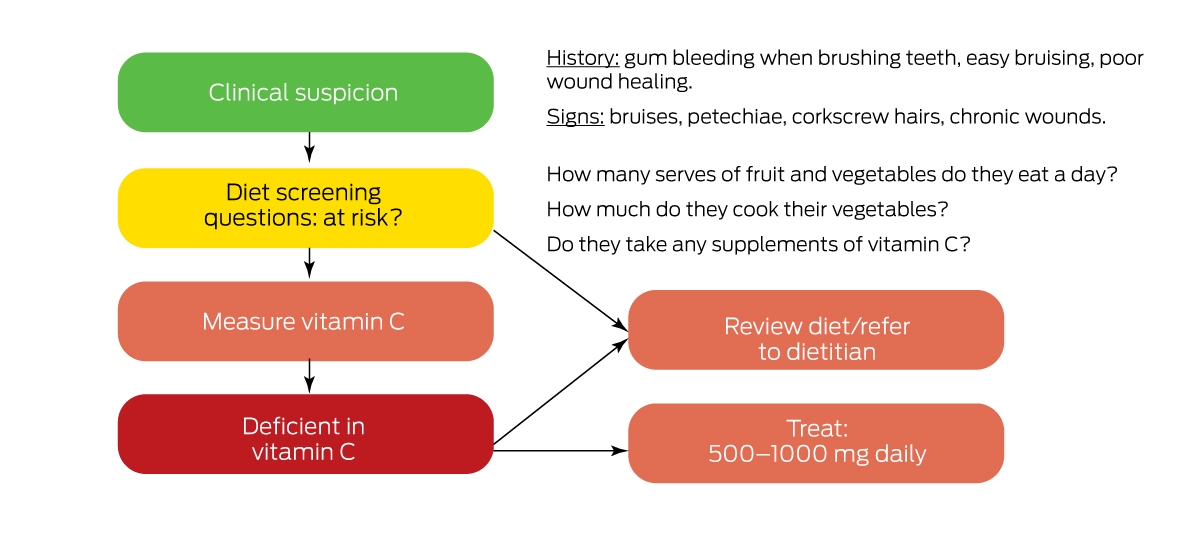
We agree with Bhattacharyya and colleagues11 that a formal investigation of the vitamin C status of Australians should be undertaken. Mild vitamin C deficiency has few, if any, signs, and early symptoms are non‐specific, and we do not recommend general population screening. However, when clinical vitamin C insufficiency is suspected (Box), dietary screening questions could be useful, such as “How many serves of fresh fruit and vegetables do you eat each day?”, “How do you cook your vegetables?”, and “Do you take any supplements with vitamin C?” If the answers are not reassuring, blood testing should be considered.
High dose supplementation with vitamin C (in excess of 5000mg per day) can be harmful, especially to the kidneys.17 For people with low circulating levels of vitamin C, we recommend 500–1000mg of a vitamin C supplement per day and a formal dietary review, with low vitamin C levels as the stated reason for referral to a dietitian.
Competing interests
No relevant disclosures.
Acknowledgements
Jenny Gunton receives funding from a National Health and Medical Research Council program grant (Complexity in nutrition; 1149976). Jenny Gunton and Nada Bechara receive funding from the Western Sydney Local Health District Research and Education Network.
References
- Carpenter KJ. The discovery of vitamin C. Ann Nutr Metab 2012; 61: 259‐264.
- Lamb J. Scurvy: the disease of discovery. Princeton: Princeton University Press, 2019.
- Magana AA, Reed RL, Koluda R, et al. Vitamin C activates the folate‐mediated one‐carbon cycle in C2C12 myoblasts. Antioxidants (Basel) 2020; 9: 217.
- Munday MR, Rodricks R, Fitzpatrick M, et al. A pilot study examining vitamin C levels in periodontal patients. Nutrients 2020; 12: 2255.
- Pemberton J. Medical experiments carried out in Sheffield on conscientious objectors to military service during the 1939–45 war. Int J Epidemiol 2006; 35: 556‐558.
- Christie‐David DJ, Gunton JE. Vitamin C deficiency and diabetes mellitus: easily missed? Diabet Med 2017; 34: 294‐296.
- Gunton JE, Girgis CM, Lau T, et al. Vitamin C improves healing of foot ulcers: a randomised, double‐blind, placebo‐controlled trial. Br J Nutr 2021; 126: 1451‐1458.
- Brookes JDL, Jaya JS, Tran H, et al. Broad‐ranging nutritional deficiencies predict amputation in diabetic foot ulcers. Int J Low Extrem Wounds 2020; 19: 27‐33.
- Ravindran P, Wiltshire S, Das K, Wilson RB. Vitamin C deficiency in an Australian cohort of metropolitan surgical patients. Pathology 2018; 50: 654‐658.
- Carr AC, Vissers MC, Lewis J, Elder P. Multiple nutrient insufficiencies: hypovitaminosis D and C in young adult New Zealand males. N Z Med J 2012; 125: 119‐120.
- Bhattacharyya P, Schemann K, Min SS, et al. Serum vitamin C status of people in New South Wales: retrospective analysis of findings at a public referral hospital. Med J Aust 2023; 219: 475‐481.
- McCall SJ, Clark AB, Luben RN, et al. Plasma vitamin C Levels: risk factors for deficiency and association with self‐reported functional health in the European Prospective Investigation into Cancer–Norfolk. Nutrients 2019; 11: 1552.
- National Health and Medical Research Council; Australian Department of Health and Ageing; New Zealand Ministry of Health. Nutrient reference values for Australia and New Zealand. Updated 13 July 2017. https://www.eatforhealth.gov.au/nutrient‐reference‐values (viewed May 2023).
- Levine M, Conry‐Cantilena C, Wang Y, et al. Vitamin C pharmacokinetics in healthy volunteers: evidence for a recommended dietary allowance. Proc Natl Acad Sci U S A 1996; 93: 3704‐3709.
- Mosdøl A, Erens B, Brunner EJ. Estimated prevalence and predictors of vitamin C deficiency within UK's low‐income population. J Public Health (Oxf) 2008; 30: 456‐460.
- Schleicher RL, Carroll MD, Ford ES, Lacher DA. Serum vitamin C and the prevalence of vitamin C deficiency in the United States: 2003‐2004 National Health and Nutrition Examination Survey (NHANES). Am J Clin Nutr 2009; 90: 1252‐1263.
- Mashour S, Turner JF, Merrell R. Acute renal failure, oxalosis, and vitamin C supplementation: a case report and review of the literature. Chest 2000; 118: 561‐563.
Provenance: Commissioned; not externally peer reviewed.
Beyond Fibrosis Stratification: Integrating Behavioural, Metabolic and Policy-Level Interventions in Metabolic Dysfunction-Associated Steatotic Liver Disease
Yousef Hakimi, Prarthana Thiagarajan, Michael Braude
Fatty Liver Disease in Australia: A Narrative Review on the Epidemiology, Natural History, Prognostication and Management in People With Metabolic Dysfunction
Karl Vaz, Daniel Clayton-Chubb, William W. Kemp, Stuart K. Roberts, Ammar Majeed
When ‘Liver Enzymes’ Are Not Hepatic: Late-Onset Pompe Disease
Shauna Madigan, Georgina England, Wayne Rankin
Fatty Liver Disease in Australia: A Narrative Review on the Epidemiology, Natural History, Prognostication and Management in People With Metabolic Dysfunction
Karl Vaz, Daniel Clayton-Chubb, William W. Kemp, Stuart K. Roberts, Ammar Majeed
The early implementation phase of the Omega‐3 Test‐and‐Treat Program for reducing the risk of preterm birth, South Australia, 2021–22: an implementation evaluation study
Karen P Best, Celine Northcott, Lucy A Simmonds, Philippa Middleton, Lisa N Yelland, Vanessa Moffa, Khoa Lam, Penelope Coates, Cornelia Späth, Carol WK Siu, Karen Glover, Rhiannon Smith, Robert Gibson, Maria Makrides
Cause‐specific mortality among Queensland people with cirrhosis, by cirrhosis aetiology and decompensation status, 2007–22: a retrospective cohort study
Vikas Bhasker, Jessica R Fong, Paul J Clark, Gunter F Hartel, Richard Skoien, James O’Beirne, Elizabeth E Powell, Patricia C Valery