




Volume 217 - Issue 4
The impact of the MJA continues its rise
Author: Nicholas J Talley
Med J Aust 2022; 217 (4): 187-188. || doi: 10.5694/mja2.51660
Published online: 15 August 2022
Published online: 15 August 2022
During times of medical crisis, reputable general medical journals are needed more than ever
During times of medical crisis, reputable general medical journals are needed more than ever
As a society, we are obsessed with rankings. If you play sport or are a keen fan, you’ll likely know who is number one, whether it be a tennis player or golfer, or a football team. If you are an academic, you probably know the leading universities by their approximate rankings, and where your own institution stands. Mind you, this varies markedly between ranking systems! And if you are a researcher, you know the best ranked journals in your field, as this influences where you submit your best work, what you read most carefully, and how you shape the track record sections of your grant applications. Clinicians also pay attention to the most highly regarded journals in their field to shape their practice.
Notably, rankings depend on the criteria and algorithms applied, and they are often artificial, even opaque. University rankings are a good example: in many cases, they rely on selected surveys of academic opinion, arguably an almost meaningless measure. Journals also suffer from ranking fever. The latest Clarivate Journal Impact Factors (JIF), for 2021, were released at the end of June. The impact factor for the MJA again rose substantially (Box 1), and we maintained our place among the top 10% of general medical journals. Movement in JIFs this year were generally larger than usual because the calculations now include content published online prior to inclusion in a journal issue, and many papers on COVID‐19 attracted larger numbers of citations. However, journal impact factors do not comprehensively assess the impact of our Journal or our articles; the Clarivate JIF, for example, is derived from the number of citations for articles during the two calendar years following their publication. But there is certainly more to impact than short term citations!1,2,3 It is consequently heartening that alternative measures of our impact also have positive trajectories (Box 2).
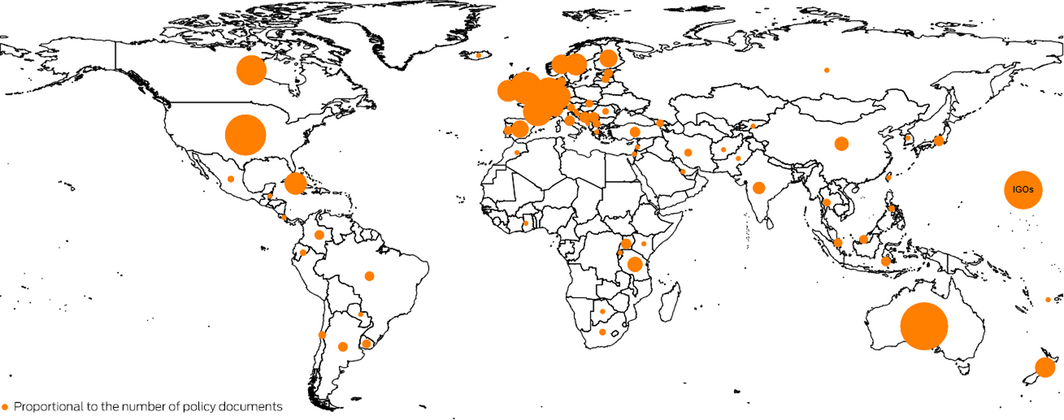
If nothing else, we can infer from the impact factor of our Journal that the quality of the research conducted in our region is among the best globally. That said, there are other ways to measure the influence of a journal on medicine and people around the world. For example, Elmer Villanueva, MJA Deputy Medical Editor and Consultant Biostatistician, found in his evaluation of the past ten years of Overton database information (https://www.overton.io) that research articles published in our Journal had been cited in 644 policy documents from more than 80 countries and intergovernmental organisations (Box 3). Further, these policies covered 16 of the 17 Sustainable Development Goals of the United Nations.4 While most of the citing policies concerned health and medicine, many were in fields not typically associated with our Journal, including economics, business and finance, crime, law and justice, and politics. These findings add an extra dimension to the numerical information provided by typical metrics of journal impact. It means, quite simply, that research published in the Medical Journal of Australia is considered by policymakers, both in Australia and overseas, when tackling the most critical problems affecting their countries.
The Journal has greatly expanded its global reach during its partnership with Wiley, and is available at more than 6000 institutions around the world. Readership of the Journal continues to increase; article downloads from the Wiley site exceeded 3.3 million during 2019–2021, with a 260% increase in annual downloads since our first year in the Wiley Online Library (2019, 0.57million; 2021, 1.50 million). We anticipate that our readership and impact will further increase as more MJA article authors take advantage of the fee‐free Gold Open Access made possible by the agreement between Wiley and the Council of Australian University Librarians (CAUL).5,6
In 2022, Wiley signed the San Francisco Declaration on Research Assessment (DORA; https://sfdora.org). The overarching goal of DORA, which we broadly support, is to shift the emphasis from journal‐based metrics and assessment to measures of individual author contributions to articles.7 Changes at the MJA will include monitoring a variety of article‐level metrics, requiring more detailed information on the specific contributions of each author, and being more liberal with reference limits to ensure that the key primary literature is included for reviewers and readers.
During a time of medical crisis, the role of a highly reputable national general medical journal has never been more critical. And the crisis is not yet over, given the potential for new SARS‐CoV‐2 variants, the winter spread of influenza, and the unclear monkeypox virus situation.8,9 The goals of the MJA are unchanged. We will promote excellence, protect editorial independence, publish both world class evidence‐based research and expert evidence‐based reviews, perspectives and guidelines, help to authoritatively translate this evidence into improved clinical practice for doctors and better outcomes for patients, work to influence health system and health policy reform, and promote better public health by generating awareness of problems and their potential solutions.
I thank all our authors for continuing to choose the MJA to disseminate their important research findings, insights, and opinions on health care in Australia. I also thank our expert reviewers who skilfully assist us in decision making, as well as our faithful readers. I am confident that, despite the rough seas that all journals and other publications are currently navigating, the future looks very bright for the MJA.
Box 1 – Medical Journal of Australia: Journal Impact Factor, 2015–2021*
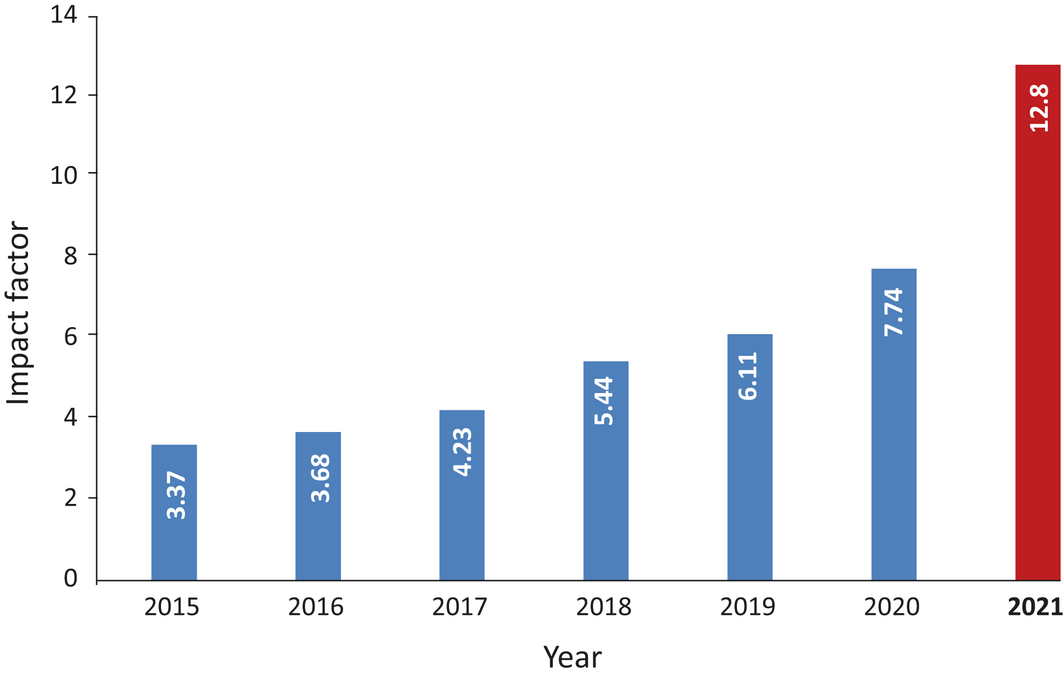
* Source: Clarivate Analytics.
Box 2 – Medical Journal of Australia: selection of journal impact metrics, 2017–2021
|
|
2017 |
2018 |
2019 |
2020 |
2021 |
||||||||||
|
|
|||||||||||||||
|
Article citations (all types) |
8898 |
11134 |
11075 |
14127 |
14683 |
||||||||||
|
5‐year journal impact factor* |
4.33 |
4.51 |
5.05 |
6.91 |
9.86 |
||||||||||
|
Journal citation indicator*,† |
1.16 |
1.18 |
1.47 |
1.55 |
1.60 |
||||||||||
|
Eigenfactor (normalised)*,† |
1.61 |
1.50 |
1.35 |
2.34 |
3.08 |
||||||||||
|
SCImago journal rank |
0.825 |
0.79 |
0.77 |
0.904 |
1.302 |
||||||||||
|
SciMAGO citations/article (2years)‡ |
1.18 |
1.37 |
1.50 |
1.83 |
3.23 |
||||||||||
|
|
|||||||||||||||
|
* Source: Clarivate Analytics. † The JCI provides a field‐normalised measure of citation impact of citable articles and reviews published during the preceding three years. For the eigenfactor score, citations are weighted according to the impact ranking of the citing journal. ‡ Source: SCImago Journal & Country Rank [portal] (http://www.scimagojr.com); viewed 1 July 2022. |
|||||||||||||||
Competing interests
A complete list of disclosures is available at https://www.mja.com.au/journal/staff/editor‐chief‐professor‐nick‐talley
References
- Callaway, E. Beat it, impact factor! Publishing elite turns against controversial metric. Nature 2016; 535: 210‐211.
- Saginur M, Fergusson D, Zhang T, et al. Journal impact factor, trial effect size, and methodological quality appear scantly related: a systematic review and meta‐analysis. Syst Rev 2020; 9: 53.
- Waltman L, Traag VA. Use of the journal impact factor for assessing individual articles: Statistically flawed or not? [version 2; peer review: 2 approved]. F1000Research 2021; 9: 366.
- United Nations Department of Economic and Social Affairs. Sustainable development goals. Updated July 2022. https://sdgs.un.org (viewed July 2022).
- Talley NJ. Welcome to 2022: The Year of the Tiger! Med J Aust 2022; 216: 20‐23. https://www.mja.com.au/journal/2022/216/1/welcome‐2022‐year‐tiger
- Wiley. Open access agreement for authors at eligible Australia and New Zealand institutions. https://authorservices.wiley.com/author‐resources/Journal‐Authors/open‐access/affiliation‐policies‐payments/caul‐agreement.html (viewed July 2022).
- Schmid SL. Five years post‐DORA: promoting best practices for research assessment. Mol Biol Cell 2017; 28: 2941‐2944.
- Jackson CL. Living with COVID‐19 in 2022: the impact of the pandemic on Australian general practice. Med J Aust 2022; 216: 442‐444. https://www.mja.com.au/journal/2022/216/9/living‐covid‐19‐2022‐impact‐pandemic‐australian‐general‐practice
- Guarner J, del Rio C, Malani PN. Monkeypox in 2022: what clinicians need to know. JAMA 2022; 328: 139‐140.
Provenance: Not commissioned; not externally peer reviewed.
Using generative artificial intelligence in clinical practice: a narrative review and proposed agenda for implementation
Ian A Scott, Sandeep Reddy, Tanya Kelly, Tim Miller, Anton Vegt
The CURE Asthma roadmap
Gary P Anderson, Anthony Flynn, Phil G Bardin, John D Blakey, Shyamali C Dharmage, Paul Foster, Peter G Gibson, Adam Jaffe, Alan James, Christine R Jenkins, Sundram Sivamalai, Peter D Sly, Guy B Marks, Vanessa M McDonald, Judy Wetttenhall
CURE Asthma: a unique opportunity for Australia
Anthony Flynn, Wendy Edmondson, Alan James, Caroline Lodge, Vanessa M McDonald, Christine R Jenkins, John Blakey, Gary P Anderson
Evidence from Australian cohort studies about asthma trajectories and transitions across the life course: a narrative review
Caroline Lodge, Xin Dai, Ingrid A. Laing, Michael P Menden, Anthony Flynn, Gary P Anderson, Sarath Ranganathan, Shyamali C Dharmage
Technological advances in the search for a CURE for asthma
Sara Quon, Timothy M Johanson, Ridhima Wadhwa, Alen Faiz, Anthony Flynn, Gary P Anderson, Amanda J Cox, Nicholas P West, Michael P Menden, Rhys S Allan
Protecting public interest journalism as a public health good
Bronwyn Fredericks, Neha Lalchandani, Melissa A Sweet, Alex Cramb, Carmel Williams