




Medical education
Snapshot
Volume 216 - Issue 8
In‐transit cutaneous squamous cell carcinoma
Authors: Luke S McLean and Danny Rischin
Med J Aust 2022; 216 (8): 401-401. || doi: 10.5694/mja2.51486
Published online: 2 May 2022
Published online: 2 May 2022
A 79-year-old man presented with painful lesions over his left arm on a background of non-Hodgkin lymphoma, which was well controlled on rituximab
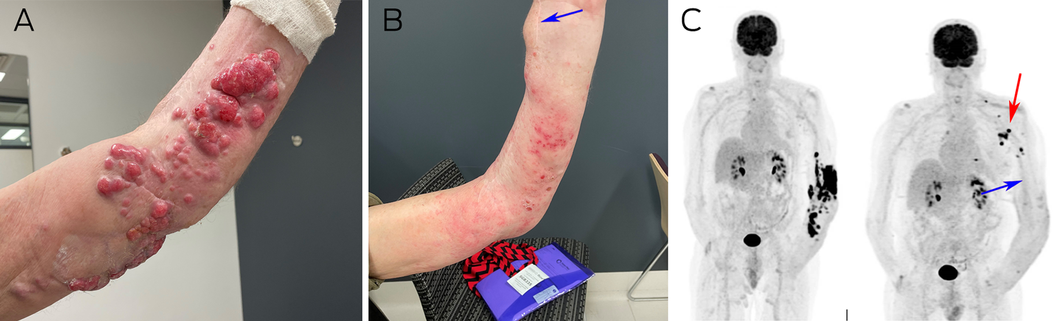
A 79‐year‐old man presented with painful lesions over his left arm on a background of non‐Hodgkin lymphoma, which was well controlled on rituximab (Figure, A). Two years earlier, he had a poorly differentiated cutaneous squamous cell carcinoma of the left wrist excised (Figure, B, arrow). Fluorodeoxyglucose (FDG)‐positron emission tomography (PET) demonstrated extensive, avid cutaneous and subcutaneous lesions along the left upper limb and an axillary node. Biopsies confirmed poorly differentiated cutaneous squamous cell carcinoma. He commenced first line immunotherapy (cemiplimab 350 mg every 3 weeks) with concurrent radiotherapy, with a near complete resolution in his symptoms after seven cycles (Figure, B). FDG‐PET imaging at this time point confirmed a significant partial response in the left arm (Figure, C, blue arrow) but with progressive nodal disease in the left axilla extending to the supraclavicular region (Figure, C, red arrow). In‐transit disease represents an uncommon form of metastatic skin cancer related to lymphatic spread and is an important differential in immunocompromised patients, in whom it occurs more frequently.1
Competing interests
Danny Rischin receives institutional research funding from MSD, Bristol–Myers Squibb, GSK and Roche. He participates in trial steering committees and/or advisory boards (all uncompensated) for MSD, GSK, Regeneron and Sanofi.
References
- Levine DE, Karia PS, Schmults CD. Outcomes of patients with multiple cutaneous squamous cell carcinomas: a 10‐year single‐institution cohort study. JAMA Dermatol 2015; 151: 1220–1225.
From Ambition to Action: Closing Policy, Equity and Implementation Gaps in the Australian Cancer Plan's ‘Enhanced Consumer Experience’
Carla Thamm, Elise Button, Oluwaseyifunmi A. Agbejule, Reegan Knowles, Karen van Gorp, Mark B. Pinkham, Meinir Krishnasamy, Alexandra L. McCarthy, Raymond J. Chan
Sovereignty and Survival: Understanding Lung Cancer Outcomes for Aboriginal and Torres Strait Islander People in Australia, a Case–Control Study
Alice R. T. Bergin, Luc te Marvelde, Roger L. Milne, Benjamin J. Solomon, Kris Ivanova, Peter Savas, Stephen J. Luen, Jay Hamann, Andrea Casey, Nicole Watt, Sue M. Evans, Gail Garvey, Sherene Loi
The Changing Indications for Adult Liver Transplantation in Australia: A Narrative Review
Fadak Mohammadi, Alan J. Wigg, Ken Liu, Simone I. Strasser
Uneven Ground: Survival Differences Among Victorian Lung Cancer Patients by Location of Residence (2011–2023): A Retrospective Cohort Study
Evangeline Samuel, Eldho Paul, Mike Lloyd, Sanuki Tissera, Craig Underhill, Sagun Parakh, Phillip Parente, Inger Olesen, Javier Torres, Katharine See, Gavin M. Wright, David Langton, Thomas John, Matthew Conron, James Bartlett, Nicola Atkin, Nikolajs Zeps, Susan V. Harden, Wasek Faisal, John R. Zalcberg, Rob G. Stirling
Early-Onset Colorectal Cancer With Liver-Only Metastases: A Retrospective Cohort Study Integrating Prospectively Collected Real-World Clinical and Molecular Data From an Australian National Database (2009–2024) to Guide Treatment Planning
Savio G. Barreto, Christos S. Karapetis, Shahid Ullah, Matthew Burge, Susan Caird, Angus Campbell, Azim Jalali, Ross Jennens, Muhammad A. Khattak, Belinda Lee, Stephanie H. Lim, Shehara Mendis, Louise Nott, Timothy J. Price, Jeremy D. Shapiro, Jeanne Tie, Javier Torres, Colin Williams, Rachel Wong, Vanessa Wong, Peter Gibbs
Australian Pathways for Specialist Pain Management and Early Palliative Care for People With Pancreatic Cancer: Developed Using a Community Consensus Approach
Jennifer Philip, Melanie R. Lovell, Kylee Bellingham, Gail Garvey, Gregory B. Crawford, Nicole M. Rankin, Kara Burns, Isabel Young, Vivienne Milch, Dorothy Keefe, Katrina Anderson, James Lawson, Meinir Krishnasamy