





Volume 215 - Issue 2
Influenza disease and vaccination in children in Australia
Authors: Samantha J Carlson, Christopher C Blyth, Frank H Beard, Alexandra J Hendry, Allen C Cheng, Helen E Quinn, Julie Leask and Kristine Macartney
Med J Aust 2021; 215 (2): 64-67.e1. || doi: 10.5694/mja2.51100
Published online: 31 May 2021
Published online: 31 May 2021
Influenza vaccine uptake in children has grown in response to increased awareness and progressive expansion of funding
Over the past decade, multiple initiatives have been implemented to strengthen influenza vaccination programs in Australia, with an increasing focus on children. In this article, we review these changes, the events that prompted them, and how they have influenced influenza vaccine uptake in Australia.
Burden of influenza
Before the coronavirus disease 2019 (COVID‐19) pandemic, influenza was responsible for a higher disease burden and overall health impact than any other vaccine‐preventable disease in Australia.1
Historically, Australian influenza notification rates have been highest in children, particularly in those aged less than 2 years.2 The highest annual hospitalisation rates for influenza overall have been recorded in children aged less than 6 months (192 per 100 000 per year), followed by children aged 6–23 months (109 per 100 000 per year).2 Although paediatric hospitalisation rates are high, annual rates of influenza‐associated deaths in children are low compared with adults: 0.20–0.39 per 100 000 children aged under 5 years compared with 0.65 per 100 000 in people aged 65–74 years and 3.66 per 100 000 in people aged 75 years or more.2
While it appears that influenza may have become more burdensome for children in recent years due to an increase in disease notifications (Box 1), the notification rates also reflect an increase in influenza testing rates. For example, in New South Wales, there was a seven‐fold increase in tests done in 2019 compared with 2009.3 However, influenza notifications dramatically declined in 2020 in all age groups (Box 1), most likely due to increased hygiene and physical distancing measures and the implementation of border closures to reduce transmission of severe acute respiratory syndrome coronavirus 2 (SARS‐CoV‐2) — the virus that causes COVID‐19.
Influenza‐associated morbidity and mortality rates also likely underestimate the true influenza‐associated burden related to underascertainment bias and other factors.
Influenza vaccination recommendations and funding
All people in Australia aged 6 months or more are recommended to receive annual influenza vaccination, with free influenza vaccines for the highest risk groups provided by the National Immunisation Program (NIP).4 Vaccination is only contraindicated for people who have experienced anaphylaxis in association with a previous dose or any component of an influenza vaccine.4 Children aged 6 months to 9 years receiving the vaccine for the first time require two doses at least 4 weeks apart; those aged 9 years or more require only one dose in their first year of receipt.4
Until recently, there was limited funding for, and promotion of, influenza vaccination in children. In 2018, following the large 2017 influenza season (Box 1), and underpinned by evidence of paediatric disease burden, vaccine safety and efficacy,2,6,7 all Australian states and territories, except the Northern Territory, followed Western Australia’s 2008 initiative in funding influenza vaccination for all children aged 6–59 months; the NT followed in 2019 (Box 2). The NIP expanded in 2019 to include Aboriginal and Torres Strait Islander peoples of all ages (closing the funding gap for those aged 5 to < 15 years), and in 2020, the influenza vaccine was added to the NIP for all children aged 6–59 months.5
Influenza vaccine effectiveness
Influenza vaccine effectiveness is usually measured against either all laboratory‐confirmed influenza (using disease notification data) or influenza‐associated hospitalisation (a proxy for severe disease) and varies each year. In 2015, influenza vaccine effectiveness in children aged under 18 years estimated from data collected from sentinel general practitioner networks was 54%,8 indicating that influenza‐associated primary care visits more than halved in vaccinated children compared with unvaccinated children. In 2017, a year dominated by the influenza A subtype H3N2, for which the vaccine typically performs less well, the influenza vaccine effectiveness against hospitalisation for influenza was estimated to be 30% in children;6 however, in 2018, an influenza A subtype H1N1 predominant year, vaccine effectiveness against paediatric influenza hospitalisation was 78%.9
Despite moderate effectiveness, at an individual and population level, influenza vaccination still prevents significant morbidity and mortality. For example, with 55% of population coverage and an adjusted vaccine effectiveness of only 32% (95% CI, 16–44%) for children aged 5–17 years during the 2017–2018 influenza season in the United States, vaccination was still estimated to have prevented 1.4 million illnesses, 711 000 medical visits, 3700 hospitalisations, and 89 deaths of children aged 5–17 years.10
Influenza vaccine safety
In April 2010, early in the Australian influenza vaccination season, the Australian Government’s Chief Medical Officer suspended the use of influenza vaccine in children aged 5 years or less due to an unexpectedly high rate of fever and febrile seizures in the 4–24 hours following influenza vaccine administration.11 Influenza vaccination in children aged 5 years or less continued with non‐CSL influenza vaccines from August 2010 onwards,12 given they had no safety issues. The program suspension had negative effects on influenza vaccine attitudes, confidence and coverage in children in the following years.13 However, recent evidence suggests that influenza vaccine safety concerns may no longer be a significant barrier to influenza vaccination of children in Australia. Rather, significant barriers include a lack of recommendation from a health care provider, difficulties in either remembering to make or getting an appointment for vaccination, a general lack of support for influenza vaccination, or a lack of history of influenza vaccine uptake by the child or their parent.14
An independent review into the national response to the Fluvax (CSL) safety incident identified ways to strengthen the safe delivery of influenza (and other) vaccines in Australia.15 In response to these recommendations, a national sentinel vaccine active safety surveillance system, known as AusVaxSafety (www.ausvaxsafety.org.au) was established in 2014. In this system, people of all ages who receive an influenza vaccine (or their carers) at more than 350 participating sentinel clinics (as at March 2021) are sent a short message service (SMS) text message and/or email in the days after vaccination with questions on whether they or their child experienced an adverse event following immunisation.7 Overall, data from this system have shown a safety profile consistent with that expected from clinical trials for all vaccine brands: approximately 10% of children’s carers report an adverse event following immunisation in their child within 3 days of influenza vaccination, the most common being fever or pain, swelling or redness at the injection site.7 Data from this ever‐expanding vaccine safety monitoring system have consistently shown low and expected reporting rates of mild transient adverse events known to be associated with the influenza vaccine.
Recorded influenza vaccine uptake
Since 2007, the number of influenza vaccine doses distributed and the recorded population coverage have increased in Australia, but with fluctuating uptake in children. Following the rapid attainment of high coverage in Western Australia in both Aboriginal and Torres Strait Islander and non‐Aboriginal children aged 6–59 months from 2008, coverage decreased substantially after the 2010 safety incident (Box 3 and Box 4). Coverage in Aboriginal and Torres Strait Islander children increased after the NIP funding in 2015, with highest rates in the NT (55.8%) in 2015 (Box 3). Coverage also increased dramatically in non‐Aboriginal children in 2018 (Box 4) following the introduction of state‐ and territory‐based programs for all children aged 6–59 months. In 2020, the first year of NIP‐funding for children aged 6–59 months, the reported uptake was 43.9%.16 This estimate may be higher given the uptake was calculated using doses recorded between March and August 2020 (rather than a full 12‐month period),16 and overall, actual coverage is likely higher due to issues of under‐reporting to the Australian Immunisation Register.17 The number of influenza vaccine doses available around Australia for all ages has also increased, with 8.3 million distributed in 2017, to 18 million in 2020.18
While a 43.9% uptake in children aged 6–59 months in 2020 in Australia represents an improvement from past low vaccination rates, Australia needs strategies to improve and sustain high coverage. These could include personalised vaccination reminders19 and provision of greater access to influenza vaccination services.20 Furthermore, given the influence of a recommendation from a health care provider on vaccine uptake,14 implementing a combination of education, communication training, electronic prompts and standing order protocols21 may assist health care providers in recommending influenza vaccination to all patients. Mandatory reporting of vaccination data to the Australian Immunisation Register, recently implemented in the context of the COVID‐19 vaccine roll‐out in Australia and extended to include other vaccines,22 should also assist in ensuring more accurate vaccine coverage estimations of influenza and all vaccines.
Conclusion
Influenza vaccine uptake in young children in Australia has increased in response to the progressive expansion of funding and is now delivered under the NIP. Further gains in uptake should ensure that protection against influenza disease in children is optimised during the ongoing COVID‐19 pandemic and in years to come.
Box 1 – Notification rates of laboratory‐confirmed influenza in children aged less than 5 years in Australia, 2007–2020*
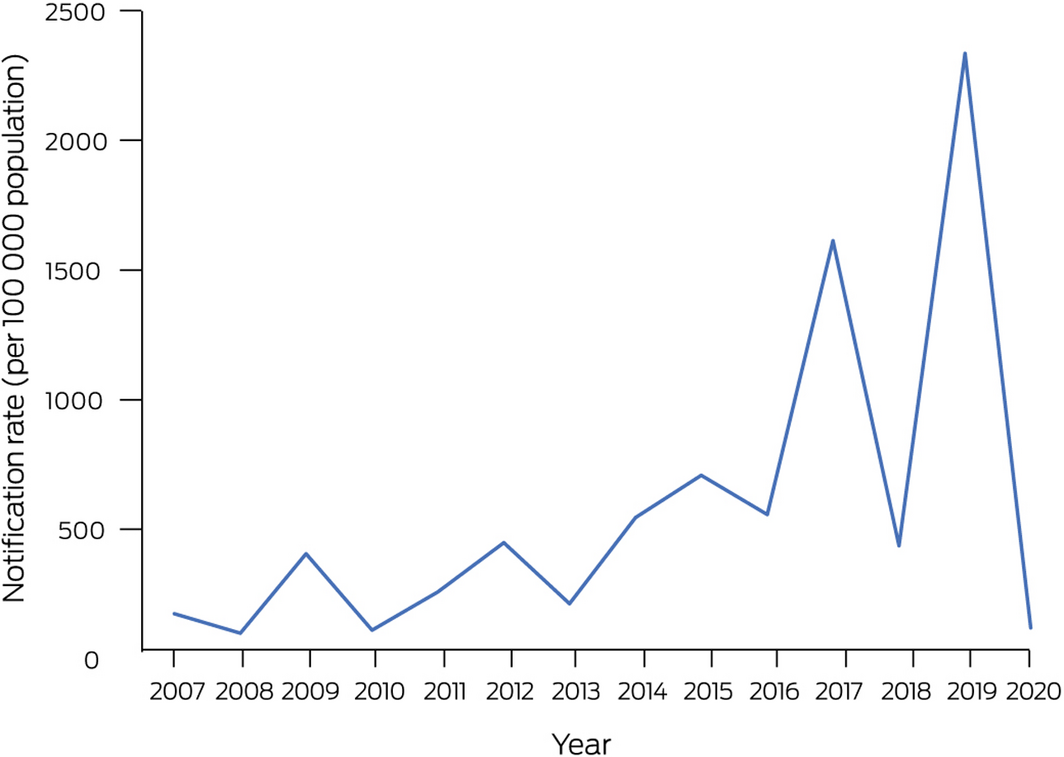
* Influenza testing rates also increased over this time period.3 Source: National Notifiable Diseases Surveillance System, as at 18 February 2021.
Box 2 – Significant events in influenza disease and vaccination policy in Australia
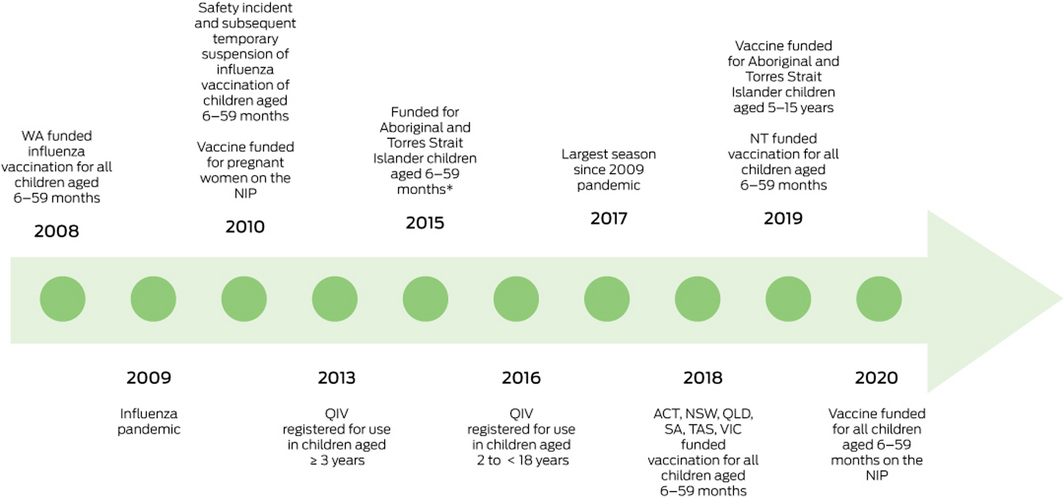
ACT = Australian Capital Territory; NSW = New South Wales; NT = Northern Territory; QLD = Queensland; SA = South Australia; TAS = Tasmania; VIC = Victoria; WA = Western Australia; QIV = quadrivalent influenza vaccine. * Vaccine funded for Aboriginal and Torres Strait Islander people aged 15 years or more since 1999 (for all Aboriginal and Torres Strait Islander people aged ≥ 50 years, and Aboriginal and Torres Strait Islander people aged 15–49 years who have at least one of a range of underlying medical conditions that increase their risk of influenza or complications). Source: National Centre for Immunisation Research and Surveillance.5
Box 3 – Trends in recorded coverage of any dose of seasonal influenza vaccine among Aboriginal and Torres Strait Islander children aged 6 months to less than 5 years, by jurisdiction, 2007–2019
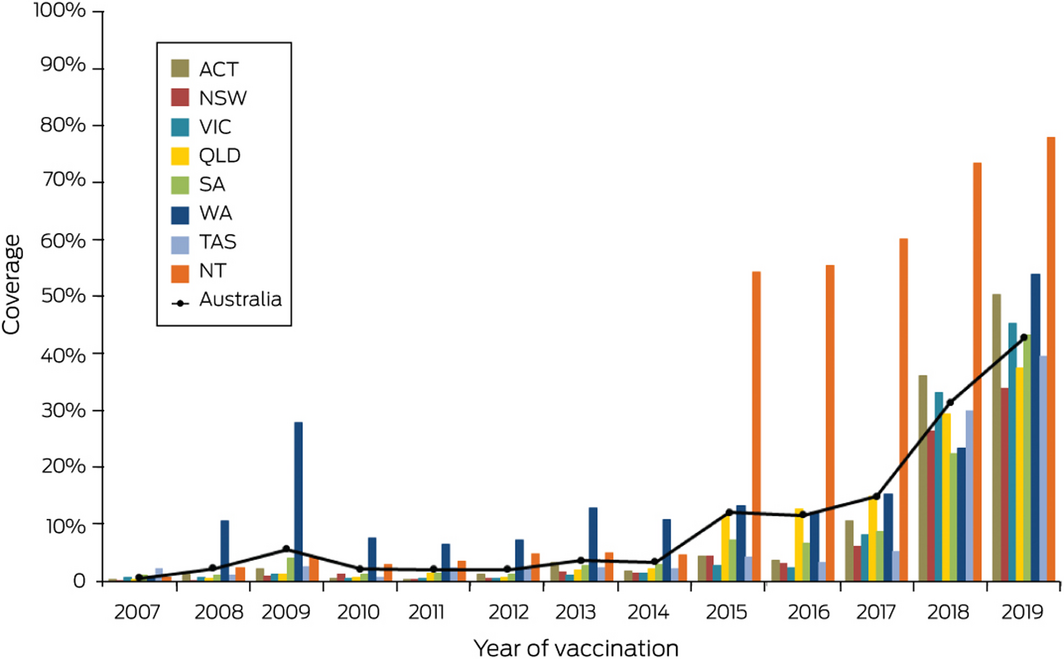
ACT = Australian Capital Territory; NSW = New South Wales; NT = Northern Territory; QLD = Queensland; SA = South Australia; TAS = Tasmania; VIC = Victoria; WA = Western Australia. Source: Australian Immunisation Register, data as at 31 March 2020.
Box 4 – Trends in recorded coverage of any dose of seasonal influenza vaccine among non‐Aboriginal children aged 6 months to less than 5 years, by jurisdiction, 2007–2019
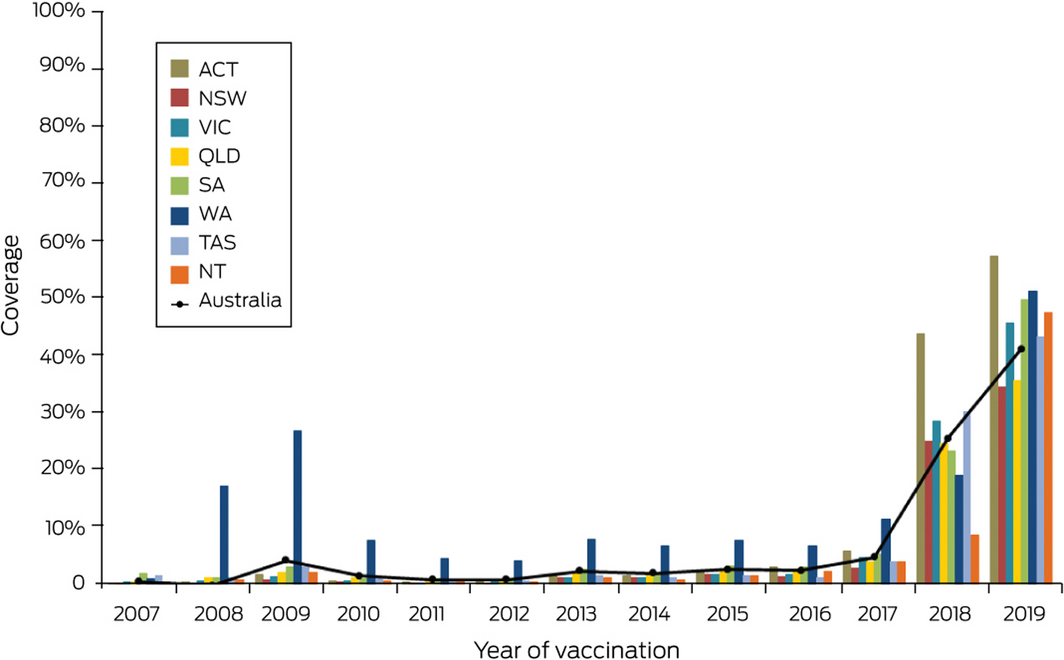
ACT = Australian Capital Territory; NSW = New South Wales; NT = Northern Territory; QLD = Queensland; SA = South Australia; TAS = Tasmania; VIC = Victoria; WA = Western Australia. Source: Australian Immunisation Register, data as at 31 March 2020.
Competing interests
No relevant disclosures.
Acknowledgements
Influenza notification rates were obtained from the National Notifiable Diseases Surveillance System as at 18 February 2021. De‐identified data were obtained from the Australian Immunisation Register as at 31 March 2020 and analysed with approval of the Australian Government Department of Health.
References
- Australian Institute of Health and Welfare. The burden of vaccine preventable diseases in Australia [Cat. No. PHE 26]. Canberra: AIHW, 2019. https://www.aihw.gov.au/getmedia/49809836-8ead-4da5-81c4-352fa64df75b/aihw-phe-263.pdf.aspx?inline=true (viewed Apr 2021).
- Li-Kim-Moy J, Yin JK, Patel C, et al. Australian vaccine preventable disease epidemiological review series: Influenza 2006 to 2015. Commun Dis Intell 2016; 40: E482–E495.
- Sheppeard V, Gilmour R, Tobin S. Record number of influenza tests in 2019, not a “mutant flu crisis”. Med J Aust 2019; 211: 333. https://www.mja.com.au/journal/2019/211/7/record-number-influenza-tests-2019-not-mutant-flu-crisis
- Australian Technical Advisory Group on Immunisation. Australian immunisation handbook. Canberra: Commonwealth of Australia, 2018. https://immunisationhandbook.health.gov.au (viewed Apr 2021).
- National Centre for Immunisation Research and Surveillance. Significant events in influenza vaccination practice in Australia. Sydney: NCIRS, 2020. https://www.ncirs.org.au/sites/default/files/2020-12/Influenza-history-Dec%202020.pdf (viewed Apr 2021).
- Blyth CC, Macartney KK, McRae J, et al. Influenza epidemiology, vaccine coverage and vaccine effectiveness in children admitted to sentinel Australian hospitals in 2017: Results from the PAEDS-FluCAN collaboration. Clin Infect Dis 2019; 68: 940–948.
- Pillsbury A, Quinn H, Cashman P, et al. Active SMS-based influenza vaccine safety surveillance in Australian children. Vaccine 2017; 35: 7101–7106.
- Fielding JE, Levy A, Chilver MB, et al. Effectiveness of seasonal influenza vaccine in Australia, 2015: An epidemiological, antigenic and phylogenetic assessment. Vaccine 2016; 34: 4905–4912.
- Blyth CC, Cheng AC, Crawford NW, et al. The impact of new universal child influenza programs in Australia: Vaccine coverage, effectiveness and disease epidemiology in hospitalised children in 2018. Vaccine 2020; 38: 2779–2787.
- Rolfes MA, Flannery B, Chung JR, et al. Effects of influenza vaccination in the United States during the 2017–2018 influenza season. Clin Infect Dis 2019; 69: 1845–1853.
- Armstrong P, Dowse G, Effler P, et al. Epidemiological study of severe febrile reactions in young children in Western Australia caused by a 2010 trivalent inactivated influenza vaccine. BMJ Open 2011; 1: e000016.
- Therapeutic Goods Administration. Seasonal flu vaccine: investigation into febrile reactions in young children following 2010 seasonal trivalent influenza vaccination. Canberra: TGA, 2010. https://www.tga.gov.au/alert/seasonal-flu-vaccine-investigation-febrile-reactions-young-children-following-2010-seasonal-trivalent-influenza-vaccination (viewed Apr 2021).
- King C, Leask J. The impact of a vaccine scare on parental views, trust and information needs: A qualitative study in Sydney, Australia. BMC Public Health 2017; 17: 106.
- Carlson SJ, Quinn HE, Blyth CC, et al. Barriers to influenza vaccination of children hospitalised for acute respiratory illness: a cross-sectional survey. J Paediatr Child Health 2021; 57: 409–418.
- Horvath J. Review of the management of adverse events associated with Panvax and Fluvax. Canberra: Australian Government, Department of Health and Ageing; 2011. https://www.health.gov.au/sites/default/files/adverse-event-march-2011.pdf (viewed Apr 2021).
- Beard F, Hendry A, Macartney K. Influenza vaccination uptake in Australia in 2020: impact of the COVID-19 pandemic? Commun Dis Intell 2021; 45: 1–4.
- Law C, McGuire R, Ferson MJ, et al. Children overdue for immunisation: a question of coverage or reporting? An audit of the Australian Immunisation Register. Aust N Z J Public Health 2019; 43: 214–220.
- Ministers Department of Health. Record flu vaccines in 2020 to protect Australians [media release]. Canberra: Commonwealth of Australia, 2020. https://www.health.gov.au/ministers/the-hon-greg-hunt-mp/media/record-flu-vaccines-in-2020-to-protect-australians (viewed Apr 2021).
- Jacobson Vann JC, Jacobson RM, Coyne-Beasley T, et al. Patient reminder and recall interventions to improve immunization rates. Cochrane Database Syst Rev 2018; (1): CD003941.
- Kang GJ, Culp RK, Abbas KM. Facilitators and barriers of parental attitudes and beliefs toward school-located influenza vaccination in the United States: systematic review. Vaccine 2017; 35: 1987–1995.
- Frew PM, Lutz CS. Interventions to increase pediatric vaccine uptake: an overview of recent findings. Hum Vaccin Immunother 2017; 13: 2503–2511.
- Ministers Department of Health Strengthening Australia’s immunisation program [media release]. Canberra: Ministers Department of Health; 2020. https://www.health.gov.au/ministers/the-hon-greg-hunt-mp/media/strengthening-australias-immunisation-program (viewed Apr 2021).
Provenance: Not commissioned; externally peer reviewed.
Costs of Delivering the Hep B PAST Model of Care in Remote Australia: A Retrospective Pre–Post Study
Hoa Nguyen, Anh Le Tuan Nguyen, Paula Binks, Melita McKinnon, Emily Vintour-Cesar, Karen Wills, Nicola Stephens, Benjamin Cowie, Joshua S. Davis, Yuejen Zhao, Peter Nihill, Julie A. Campbell, Andrew J. Palmer, Jane Davies, Barbara de Graaff
Buruli Ulcer Acquired From Ringtail Possum Rescue
Daniel P. O'Brien, Naomi Clarke, Sara Bonnici, Mohammad A. Hussain
Q Fever Visceral Abscesses After Contact With Native Australian Marsupials
Samantha J. Laws, Enzo Binotto, James Stewart, Jennifer Ho, Trent Yarwood, Josh Hanson, Simon Smith
Hospital-Admitted Injection-Related Infections Among Incarcerated People Who Inject Drugs in Australia: A Retrospective Cohort Study
Andrew Palmer, Matthew Carter, Jeremy Yeo, Cecilia Shim, Jason Connor, Jeremy Hayllar, Gerald Holtmann, Naomi Moy, Elliott G. Playford, Naomi Runnegar, Paul J. Clark
The Live Attenuated Influenza Vaccine in Australia: An Additional Tool for Influenza Prevention
Cyra Patel, Alexis Pillsbury, Tran Nguyen, Xia Wang, Helen E. Quinn, Clayton K. Chiu, Allen C. Cheng, Katie L. Flanagan, Zhicheng Wang
Reflex Testing for Hepatitis D Infection: A Unique Opportunity to Reduce Hepatitis D-Related Chronic Liver Disease Deaths in Australia
Jessica Howell, Lauren Andersson, Miriam T. Levy, James O'Beirne, Leon Adams, Katharine Irvine, Avik Majumdar, Golo Ahlenstiel, Kathy Jackson, Krispin Hajkowicz, Joseph Doyle, Jane Davies, Sarah Cherian, Wayne Dimech, Alexander J. Thompson