




Volume 215 - Issue 2
Rethinking cancer survivorship: the Prostate Cancer Survivorship Essentials Framework
Authors: Jeff Dunn, Bogda Koczwara and Suzanne Chambers
Med J Aust 2021; 215 (2): 94-94.e1. || doi: 10.5694/mja2.51142
Published online: 19 July 2021
Published online: 19 July 2021
To the Editor: The broadly accepted definition of a cancer survivor recognises that the survivorship begins at diagnosis.1 However, survivorship care pathways conventionally begin at completion of active treatment, presenting a challenge for addressing survivorship needs at diagnosis and for people living with incurable cancer.2 A revision of the concept of cancer survivorship is needed, placing the survivor at the centre of a dynamic experience of life after a cancer diagnosis and opening up the survivorship experience to persons at any stage of cancer and at any phase of their disease trajectory.
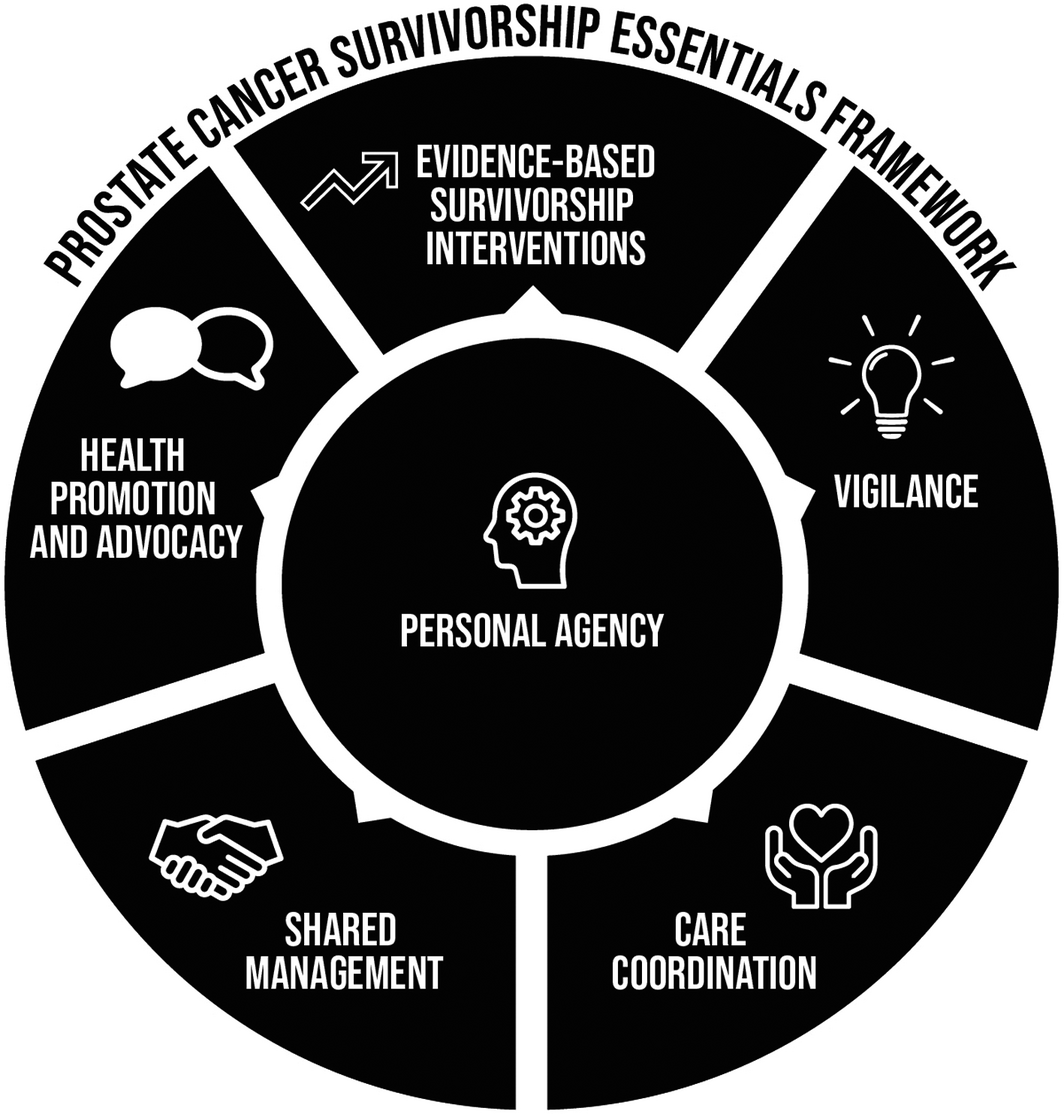
Until now, clinical care guidelines and models of survivorship have typically not included consumer input, but rather have been developed principally through health professional expert consensus.3,4 In a novel approach from 2019–2020, a panel of 47 experts and consumers across Australia and New Zealand came together to define six key domains of survivorship care in a Prostate Cancer Survivorship Essentials Framework:5 health promotion and advocacy, shared management, vigilance, personal agency, care coordination, and evidence‐based survivorship interventions.
These six domains reached high consensus as being essential, with the 26 elements within domains all rated as high importance. Almost one‐third of the 47‐member panel were cancer survivors working collaboratively with medical, allied health and nursing expert representatives. The degree of consensus in such a broad coalition is remarkable, underscoring the validity of the approach that reflects the lived experience driven by survivors’ preferences.
Importantly, the central domain related to personal agency of a survivor as a key element that linked all others (Box) and all domains were framed around outcomes that mattered for the patient (eg, empowerment, information, shared decision making, care coordination, symptom management). While the framework was developed for prostate cancer survivorship, none of the elements were unique to prostate cancer, highlighting the potential relevance of the framework to other cancers. More broadly, this approach aligns with existing models of chronic disease management and frameworks of consumer engagement in care that are fundamental to the delivery of health care in Australia and New Zealand.
We believe the essentials framework is applicable to other adult cancer patient cohorts and presents an opportunity to move forward on cancer survivorship in Australia, taking forward a unique consumer–practitioner model where the survivor is not just the passive object of care but an actor in their own health and an empowered and supported agent of change.
Competing interests
No relevant disclosures.
References
- Marzorati C, Riva S, Pravettoni G. Who is a cancer survivor? A systematic review of published definitions. J Cancer Educ 2017; 32: 228–237.
- Langbaum T, Smith TJ. Time to study metastatic‐cancer survivorship. N Engl JMed 2019; 380: 1300–1302.
- Armstrong MJ, Bloom JA. Patient involvement in guidelines is poor five years after institute of medicine standards: Review of guideline methodologies. Res Involv Engagem 2017; 3: 19.
- Skolarus TA, Wolf AMD, Erb NL, et al. American Cancer Society prostate cancer survivorship care guidelines. CA Cancer J Clin 2014; 64: 225–249.
- Dunn J, Green A, Ralph N, et al. Prostate Cancer Survivorship Essentials Framework: guidelines for practitioners. BJUI Int 2020; https://doi.org/10.1111/bju.15159 [Epub ahead of print].
The first Australian evidence‐based guidelines on male infertility
Darren J Katz, Liza O’Donnell, Robert I McLachlan, Tim J Moss, Clare V Boothroyd, Veena Jayadev, Sarah R Catford
The public health impacts of mining in Australia
Javier Cortes‐Ramirez, Ruby N Michael, Leisa‐Maree Toms, Melissa Haswell
Who smokes in Australia? Cross‐sectional analysis of Australian Bureau of Statistics survey data, 2017–19
Jessica Yi Han Aw, Christina Heris, Raglan Maddox, Grace Joshy, Emily Banks AM
Dual‐energy x‐ray absorptiometry assessment of bone health in Australian men with prostate cancer commencing androgen deprivation therapy
Mariya F Hamid, Amy Hayden, Tania Moujaber, Sandra Turner, Howard Gurney, Mathis Grossmann, Peter Wong
Modern paradigms for prostate cancer detection and management
Isabella SC Williams, Aoife McVey, Sachin Perera, Jonathan S O’Brien, Louise Kostos, Kenneth Chen, Shankar Siva, Arun A Azad, Declan G Murphy, Veeru Kasivisvanathan, Nathan Lawrentschuk, Mark Frydenberg
Urological Society of Australia and New Zealand (USANZ) and Australasian Chapter of Sexual Health Medicine (AChSHM) for the Royal Australasian College of Physicians (RACP) clinical guidelines on the management of erectile dysfunction
Eric Chung, Michael Lowy, Michael Gillman, Chris Love, Darren Katz, Graham Neilsen