




Medical education
Lessons from practice
Volume 215 - Issue 10
Progressive multifocal leukoencephalopathy: a complication of prolonged immunosuppression for plasma cell myeloma
Authors: Sophie C Burn and Akash Kalro
Med J Aust 2021; 215 (10): 454-455. || doi: 10.5694/mja2.51315
Published online: 15 November 2021
Published online: 15 November 2021
A 66-year-old man presented to a tertiary emergency department following a fall
Clinical record
A 66‐year‐old man presented to a tertiary emergency department following a fall. He had a 6‐month history of agitation, personality change, progressive cognitive impairment, dysarthria, dysphagia and recurrent falls. On examination, there was proximal muscle wasting and weakness, brisk reflexes and an upgoing plantar reflex on the left foot. Cranial nerve examination was normal.
His medical history was significant for multiple myeloma diagnosed in 2014 with no known comorbidities at the time of diagnosis. The myeloma was treated with three cycles of chemotherapy (bortezomib–cyclophosphamide–dexamethasone), followed by an autologous stem cell transplant (ASCT) with melphalan conditioning and thalidomide maintenance. He developed disease progression 2 years after ASCT, which was treated with lenalidomide with dexamethasone and subsequently pomalidomide. Five months before this presentation, he was found to have profound hypogammaglobulinaemia in the context of a bacterial pneumonia, which was managed with intravenous immunoglobulin. There was no recurrent pneumonia.
The patient’s neurological presentation and findings were atypical and, in the setting of immunomodulator therapy and previous ASCT, the differential diagnoses were broad. Concerning differential diagnoses included a space occupying lesion such as a subdural haematoma or secondary central nervous system (CNS) malignancy, a neurodegenerative disorder such as progressive multifocal leukoencephalopathy (PML), vasculitis or CNS infection.
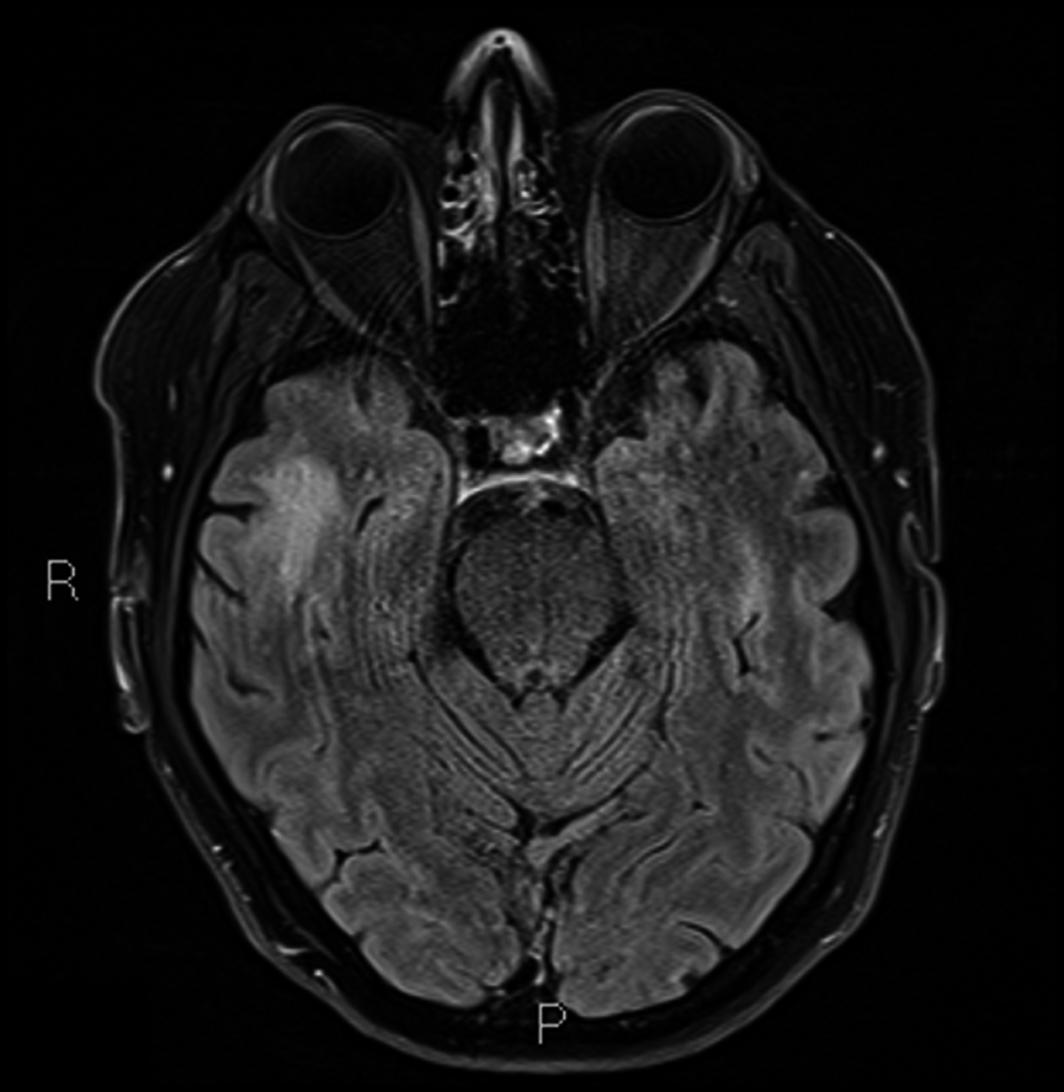
Complete blood examination was unremarkable, with no features of myeloma relapse on immunofixation studies. Lymphocyte count was normal and a CD3/4 differential count was therefore not performed. Computed tomography of the brain showed progressive myeloma with two new, likely myelomatous deposits in the calvarium. Magnetic resonance imaging showed increased mineral deposition at the precentral gyrus which can be seen in motor degenerative states. His initial lumbar puncture result was negative for John Cunningham (JC) virus, bacteria and antineuronal antibodies (full cerebrospinal fluid [CSF] results are provided in the Supporting Information). Following thorough investigation and work‐up for a progressive neurological condition, the patient was discharged with planned follow‐up and temporary interruption of anti‐myeloma therapy while awaiting final lumbar puncture results. However, he was re‐admitted to hospital 2 weeks later with general decline. Repeat magnetic resonance imaging (Box) and CSF studies identified features of PML, including progressive white matter changes involving the temporal lobes and a positive CSF result for JC virus. He deteriorated rapidly and died within 6 weeks of initial presentation.
Discussion
JC virus is poorly understood in transmission and pathogenicity. It is likely spread via the faecal–oral route and, after establishing a primary infection in the tonsils, persists as a latent infection. Immunosuppression can cause reactivation and subsequent PML. It is unclear whether the virus travels to the CSF from latent sites potentially in the kidney or bone marrow, or whether it is dormant there during the latent period. Infection with the virus usually occurs in early life and many people are positive for the virus without manifestations.
PML is a rare demyelinating neurodegenerative condition caused by JC virus, resulting in a highly variable clinical picture of advancing neurological deficits. It can be rapidly progressive and is always fatal. Definitive diagnosis based on brain biopsy is rarely achieved. Therefore, the presence of clinical and imaging manifestations not better explained by other diseases, in addition to a JC virus‐positive polymerase chain reaction result, is considered diagnostic.1 PML is commonly associated with chronic and severely depressed immune systems (eg, human immunodeficiency virus infection), haematological malignancies, and multiple sclerosis treated with natalizumab.2 Treatment is limited and largely experimental.
ASCT is commonly used in eligible patients with plasma cell myeloma to achieve long term disease control. It is associated with short term complications before cell count recovery, including infection and severe sepsis. Longer term complications related to chronic immunosuppression include reactivation of viruses including cytomegalovirus, herpes simplex virus and varicella zoster virus. ASCT improves the duration of remission and overall survival in patients with multiple myeloma, although most will experience relapse of disease.3
There are a small number of case reports linking PML with multiple myeloma and chronic immunosuppression. Identifying a causative agent in these cases is difficult. ASCT was used in all cases except two, and lenalidomide in four.3 Misdiagnosis of PML as CNS malignancy or other pathologies such as a previous infarction may lead to worsening of the disease due to further oncological treatment and resultant immunosuppression.4 Current treatment options for PML include mirtazapine, which is thought to block virus entry into glial cells via serotonin 5‐HT2a receptors.3 Use of pembrolizumab (an anti‐programmed death ligand 1 antibody) has recently been described with some response.5
In conclusion, PML should always be considered as a differential diagnosis in patients with neurological symptoms and immunosuppression as treatment for multiple myeloma. The treatment options are limited; however, early diagnosis can assist with prognostication.
Lessons from practice
- Any patient with a history of chronic immunosuppression presenting with neurological symptoms for whom clinical examination and investigations are not consistent with another diagnosis should be evaluated for progressive multifocal leukoencephalopathy (PML).
- PML is a rapidly progressive and fatal neurodegenerative disorder which is more common in immunosuppressed patients.
- Definitive diagnosis can only be made on the basis of a brain biopsy; diagnosis is therefore clinical and at the exclusion of other pathologies.
- Treatment options for PML are limited and experimental.
Competing interests
No relevant disclosures.
References
- Berger JR, Aksamit AJ, Clifford DB, et al. PML diagnostic criteria: consensus statement from the AAN neuroinfectious disease section. Neurology 2013; 80: 1430–1438.
- Pavlovic D, Patera AC, Nyberg F, et al. Progressive multifocal leukoencephalopathy: current treatment options and future perspectives. Therap Adv Neurol Disord 2015; 8: 255–273.
- Bennett KM, Storrar N, Johnson P, Fernandes PM. Progressive multifocal leukoencephalopathy (PML) following autologous peripheral blood stem cell transplantation for multiple myeloma. Clin Case Rep 2020; 8: 938–943.
- Akiyama M, Takahashi T, Nomura S, et al. Progressive multifocal leukoencephalopathy in patient with multiple myeloma. Int J Hematol 2010; 92: 186.
- Cortese, I, Muranski P, Enose‐Akahata Y, et al. Pembrolizumab treatment for progressive multifocal leukoencephalopathy. N Engl J Med 2019; 380: 1597–1605.
Provenance: Not commissioned; externally peer reviewed.
Rapid Growth in Diagnostic CT Knee Imaging in Australia: Implications for Imaging Stewardship
Hanwen Chen, Rachelle Buchbinder, Sean Docking, Ian A Harris
Disease‐specific survival for people with chronic myeloid leukaemia, South Australia, 1980–2020: a retrospective cohort study
Kerri Beckmann, Brendon J Kearney, Naranie Shanmuganathan, David Yeung, Tim Hughes
Technological advances in the search for a CURE for asthma
Sara Quon, Timothy M Johanson, Ridhima Wadhwa, Alen Faiz, Anthony Flynn, Gary P Anderson, Amanda J Cox, Nicholas P West, Michael P Menden, Rhys S Allan
Who gets asthma, and why?
Denby J Evans, Peter D Sly, Paul Foster, Chantal Donovan
The first Australian evidence‐based guidelines on male infertility
Darren J Katz, Liza O’Donnell, Robert I McLachlan, Tim J Moss, Clare V Boothroyd, Veena Jayadev, Sarah R Catford
Sex differences in management and outcomes of people with ST‐elevation myocardial infarction, New South Wales, 2011–2020: a retrospective cohort study
Samia Kazi, Simone Marschner, Haeri Min, Desi Quintans, James JH Chong, Ehsan Khan, David B Brieger, Clara K Chow