




Volume 214 - Issue 9
The impact of practice size and ownership on general practice care in Australia
Authors: Caroline Moel-Mandel and Vijaya Sundararajan
Med J Aust 2021; 214 (9): 408-410.e1. || doi: 10.5694/mja2.51038
Published online: 10 May 2021
Published online: 10 May 2021
Recent trends in general practice structure may have an impact on future patient care in Australia
The organisational structure of general practice in Australia has changed considerably since the late 1990s.1 Prompted by health care system changes, practice cost increases and incentives, originally small‐scaled general practices have merged into larger entities.1
At present, 2% of Australian general practitioners work in solo private practices, while 20% of full‐time GPs and 33% of part‐time GPs are employed in large practices with six or more GPs.1 Practice ownership levels have changed as well. In 2020, 25% of Australian GPs were practice owners, a decline from 35% in 2008.2 Factors such as management responsibilities, financial burdens and a lack of work–life balance seem to discourage practice ownership.3 Concurrently, commercial ownership models emerged, ranging from ownership by other health professionals to corporate groups of publicly listed companies, with shareholders having little or no involvement in patient care or practice management.3 In 2000, there were six corporate groups; by 2020, three remained, which operate over 400 medical centres. Survey data from 2020 indicate that approximately 16% of GPs work in corporate‐owned practices.1 Co‐located services increased as well. In 2016, 81% of practices had pathology services on location versus 49% in 2010; for imaging, these figures are 30% versus 15% and for physiotherapy 50% versus 29% respectively.3,4
Trends towards increasing general practice size and corporatisation have also been reported in other advanced economies. In the United States, about 16% of primary health physicians are employed in corporate‐owned practices.5 Sweden has encouraged for‐profit facilities to increase provider choice and competition, resulting in 40% of general practices being privately owned.6 Corporatisation of general practice in New Zealand is rising as new generation GPs prefer a lower administrative burden.7 While national policies in the United Kingdom have encouraged partnerships and the integration of general practices to improve service quality and facilitate access, most practice groups have remained independent businesses (< 5% corporate‐owned).4
Corporate business models may have clear advantages for GPs, including financial security and a better work–life balance, and they might benefit patients as they offer a range of on‐site medical services and extended opening hours.3 However, concerns have been raised about the consequences of growing practice sizes and corporate‐owned general practices, in particular regarding corporate obligation to deliver revenue to their shareholders who do not participate in any aspect of patient care, putting profits before patient care.8 Moreover, some corporations currently active in Australian general practice operate across international borders and their cultures may be inimical to patient‐focused health care. The aim of this narrative is to synthesise the available information about the impact of changes to size and ownership on the delivery of patient care and the health care system. The review is based on articles and reports found through an extensive search of the (grey) literature, the reference lists of key articles and related articles, and via the “cited by” feature in Google Scholar. Only publications in English, published after 2000 and applicable to the developments in Australia were considered for inclusion. After screening, 14 publications were included (Supporting Information, table 1).
Impact of general practice size and ownership model
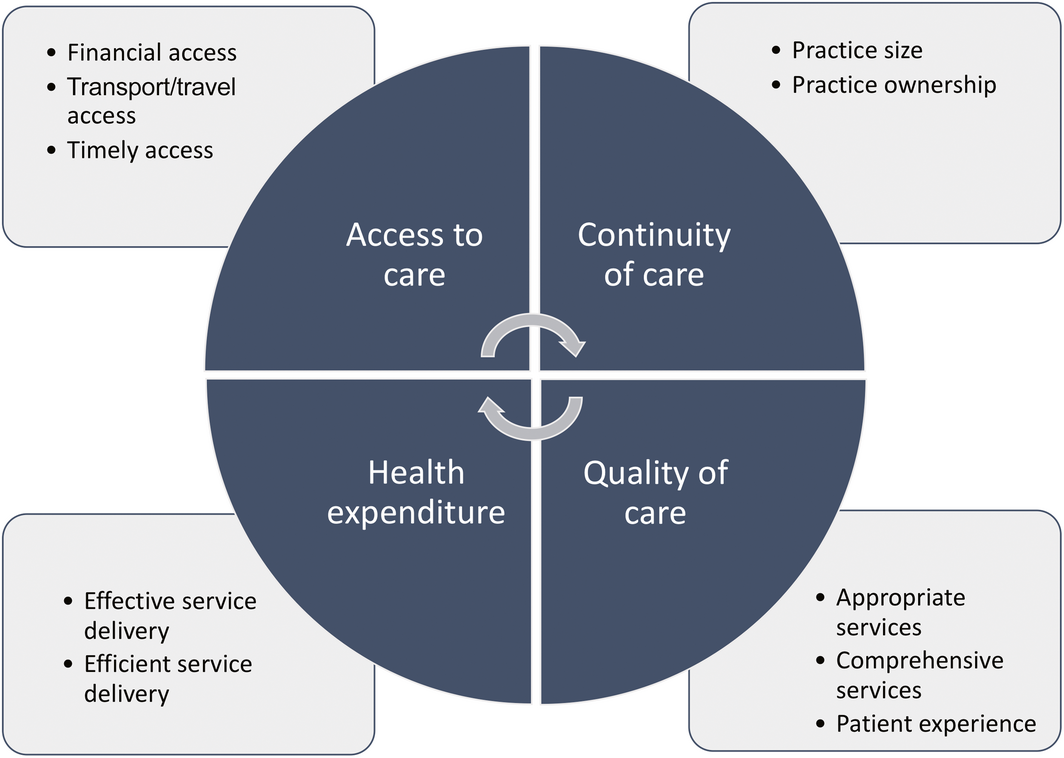
Independent of size and ownership, general practices should deliver high quality services, with commitments to access, continuity and quality of care and optimal use of health expenditure (Box 1).
Impact on access to care
Initially, most corporate practice models offered bulk‐billing; however, the introduction of the Medicare rebate freeze in 2013 resulted in a change to mixed‐ or private‐billing models.9 The expansion of GP practice consolidation and corporatisation is associated with less closely located competition, which may lead to further reductions in bulk‐billing and an increase in service fees and out‐of‐pocket expenses.10 While there is no direct evidence that larger practices and corporatisation lead to financial barriers to accessing care, access may be affected when multiple smaller practices conglomerate into larger, more centrally located practices, especially for people residing in regional and remote areas where there are already fewer GPs per person.1 The reported long waiting times in corporate medical centres and the shortage of viable transport options to more distant general practices may further impede access to medical care when required.11
Impact on continuity of care
Continuity of care enhances patient satisfaction and trust, which improves the understanding and management of illnesses, adherence to treatment and may ultimately lower mortality rates.12 Results from an Australian online survey13 showed that while most participants (n = 2477 ) do have a usual GP (80%) or general practice (90%), 28% had sought care from multiple practices in the preceding year. Reasons for multiple practice visits were not provided.13 In larger practices, the “usual GP” was often replaced by “usual practice”, resulting in patients consulting GPs they had never met before.13
Similarly, higher levels of continuity of care were experienced in small practices (50%) compared with practices with seven or more GPs (31%), according to a study from the UK.14 A large UK study4 (n = 903 357) found that corporatised practices provided significantly worse overall patient experience compared with traditional GP practices and particularly in regards to consulting a preferred GP. In the qualitative aspect of an Australian study,11 participants visiting corporate practices reported a lack of continuity of care and that doctors were often not aware of their medical history. Furthermore, participants indicated that appointments were short, unsatisfactory and lacked follow‐up. Lower follow‐up rates were also found in for‐profit Swedish primary care centres for patients with chronic diseases compared with centres owned by not‐for‐profit organisations (71% v 75%).15
Impact on quality of care
While the efficiency of management processes, co‐location of health services and extension of opening hours of corporate‐owned general practices undoubtedly accommodate the need of patients, research suggests that the quality of corporatised GP services may be worse compared with care delivered by traditional providers.11,16,17 In a UK cross‐sectional study16 (n = 971 232), out‐of‐hours services delivered by corporate organisations scored significantly lower for the timeliness of provided care and for physician and overall patient experience. In 2013, a survey11 of 617 Australian Capital Territory residents did not find a relationship between practice size and patient satisfaction. However, there was a difference between patient satisfaction and care delivered in non‐corporate practices (91%) and corporate practices (79%).11
A UK study17 (n = 8300) found that non‐traditional providers performed consistently worse (P < 0.01) on 15 out of 17 performance measures related to patient experience, cost and efficiency, access and clinical effectiveness. There are few Australian studies that investigate whether size or ownership affects patient outcomes. One of these,18 which focused on diabetes care in nearly 150 practices across three states between 2011 and 2014, found that neither practice size nor ownership type related to good glycaemic control and completion of annual cycles of diabetes care.
Impact on health expenditure
In 2018–19, about $8.0 billion (6%) of the total government health expenditure related to benefit paid for non‐referred medical services, which include GP services, an increase of 75% in the past decade Box 2).19 The concurrent 48% government expenditure increase per capita on received GP services has been linked to the rise in chronic diseases, resulting in a multitude of services delivered to single patients.1,19 It has been argued that the observed increase might be associated with the practice of overservicing to meet income targets, or with GPs over‐referring to commercially related and co‐located services.22 An analysis of 8 years of general practice activity data, found that practice size was positively associated with pathology ordering: practices with five to ten full‐time equivalent (FTE) GPs had a nearly eight times higher rate of ordering than those with fewer than two FTE GPs.23 An investigation of the impact of pathology co‐location with similar data found no direct association between co‐location and increased test ordering, although the clinical appropriateness of tests was not investigated.24 In addition, some corporate GPs reported feeling pressured by their employers to increase services billed and the occasional use of provider numbers for clinically unnecessary services or added consultation items without the physician’s consent.8
There is also evidence of potential underuse of GP services. Up to 40% of emergency department presentations could have been managed in a general practice setting, and a clear relationship was found with lower levels of continuity of care provided.4,25 Large and corporate‐owned practices seem to be associated with overservicing and lower levels of continuity of care and may therefore negatively affect health costs. A considerable amount of secondary care expenditures might thus be saved each year through effective primary health care delivery.
Conclusion
There is a growing trend of general practice consolidation with co‐located pathology, imaging and allied health services. This trend is expected to continue as 50% of current practice owners plan to retire within 10 years and nearly 60% of non‐owning GPs are “not at all interested” in becoming practice owners in the future.1 While there is little Australian evidence that worse clinical care is delivered in privately or corporate‐owned general practices, there is also no evidence that care is better. Hence, if general practice in Australia is to navigate the future changes in practice size, ownership and increasingly co‐located service organisation, more Australian research and potentially regulation are needed to track and control what this means for patient care in terms not only of patient experience but also for health outcomes in general practice.
Box 2 – Government health expenditures and Medicare benefits paid per capita in the financial years 2008–09 and 2018–1919
|
|
2008–09 |
2018–19 |
Increase (%) |
||||||||||||
|
|
|||||||||||||||
|
Estimated resident population Australia |
21 249 199 |
24 992 747 |
17.6% |
||||||||||||
|
78.6* |
133.6* |
70.0%† |
|||||||||||||
|
Benefit paid all services ($) |
14.3* |
24.1* |
68.9%† |
||||||||||||
|
Benefit paid out‐of‐hospital non‐referred services (GP services) |
4.6* |
8.0* |
74.6%† |
||||||||||||
|
Benefit paid per capita for total Medicare |
671 |
963 |
43.5% |
||||||||||||
|
Benefit paid per capita for GP services |
218 |
322 |
47.7% |
||||||||||||
|
Average of GP services per capita |
5.3 |
6.3 |
18.9% |
||||||||||||
|
|
|||||||||||||||
|
GP = general practice. * Billion. † The increase in percentage is calculated before rounding the expenditures to one decimal point in billions. Source: Australian Institute of Health and Welfare.20,21 |
|||||||||||||||
Competing interests
No relevant disclosures.
References
- Royal Australian College of General Practitioners. General Practice: Health of the Nation 2020. Melbourne: RACGP, 2019. https://www.racgp.org.au/getmedia/c2c12dae-21ed-445f-8e50-530305b0520a/Health-of-the-Nation-2020-WEB.pdf.aspx (viewed Oct 2020).
- Royal Australian College of General Practitioners. General Practice: Health of the Nation 2019. Melbourne: RACGP, 2019. https://www.racgp.org.au/getmedia/bacc0983-cc7d-4810-b34a-25e12043a53e/Health-of-the-Nation-2019-report.pdf.aspx (viewed Oct 2020).
- Joyce C, McDonald H, Lawlor-Smith L. General practitioners’ perceptions of different practice models: a qualitative study. Aust J Prim Health 2016; 22: 388–393.
- Cowling TE, Laverty AA, Harris MJ, et al. Contract and ownership type of general practices and patient experience in England: multilevel analysis of a national cross-sectional survey. J R Soc Med 2017; 110: 440–451.
- Willis J, Antono B, Bazemore A, et al. The state of primary care in the United States: a chartbook of facts and statistics. Washington: Robert Graham Center, 2020. https://www.graham-center.org/content/dam/rgc/documents/publications-reports/reports/PrimaryCareChartbook2021.pdf (viewed March 2021).
- Holt E. Health in Sweden: a political issue. Lancet 2018; 392: 1184–1185.
- Greatbanks R, Doolan-Noble F, McKenna A. Cheques and challenges: business performance in New Zealand general practice. J Prim Health Care 2017; 9: 185–190.
- Commonwealth of Australia. Professional Services Review: annual report 2017–18. https://www.psr.gov.au/publications-and-resources/annual-reports (viewed Jan 2021).
- Erny-Albrecht K, Bywood P. Corporatisation of general practice — impact and implications. Adelaide: Primary Health Care Research and Information Service, 2016. http://hdl.handle.net/2328/38389 (viewed Oct 2020).
- Gravelle H, Scott A, Sivey P, et al. Competition, prices and quality in the market for physician consultations. J Ind Econ 2016; 64: 135–169.
- McGowan H. Primary health care in the ACT: consumer experiences. Canberra: Health Care Consumers’ Association, 2014. https://www.aph.gov.au/DocumentStore.ashx?id=02344196-beb1-473f-be08-c556d379677c&subId=252668 (viewed March 2020).
- Pereira Gray DJ, Sidaway-Lee K, White E, et al. Continuity of care with doctors — a matter of life and death? A systematic review of continuity of care and mortality. BMJ Open 2018; 8: e021161.
- Wright M, Hall J, Van Gool K, et al. How common is multiple general practice attendance in Australia? Aust J Gen Pract 2018; 47: 289.
- Barker I, Steventon A, Deeny SR. Association between continuity of care in general practice and hospital admissions for ambulatory care sensitive conditions: cross sectional study of routinely collected, person level data. BMJ 2017; 356: j84.
- Maun A, Wessman C, Sundvall PD, et al. Is the quality of primary healthcare services influenced by the healthcare centre’s type of ownership? An observational study of patient perceived quality, prescription rates and follow-up routines in privately and publicly owned primary care centres. BMC Health Serv Res 2015; 15: 417.
- Warren FC, Abel G, Lyratzopoulos G, et al. Characteristics of service users and provider organisations associated with experience of out of hours general practitioner care in England: population based cross sectional postal questionnaire survey. BMJ 2015; 350: h2040.
- Greaves F, Laverty AA, Pape U, et al. Performance of new alternative providers of primary care services in England: an observational study. J R Soc Med 2015; 108: 171–183.
- Esterman AJ, Fountaine T, McDermott R. Are general practice characteristics predictors of good glycaemic control in patients with diabetes? A cross-sectional study. Med J Aust 2016; 204: 23. https://www.mja.com.au/journal/2016/204/1/are-general-practice-characteristics-predictors-good-glycaemic-control-patients
- Department of Health. Annual Medicare statistics. Canberra: Commonwealth of Australia, 2019. https://www1.health.gov.au/internet/main/publishing.nsf/Content/Medicare%20Statistics-1 (viewed Sept 2019).
- Australian Institute of Health and Welfare. Health expenditure Australia 2018–19 [Cat. No. HWE 80]. Canberra: AIHW, 2020. https://www.aihw.gov.au/reports/health-welfare-expenditure/health-expenditure-australia-2018-19/contents/data-visualisation (viewed Oct 2020).
- Australian Institute of Health and Welfare. Health expenditure Australia 2008–09 [ Cat. No. HWE 51]. Canberra: AIHW, 2010. https://www.aihw.gov.au/reports/health-welfare-expenditure/health-expenditure-australia-2008-09/contents/table-of-contents (viewed Oct 2020).
- Moynihan M, Birrell B. GP oversupply — ignoring the evidence. Melbourne: Australian Population Research Institute, Monash University, 2016. http://tapri.org.au/wp-content/uploads/2016/04/GP-oversupply-ignoring-the-evidence-12-Dec-2016.pdf (viewed Sept 2019).
- Bayram C. Evaluation of pathology ordering by general practitioners in Australia. Sydney: University of Sydney, 2013. https://ses.library.usyd.edu.au/handle/2123/9471 (viewed Oct 2020).
- Studdert DM, Britt HC, Pan Y, et al. Are rates of pathology test ordering higher in general practices co-located with pathology collection centres? Med J Aust 2010; 193: 114-119. https://www.mja.com.au/journal/2010/193/2/are-rates-pathology-test-ordering-higher-general-practices-co-located-pathology#:~:text=Conclusions%3A%20Pathology%20test%2Dordering%20rates,ordering%20behaviour%20may%20be%20unaffected
- Whyatt D, Tuson M, Haynes E, et al. Burden of primary care-type emergency department presentations using clinical assessment by general practitioners: a cross-sectional study. Emerg Med Australas 2019; 31: 780–786.
Linked content
-
MJA Podcast: Dr Caroline de Moel-Mandel
-
InSight+: Corporatised general practice: does it impact quality of care?
Provenance: Not commissioned; externally peer reviewed.
Shifting focus to adolescent wellbeing and inclusive participation in the digital age
Allyson R Todd, Elena Wang, Stephanie R Partridge
The clinical presentation, investigation, and management of women diagnosed with endometriosis in Australian general practices, 2011–2021: an open cohort study
Danielle Mazza, Kailash Thapaliya, Sharinne B Crawford, Alissia Hui, Maryam Moradi, Luke E Grzeskowiak
The impact of the Breast Screen NSW transition from film to digital mammography, 2002–2016: a linked population health data analysis
Rachel Farber, Nehmat Houssami, Katy J L Bell
Non‐technical errors associated with deaths in surgical care, Australia, 2012–2019, by surgical specialty (Australian and New Zealand Audit of Surgical Mortality): a retrospective cohort study
Jesse Ey, Victoria Kollias, Octavia Lee, Kelly Hou, Matheesha Herath, John B North, Ellie Treloar, Suzanne Edwards, Martin Bruening, Adam J Wells, Guy J Maddern
The CURE Asthma roadmap
Gary P Anderson, Anthony Flynn, Phil G Bardin, John D Blakey, Shyamali C Dharmage, Paul Foster, Peter G Gibson, Adam Jaffe, Alan James, Christine R Jenkins, Sundram Sivamalai, Peter D Sly, Guy B Marks, Vanessa M McDonald, Judy Wetttenhall
Evidence from Australian cohort studies about asthma trajectories and transitions across the life course: a narrative review
Caroline Lodge, Xin Dai, Ingrid A. Laing, Michael P Menden, Anthony Flynn, Gary P Anderson, Sarath Ranganathan, Shyamali C Dharmage