




Volume 214 - Issue 3
Call for infant formula reconstitution uniformity and improvements in manufacturer feeding guides
Authors: Shelley Farrent, Brian Coppin and Scott Morris
Med J Aust 2021; 214 (3): 107-110.e1. || doi: 10.5694/mja2.50760
Published online: 14 September 2020
Published online: 14 September 2020
Current regulations address product safety, but they do not adequately ensure accuracy of formula preparation and provision
Breastmilk is the optimum source of nutrition for most infants born at full term. When breastmilk is unavailable or unsuitable, the only safe and nutritious substitutes are commercial infant formulas.1 Infant formula — predominantly powdered infant formula — makes a major contribution to infant nutrition in Australia, with the 2010 Australian National Infant Feeding Survey reporting that 34% of infants had been introduced formula in their first month of life, 45% by 2 months and 69% by 6 months of age.2
In Australia, infant formula products are regulated under Standard 2.9.1 — Infant Formula Products in the Australia New Zealand Food Standards Code (Std2.9.1IFPANZC).3 All commercially produced infant formula products available in Australia and New Zealand must comply with the composition and safety requirements outlined in the Code. Std2.9.1IFPANZC specifies the mandatory nutrient content for infant formula and follow‐on formula to ensure that nutrition requirements are met. The standard includes labelling requirements, specifically prohibiting various claims, images and symbols.
While these regulations address product safety, they do not adequately ensure accuracy of formula preparation and provision. In particular, potential for error remains around formula powder reconstitution, given multiple differing brands with variable scoop to water ratios, and volume of feed for differing ages and body weights.
In this article, we discuss the infant formula range available in Australia, the infant formula powder reconstitution variability and the potential impacts, and the variability of manufacturer feeding guides compared with recognised recommendations and potential implications.
Formula brands and types
In Australia, there are more than ten brands of infant formula from which to choose. Within each brand there are often minor variations, from standard formulas meeting basic Food Standards Australia New Zealand (FSANZ) formula composition guidelines through to manufacturer‐specified gold formulas and condition‐specific formulas (Supporting information, table 1).
FSANZ guidelines describe the purpose of infant formula labelling as providing information to caregivers to make informed choices, as well as information about appropriate preparation and safe use of infant formula products. Under FSANZ guidelines, all infant formulas must meet essential nutrient requirements. Specific nutrient content and health claims are prohibited in Clause 3 of Standard 1.2.7.4 Despite regulation, there are often misleading names or ingredient claims on infant formulas which construe a health claim or benefit and create doubt or sway opinion in consumers. For example, “[trade name] constipation”, as a name of a formula may be assumed by a consumer to be a superior formula for babies with constipation. Similarly, a statement of “fish oil to help support brain and eye development” could potentially be interpreted by a consumer as a health claim. There is currently no unbiased, freely available source of information to help parents choose a formula and this is often the first point of confusion. The authors frequently encounter parents swapping formulas in response to their infant's behaviour, believing that another formula may offer benefit. Typical examples in clinical practice are changing from a standard term formula to a colic, antireflux, or casein‐predominant formula when there is irritability or spilling.
Powdered formula reconstitution
While infant formulas are made in liquid ready‐to‐feed and in powdered forms, the latter is predominantly used in the home. Under Std2.9.1IFPANZC, the labelling of a powdered formula product must include the powder to water reconstitution ratio to achieve the specified nutritional composition, and the weight of powder in one scoop. However, the Standard does not dictate scoop size and, consequently, the scoop to water reconstitution ratio is determined by the manufacturer, although the powder weight to water ratio is relatively constant between manufacturers. In Australia, there is significant variation in reconstitution ratios across brands. Australian infant formula dilution reconstitution ratios are most commonly either one scoop per 30 mL water, per 50 mL water or per 60 mL water. The choice between a smaller or larger ratio is manufacturer‐specific. Explanations company representatives have provided for choosing a smaller scoop to water ratio include being able to make up smaller quantities of formula, greater accuracy, and a reconstitution method that yields rounded number volumes of 100 mL. In contrast, companies with larger scoop to water ratios propose reduced risk of error in sleep‐deprived parents who might lose count of scoops. However, none of these justifications are evidenced‐based. While there is a general expectation that parents use the formula label instructions or community advice, brand changes enhance potential for parental miscalculation of formula concentration.
Under Std2.9.1IFPANZC, all powdered infant formula products must carry a warning stating, “Warning — follow instructions exactly. Prepare bottles and teats as directed. Do not change proportions of powder except on medical advice. Incorrect preparation can make your baby very ill”.3 This warning is often not obvious, and in practice, we have observed parents swapping between formulas and either assuming that the scoop to water reconstitution ratio is the same, confusing the ratios between brands, or using the incorrect scoop with a different manufacturer's powder, resulting in incorrect formula concentration. A systematic review of five studies supports this observation, finding that significant errors may be made when reconstituting formulas.5 Incorrect dilution ratio results in a formula strength that is either too dilute, increasing risks of nutrient deficiencies and faltering growth, or too concentrated, risking hypernatraemic dehydration or excessive weight gain.
A review of reconstitution recipes of the major brands of standard infant formulas reveals a formula powder to water ratio of 0.142–0.15 g/mL (Supporting information, table 2) and a narrow caloric strength range of 4.8–5.2 Kcal/g. Clearly, a standardised reconstitution recipe is possible. We propose that standardisation of reconstitution ratio of powdered infant formula to water would minimise error and risk while providing clarity for parents and health professionals.
Formula feeding guides
Infant feeding guidelines for health workers1 state that as a formula is designed to remain at a constant strength, it is the amount of formula that should increase as the infant grows. The guidelines outline approximate formula requirements for infants (Supporting information, table 3), which correlate appropriately with the estimated energy requirements of infants as outlined in the National Health and Medical Research Council (NHMRC) Nutrient reference values for Australia and New Zealand.6 The infant feeding guidelines also note that feeding guidelines on formula packaging recommending certain amounts for various ages are guides only and do not necessarily suit every infant.1
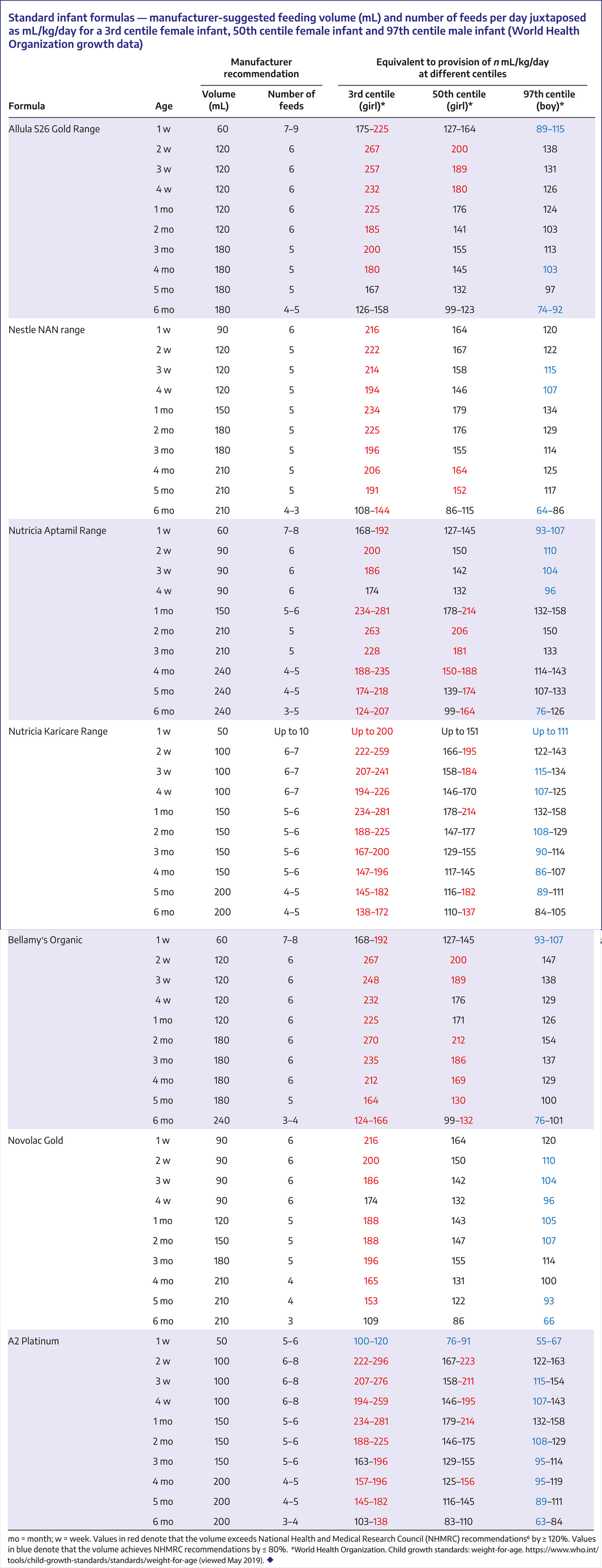
Manufacturers of commercial infant formulas usually include a feeding guideline on the formula packaging that outlines the number and volume of feeds recommended for the corresponding ages. This is not a requirement under the Food Standards Code. There is substantial inconsistency in the feeding guidelines for volume and frequency of feed by age printed on the containers (Box), both from one manufacturer to another and also compared with the NHMRC‐recommended volumes by age and weight. The lack of weight standardisation means that the caregivers of a small infant may overfeed, while a genetically larger infant might be underfed. Greater consistency or standardisation of manufacturer feeding guides that correlate appropriately with the NHMRC feeding guidelines may help reduce both over‐ and underfeeding as well as alleviate parental confusion and anxiety around feeding volumes.
While both under‐ and overfeeding may have negative clinical consequences, there are no published data to support adverse outcomes as a common consequence of parental misunderstanding. The absence of published evidence, however, should be considered in the light of anecdotal experience of health professionals within our health service, who report spilling and irritability from overfeeding and parental anxiety when their baby does not achieve volumes stated on the formula tin. Expert opinion concurs with our own clinical experience, as shown by the 2018 guideline on gastroesophageal reflux issued jointly by the European Society for Paediatric Gastroenterology, Hepatology and Nutrition (ESPGHAN) and the North American Society for Pediatric Gastroenterology, Hepatology, and Nutrition (NASPAGHAN), where the first step in management of an infant presenting with excess vomiting is to ensure that overfeeding is avoided.7 However, there is clearly a need for further study in the area of parental interpretation and use of the feeding guides provided on formula tins to determine the impact of variation in product labelling on health outcomes.
Conclusion
Infant formula is commonly used with a choice of brands and types of formula. There is limited access to unbiased advice on formula selection for parents, caregivers and health professionals who encounter feeding‐related problems in daily practice. In addition, there is a wide variation in reconstitution ratios of powdered infant formula due to differences in scoop sizes between manufacturers, which may contribute to error in formula concentration. Standardisation of reconstitution ratios is an opportunity to minimise error. Lastly, formula feeding guides provided on formula tins vary between companies and, by not accounting for weight, differ from NHMRC recommendations, which may lead to over‐ or underfeeding. Standardisation of formula feeding guides in line with NHMRC feeding guidelines, with clearer warning statements, may help reduce these risks. The absence of evidence as to the effectiveness and risks of current food and nutrition policy with respect to infant formula feeding is a significant gap in ensuring the safe care of infants both in our community and worldwide. We propose that this area becomes a future focus of public health research and advocacy for child health.
Competing interests
No relevant disclosures.
References
- National Health and Medical Research Council. Infant feeding guidelines: information for health workers. Canberra: NHMRC, 2012. https://www.nhmrc.gov.au/about-us/publications/infant-feeding-guidelines-information-health-workers (viewed May 2019).
- Australian Institute of Health and Welfare. 2010 Australian National Infant Feeding Survey. Canberra: AIHW, 2011. https://www.aihw.gov.au/getmedia/af2fe025-637e-4c09-ba03-33e69f49aba7/13632.pdf.aspx?inline=true (viewed May 2019).
- Australian Government. Australia New Zealand Food Standards Code — Standard 2.9.1 — Infant formula products. https://www.legislation.gov.au/Details/F2017C00332 (viewed May 2019).
- Australian Government. Australia New Zealand Food Standards Code — Standard 1.2.7 — Nutrition, health and related claims. https://www.legislation.gov.au/Details/F2018C00942 (viewed May 2019).
- Renfrew M, Ansell P, Macleod K. Formula feed preparation: helping reduce the risks; a systematic review. Arch Dis Child 2003; 88: 855–858.
- National Health and Medical Research Council. Nutrient reference values for Australia and New Zealand. Dietary energy. Canberra: NHMRC, 2005. https://www.nrv.gov.au/dietary-energy (viewed May 2019).
- Rosen R, Vandenplas Y, Singendonk M, et al. Pediatric gastroesophageal reflux clinical practice guidelines: joint recommendations of the North American Society for Pediatric Gastroenterology, Hepatology, and Nutrition (NASPGHAN) and the European Society for Pediatric Gastroenterology, Hepatology, and Nutrition (ESPGHAN). J Pediat Gastroenterol Nutr 2018; 66: 516–554.
Provenance: Not commissioned; externally peer reviewed.
Designing Housing to Reduce Overcrowding-Related Harms: Rheumatic Heart Disease as the Canary in the Coal Mine
Simon Quilty, Veronica Matthews, Angus Baumann, James Marangou, Bo Remenyi, Gavin Wheaton, Serena Morton Nabanunga, Norman Frank Jupurrurla, Simon Robinson, Steve Mintern, Cary Duffield, Joshua R. Francis, Paul C. Memmott
Australian Climate Leadership in 2026: COP-Out or Step-Up for Health?
Catherine G. A. Pendrey, Angie Bone, Aletha Ward, Francis Nona, Michelle Isles, Paul M. Kelly, Nicholas J. Talley
The impact of the Breast Screen NSW transition from film to digital mammography, 2002–2016: a linked population health data analysis
Rachel Farber, Nehmat Houssami, Katy J L Bell
Shifting focus to adolescent wellbeing and inclusive participation in the digital age
Allyson R Todd, Elena Wang, Stephanie R Partridge
The CURE Asthma roadmap
Gary P Anderson, Anthony Flynn, Phil G Bardin, John D Blakey, Shyamali C Dharmage, Paul Foster, Peter G Gibson, Adam Jaffe, Alan James, Christine R Jenkins, Sundram Sivamalai, Peter D Sly, Guy B Marks, Vanessa M McDonald, Judy Wetttenhall
Protecting public interest journalism as a public health good
Bronwyn Fredericks, Neha Lalchandani, Melissa A Sweet, Alex Cramb, Carmel Williams