




Volume 214 - Issue 3
A comparison of the distribution of Medical Research Future Fund grants with disease burden in Australia
Authors: Stephen E Gilbert, Rachelle Buchbinder, Ian A Harris and Christopher G Maher
Med J Aust 2021; 214 (3): 111-113.e1. || doi: 10.5694/mja2.50916
Published online: 15 February 2021
Published online: 15 February 2021
The disability burden of non-fatal disease is not reflected in allocation of grants
The disability burden of non‐fatal disease is not reflected in allocation of grants
The Medical Research Future Fund (MRFF) has become an increasingly important part of health and medical research funding in Australia. In the 2019–20 federal budget the Australian Government announced $5 billion of research funding over a 10‐year period.1 In comparison, the National Health and Medical Research Council (NHMRC) awarded $923 million in funding in the 2019 funding round.2 An important difference between the NHMRC and MRFF funding schemes is that MRFF grants are usually targeted within funding initiatives. For example, in 2019 there was a $20 million call for ovarian cancer research under the Emerging Priorities and Consumer‐Driven Research Initiative.
The preamble to the Medical Research Future Fund Act 2015 makes clear that MRFF funding of medical research and innovation should contribute to improving the health and wellbeing of all Australians.3 However, this aim may be difficult to achieve if funding themes or targeted calls focus on specific conditions and neglect common, burdensome conditions. As the MRFF has dispersed funds since 2017, it is timely to see where those funds have been allocated and to what extent they reflect the burden of disease in Australia.
The Australian Burden of Disease Study (ABDS) 2015 provides estimates of healthy life lost either through death (years of life lost [YLL]), disability (years lived with disability [YLD]) or both (disability‐adjusted life years [DALY]).4 Disease groups causing the greatest health burden are quite different depending on the perspective taken. For example, when disease burden is viewed in terms of deaths, the top three contributors are cancer (34% of death burden), cardiovascular disease (22%) and injury (14%), whereas when judged by disability, the top three contributors are musculoskeletal conditions (25% of disability burden), mental health (23%) and respiratory disease (10%).5
Our aim was to explore the allocation of MRFF funding to the 17 disease groups in the ABDS. We examined if there was any relationship between MRFF funding and disease burden, and if fatal or non‐fatal burden better explains MRFF allocation to disease groups.
Grant details were downloaded from the MRFF website (https://www.health.gov.au/resources/publications/medical-research-future-fund-mrff-grant-recipients) on 17 January 2020. Disease‐focused grants were allocated to one of the 17 disease groups in the 2015 ABDS. Grants with no specific disease focus were classified as non‐disease‐specific. Allocation was done primarily by grant title, supplemented by online information for funded studies. In cases where grant titles suggested more than one disease group, grants were classified by the primary disease focus of the study. Initial categorisation was performed by one member of the team, with classifications checked by all other team members. Where there was disagreement on the disease group to which a disease belonged, we consulted the disease lists provided in the methods of the 2015 ABDS6 and the International Statistical Classification of Diseases and Related Health Problems, 10th Revision.7
For each disease group, the sum of MRFF funds, the percentage of total MRFF funding and the percentage of disease‐specific funding (excluding grants awarded to non‐disease‐specific projects) were calculated. Burden of disease data (YLL, YLD, DALY) for each disease group were extracted from the ABDS 20154 for percentage contribution to total burden in 2015. For each disease group, data were displayed as percentage of disease burden versus percentage of MRFF funding, and relationships were explored with simple linear regression.
Between 2016 and 30 September 2019, the MRFF awarded 231 grants with a total value of $574 475 970 (median funding per grant, $1 142 252; range, $125,355 to $35 000 000). Details of funding distribution across disease groups and disease burden are provided in Box 1. There were 179 grants with total funding of $368 347 419 awarded to studies with a disease‐specific focus.
Box 2 displays the scatter plots and regression lines examining associations between the percentage of MRFF funding allocated to a disease group and the percentage of disease burden resulting from that disease group. Disease burden is displayed as death burden (YLL), disability burden (YLD) and total burden (DALY). There was a strong positive association between MRFF funding and death burden with an r2 value of 0.57, a weaker association when both death and disability were considered (r2 = 0.44), and no association with disability burden (r2 = 0.001).
A large proportion (36%) of MRFF grants are awarded to causes that do not target a specific disease classification (eg, funding of regional health partnerships, centres for drug discovery). The remaining funding is distributed across disease classifications, with the current pattern of distribution showing that allocation of funding is strongly associated with the fatal burden of a disease group but not non‐fatal burden. The current approach to funding allocation may compromise the MRFF’s aim of improving the health and wellbeing of all Australians.
The NHMRC analysis of its funding for 2013–2019 compared with the National Health Priority Areas (NHPAs) provides a similar picture to our analysis of MRFF funding, with quite varied funding to each NHPA.8 The top three NHPAs were cancer ($1.266 billion), cardiovascular disease ($821 million) and mental health ($681 million), and the bottom two were arthritis and osteoporosis ($145 million) and asthma ($126 million).
Two studies used a similar approach to ours to investigate the relationship between disease burden and NHMRC funding. The first study examined NHMRC funding over the period 1998–2003, finding strong positive correlations with both fatal (mean correlation, 0.54) and non‐fatal disease burden (mean correlation, 0.74).9 However, in the later study examining the period 2000–2008, there was a strong positive correlation with fatal burden (r = 0.91) but not non‐fatal burden (r = 0.09).10 This suggests that for recent NHMRC and MRFF funding there is a focus on disease groups with a high death burden.
The MRFF legislation requires funding to be allocated so that it benefits the health and wellbeing of all Australians. In practical terms, this would appear to be a much more holistic concept of health than simply avoiding deaths. At present, the five most highly funded conditions receive over half of disease‐specific MRFF funding, and funding decisions do not appear to be influenced by non‐fatal burden of disease. For example, musculoskeletal conditions are the leading cause of non‐fatal disease burden in Australia but have received only 1% of MRFF funding. This is also consistent with NHMRC funding for grants related to musculoskeletal trials for the 5‐year period 2009–2013 inclusive, which was also disproportionately low compared with the burden of these conditions (averaging 5.8 new trials per year through the project grant scheme, representing 0.8% of all project grants and funding, and 5% of NHMRC clinical trial funding).11
The NHMRC criteria for scoring grant applications value significance, research quality, and team quality and capability. It is therefore possible that researchers working in disease areas with less MRFF funding submit less meritorious MRFF applications than their peers, but as we do not have access to the MRFF peer review scores we cannot judge this issue. A more likely explanation, and one we can examine, is that the MRFF calls do not align with these conditions. The majority of MRFF funding calls (76% to December 2020)12 focus on specific health conditions, but only one of these calls supports research related to injuries, respiratory or musculoskeletal conditions.
This apparent focus on fatal conditions is highlighted through analysis of the MRFF initiative implementation report,13 which details the health areas which are priorities for MRFF funding. Early funding priorities are stated for 15 of the 20 initiatives. Noticeably, many non‐fatal conditions feature little within the priorities. For example, musculoskeletal conditions only feature in the Medical Research Commercialisation Initiative which includes the field of orthopaedics as a target for the development of biomedical technologies and general medical devices. Hearing loss is only a feature of the Indigenous Health Research Fund Initiative, while skin conditions do not feature at all.
We acknowledge that differences in total grant funding for disease classifications could reflect the more costly nature of research in some disease areas. However, in this case it could be expected that the total number of grants awarded to disease conditions might be similar, even if the funding amount is not. Yet disparity again appears to be evident as the five most highly funded disease conditions average 23 grants per condition, whereas the five mostly poorly funded diseases average only two grants per condition.
With the relatively limited number of MRFF rounds completed so far, it will be of interest for future research to explore whether greater funding support for health conditions with a high non‐fatal burden is provided in time. However, the current trend of MRFF distribution suggests targeted, disease‐based funding provided through the MRFF tends to go to disease groups with a high death burden and does not target disability burden.
Box 1 – Medical Research Future Fund (MRFF) funding awarded to each disease group, and fatal, non‐fatal and total disease burden*
|
Disease group |
Total grant funding |
Years of life lost |
Years lived with disability |
Disability‐adjusted life years |
|||||||||||
|
|
|||||||||||||||
|
Non disease‐specific focus |
$206 128 550 (35.9%) |
NA |
NA |
NA |
|||||||||||
|
Cancer and other neoplasms |
$89 299 684 (15.6%) |
34.1% |
2.7% |
18.3% |
|||||||||||
|
Neurological conditions |
$69 758 702 (12.1%) |
7.1% |
7.4% |
7.3% |
|||||||||||
|
Cardiovascular diseases |
$54 210 702 (9.4%) |
21.5% |
5.8% |
13.6% |
|||||||||||
|
Mental and substance use disorders |
$33 402 045 (5.8%) |
0.6% |
23.3% |
12.1% |
|||||||||||
|
Infant and congenital conditions |
$31 568 926 (5.5%) |
3.6% |
0.8% |
2.2% |
|||||||||||
|
Endocrine disorders |
$25 764 388 (4.5%) |
2.0% |
3.2% |
2.6% |
|||||||||||
|
Infectious diseases |
$18 455 823 (3.2%) |
2.7% |
1.4% |
2.0% |
|||||||||||
|
Blood and metabolic |
$8 987 742 (1.6%) |
1.4% |
1.1% |
1.3% |
|||||||||||
|
Respiratory diseases |
$8 101 692 (1.4%) |
5.5% |
9.5% |
7.5% |
|||||||||||
|
Kidney and urinary diseases |
$7 803 173 (1.4%) |
2.0% |
0.7% |
1.4% |
|||||||||||
|
Injuries |
$6 365 878 (1.1%) |
14.2% |
3.0% |
8.5% |
|||||||||||
|
Musculoskeletal conditions |
$5 627 079 (1.0%) |
0.7% |
24.8% |
12.9% |
|||||||||||
|
Reproductive and maternal conditions |
$5 081 848 (0.9%) |
< 0.1% |
1.9% |
1.0% |
|||||||||||
|
Gastrointestinal disorders |
$2 969 193 (0.5%) |
4.3% |
2.5% |
3.4% |
|||||||||||
|
Hearing and vision disorders |
$437 718 (0.1%) |
0% |
4.1% |
2.1% |
|||||||||||
|
Skin disorders |
$333 710 (0.1%) |
0.3% |
3.2% |
1.7% |
|||||||||||
|
Oral disorders |
$179 118 (< 0.1%) |
< 0.1% |
4.5% |
2.3% |
|||||||||||
|
|
|||||||||||||||
|
NA = not applicable. * Data source for fatal, non‐fatal and total disease burden: Australian Burden of Disease Study 2015.4 |
|||||||||||||||
Box 2 – Relationship between Medical Research Future Fund (MRFF) funding and disease burden
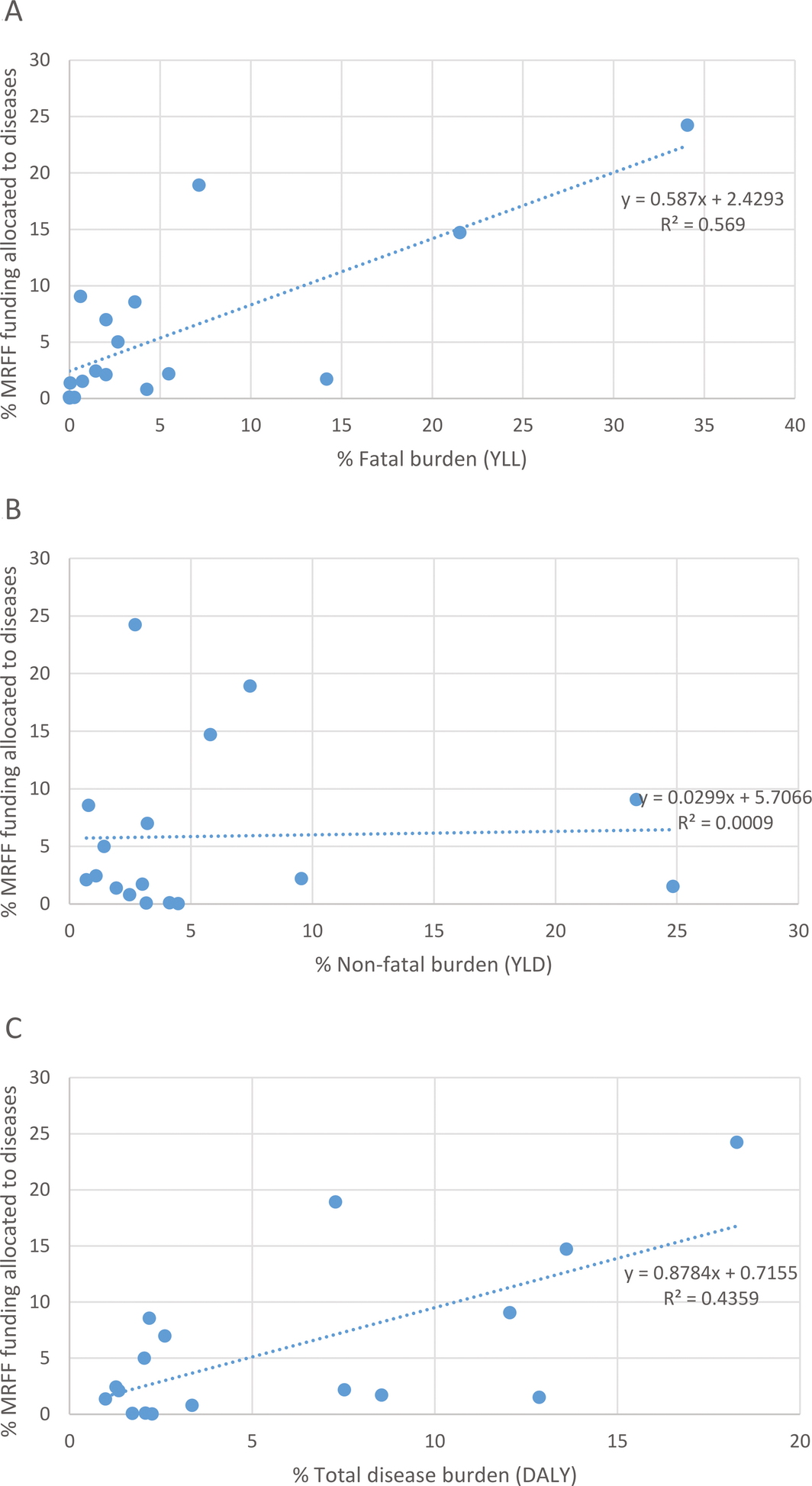
A: % MRFF funding allocated to disease v % fatal burden (years of life lost [YLL]) due to that disease in 2015. B: % MRFF funding allocated to disease v % non‐fatal burden (years lived with disability [YLD]) due to that disease in 2015. C: % MRFF funding allocated to disease v % total burden (disability‐adjusted life years [DALY]) due to that disease in 2015. There was a strong positive association between MRFF funding and death burden, a weaker association when both death and disability were considered, and no association with disability burden.
Competing interests
No relevant disclosures.
Acknowledgements
Christopher Maher and Rachelle Buchbinder are funded by NHMRC Research Fellowships. They are chief investigator or co‐investigator on multiple previous and current research grants from government agencies and charities in Australia and internationally. They have received travel expenses for speaking at conferences from the professional organisations hosting the conferences. They are investigators on the SHaPED trial which received heat wraps at no cost from Flexeze. The funding sources had no influence on any aspect of study design, data collection, analysis or interpretation, reporting or publication.
References
- Australian Department of Health. Medical Research Future Fund 10‐year plan. Canberra: Australian Government, 2019. https://www.health.gov.au/resources/publications/medical-research-future-fund-mrff-10-year-investment-plan (viewed Feb 2020).
- National Health and Medical Research Council. Outcomes of funding rounds. https://www.nhmrc.gov.au/funding/data-research/outcomes-funding-rounds (viewed Feb 2020).
- Federal Register of Legislation. Medical Research Future Fund Act 2015. https://www.legislation.gov.au/Details/C2015A00116 (viewed Feb 2020).
- Australian Institute of Health and Welfare. Australian Burden of Disease Study 2015: interactive data on disease burden. Canberra: AIHW, 2019. https://www.aihw.gov.au/reports/burden-of-disease/abds-2015-interactive-data-disease-burden/data (viewed Feb 2020).
- Australian Institute of Health and Welfare. Australian Burden of Disease Study: impact and causes of illness and death in Australia 2015 – summary report. Canberrar: AIHW, 2019. https://www.aihw.gov.au/getmedia/08eb5dd0-a7c0-429a-b35f-c8275e7a1dbf/aihw-bod-21.pdf.aspx?inline=true (viewed Feb 2020).
- Australian Institute of Health and Welfare. Australian Burden of Disease Study: methods and supplementary material 2015. Canberra: AIHW, 2019. https://www.aihw.gov.au/reports/burden-of-disease/australian-burden-disease-study-methods-2015/contents/table-of-contents (viewed Feb 2020).
- World Health Organization. International Statistical Classification of Diseases and Related Health Problems, 10th Revision. Geneva: WHO, 2016. https://icd.who.int/browse10/2016/en (viewed Feb 2020).
- National Health and Medical Research Council. Research funding statistics and data. https://www.nhmrc.gov.au/funding/data-research/research-funding-statistics-and-data (viewed Feb 2020).
- Aoun S, Pennebaker D, Pascal R. To what extent is health and medical research funding associated with the burden of disease in Australia? Aust N Z J Public Health 2004; 28: 80–86.
- Mitchell RJ, McClure RJ, Olivier J, Watson WL. Rational allocation of Australia’s research dollars: does the distribution of NHMRC funding by National Health Priority Area reflect actual disease burden? Med J Aust 2009; 191: 648–652. https://www.mja.com.au/journal/2009/191/11/rational-allocation-australias-research-dollars-does-distribution-nhmrc-funding
- Bourne AM, Whittle SL, Richards BL, et al. The scope, funding and publication of musculoskeletal clinical trials performed in Australia. Med J Aust 2014; 200: 88–91. https://www.mja.com.au/journal/2014/200/2/scope-funding-and-publication-musculoskeletal-clinical-trials-performed
- National Health and Medical Research Council. Funding schemes and calendar. https://www.nhmrc.gov.au/funding/funding-schemes-and-calendar?order=title&sort=desc (viewed Dec 2020).
- Australian Government Department of Health. Medical Research Future Fund: Snapshots 2019–20 to 2020–21. Canberra: Commonwealth of Australia, 2019. https://www.health.gov.au/sites/default/files/documents/2020/01/medical-research-future-fund-initiative-implementation-snapshots-report.pdf (viewed June 2020).
Linked content
-
MJA Podcast: Professor Christopher Maher
-
InSight+: Are we happy with the way the MRFF distributes funds?
Provenance: Not commissioned; externally peer reviewed.
Medical Colleges Have an Obligation to Ensure Full Participation in Clinical Quality Registries
Thomas J. Hugh
Getting on the Same Page: Why Australia Needs a National Maternity Early Warning System (MEWS) Chart
Briony A. Cutts, Lucy Bowyer, Nisha Khot, Sandra Lowe, Stefan C. Kane
Data for Equity: Can Linked Administrative Data Inform Pathways to More Equitable Child Health?
Sarah Gray, Shuaijun Guo, Meredith O'Connor, Elodie O'Connor, Katrina Williams, Hannah Badland, Susan Woolfenden, Josie Dickerson, Gerry Redmond, Marnie Downes, Sharon R. Goldfeld
Specialty College Selection: Why Change is Critical to Support a Future Rural Workforce
Matthew R. McGrail, Jenny May AM, Katherine Logan
Differentiated and simplified oral HIV pre‐exposure prophylaxis (PrEP) models hold the key to virtually eliminating HIV transmission in Australia by 2030
Tyson Arapali, Sarah Warzywoda, Anthony K J Smith, Curtis Chan, Timothy R Broady, Erin Sullivan, Catherine MacPhail, Mohamed A Hammoud, Alexander Dowell‐Day, Benjamin R Bavinton
The number of cancer‐related deaths that could be attributable to spatial disparities in survival in Australia, 2010–2019: a retrospective population‐based cohort study
Charlotte K Bainomugisa, Jessica Cameron, Paramita Dasgupta, Peter Baade