




Volume 210 - Issue 7
The runaway giant: ten years of the Better Access program
Authors: Sebastian P Rosenberg and Ian B Hickie
Med J Aust 2019; 210 (7): 299-301.e1. || doi: 10.5694/mja2.50068
Published online: 1 April 2019
Published online: 1 April 2019
Australia urgently needs a new and fairer approach to the provision of quality Medicare-funded psychological services
Australia urgently needs a new and fairer approach to the provision of quality Medicare‐funded psychological services
It is now more than 15 years since the Howard government first provided Commonwealth funding support for psychological interventions. First, in 2001, the Better Outcomes in Mental Health Care program responded specifically to the imbalance in care between medication‐based and psychological treatment options for common forms of anxiety or depression. The program had very attractive design features focusing on regional implementation, practitioner education, improved multidisciplinary care and funding for completed episodes of care. However, program funding was both capped and very limited (around $30 million per year).
By 2006, there was a groundswell of community and professional concern about lack of widespread and easy access to non‐medication‐based care.1 There was also advocacy by key professional groups to replace episode of care with simpler fee‐for‐service payments. Consequently, the Howard government's core commitment under the Council of Australian Governments National Action Plan for Mental Health 2006–2011 was to provide direct support for psychological services. Called the Better Access program, $538 million was initially set aside to enable Medicare‐subsidised access to services provided by psychologists and other allied health professionals. The impact of the Better Access program was to disassemble the various components of Better Outcomes, trading off the political advantages of increasing access against retaining a focus on improving quality and delivering better health and social outcomes. It also became an unrestricted program, with demand driving eventual expenditure.
Typically, the Better Access program requires that a general practitioner assess the eligibility of the person and, where appropriate, write a mental health treatment plan. The person and their plan is then referred to a relevant practitioner (typically a psychologist) for up to ten individual sessions of treatment in any calendar year. After these sessions, the patient is supposed to return to the GP for review. There is strong evidence supporting the use of treatments such as brief cognitive behavioural therapy for mild to moderate cases of anxiety and depression. The program also supports group therapy sessions but these are rarely provided.
Our examination of Medicare data (http://medicarestatistics.humanservices.gov.au/statistics/mbs_item.jsp) shows that the program far exceeded budgetary estimates — over $1.8 billion in the first 5 years, which is more than three times what had been originally allocated under the National Action Plan for Mental Health 2006–2011. From November 2006 to the end of the financial year 2016–17, Australia had spent almost $6 billion on 62 million services under the Better Access program. The program has grown every year over the decade. In 2016–17, it delivered 8.6 million services at a cost of $820 million, or $15.8 million every week (Box 1). In addition to these Medicare charges, it is common for service providers under Better Access to also charge patients out‐of‐pocket costs, which typically add around 25% to each occasion of service.2
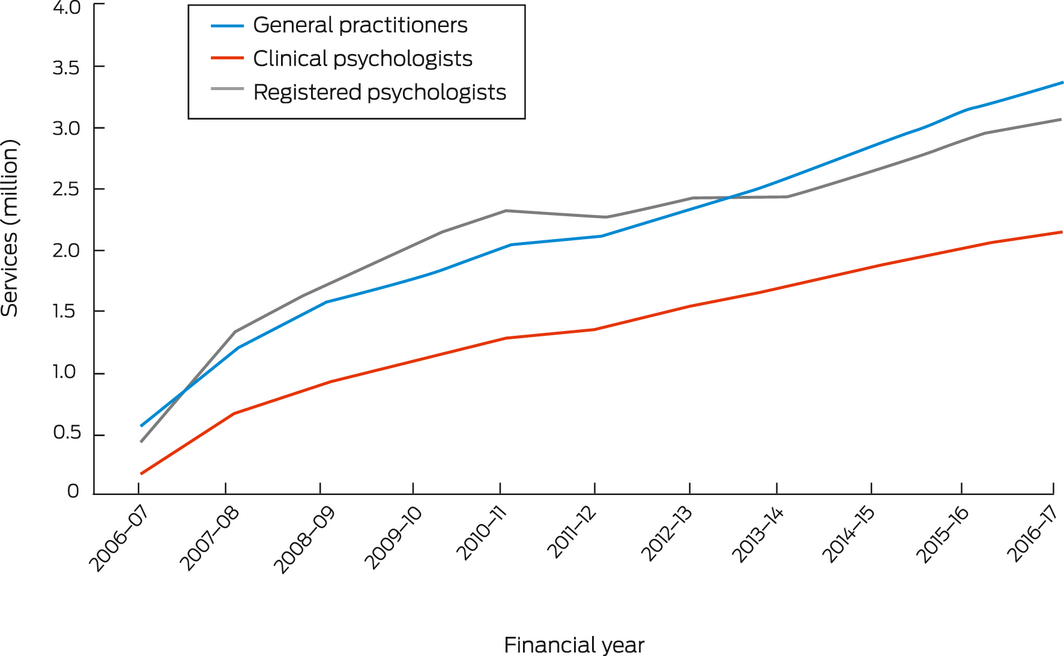
Box 2 shows that interventions by psychologists accounted for over half of all services provided (34% by registered psychologists and 24% by clinical psychologists), with the next largest group being GP services (38%). Only a further 4% of services were provided by occupational therapists or social workers. In 2016–17, GPs wrote 1.23 million mental health treatment plans, but only 456 506 plans were reviewed, meaning GPs are currently reviewing the outcomes of just over one‐third of all care plans. This review aspect of the Better Access model of care has never functioned properly.
The Better Access program has been formally evaluated once.3 A core component of this evaluation was the views of 883 consumers, selected by their own health professionals. This selection, while not random, concluded that the program was helpful.
Other independent research has indicated that the Better Access program has failed to address key service gaps and socio‐demographic challenges, particularly affecting people living in regional and rural areas.4,5 About 60% of all services under Better Access were provided to women in 2007–08 and this has remained unchanged. Young men aged 12–24 years comprised 7% of all Better Access service users in 2007–08 and 8% in 2016–17. Inequitable access on the basis of rurality and gender is a problem in Better Access, as it is with many health programs.
It has been suggested the program has driven a “remarkable” rise in the estimated population treatment rate for common mental disorders, from 37% in 2006–07 to 46% in 2009–10.6 Publicly available information makes this estimate difficult to verify. However, given the size of the investment, it would be remarkable if the rate of government‐supported access had not increased substantially. The program originally offered up to 18 individual therapy sessions per person annually. In 2011, the government reduced this to ten. Profession‐based advocacy groups expressed concern about this restriction.7 For less severe disorders, there is evidence that therapy of brief duration but higher intensity (frequency) is more likely to be effective than therapy spread over a longer period.8 Gaps clearly remain for those with more severe or enduring disorders (eg, eating disorders, major psychotic, bipolar and other mood disorders, comorbid substance misuse or personality disorders) who may benefit from more expert, prolonged or multidisciplinary care. Such less prevalent disorders were never the target of either Better Outcomes or Better Access.
While there is a need for much better evaluation of mental health programs overall, Better Access is emblematic. Its generosity reflects widespread community and political understanding of the imperative for fundamental reform and significant new investments in mental health. It is still the case that mental health receives 7.7% of the total health budget while accounting for 12% of the burden of disease.9 Without investments like Better Access, the proportion of mental health to total health spending would have declined. Nevertheless, the program represents Australia's willingness over the past two decades to “fix” mental health by prioritising increased access over systems that promote enhanced quality or monitor health or functional outcomes. Better Access continues to operate with little or no accountability at the practitioner or national policy level. Issues around poor accountability for mental health are well understood.10
Australia should address this policy problem at two levels. The first relates to the model of funding which underpins Better Access. There is good reason to consider shifting away from the sole practitioner model of mental health care perpetuated by fee‐for‐service models (like Better Access) and towards more multidisciplinary approaches typically associated with quality mental health care.11 These approaches have been identified12 and are emerging in Australia13 and, beyond access, emphasise a range of quality and functional outcomes. For example, while a psychologist may focus on issues concerning cognitive behaviour, the addition of social work and vocational support to a treating team means a person with more complex issues can also access housing and employment support. Particularly for people with more complex problems, a rebalancing of our service system away from reliance on individual clinicians and towards more multidisciplinary approaches is likely to deliver better care.
The National Mental Health Commission supported this shift, suggesting “cashing out” some activities. This would involve local health planners getting access to fee‐for‐service and other program payments in advance. Such an approach would target people with, or at risk of, very high needs. So as to build new and more multidisciplinary services, Primary Health Networks and their state‐funded local health district counterparts would pool these funds in order to design and purchase packages of care, with the aim of keeping people well and in the community.14 The concept has been further articulated by primary care networks15 but no such option has yet emerged in practice. Again, key professional groups are not supportive of cashing out.7
The second key reform Australia should undertake, at a broader systemic level, is to finally fulfil the promise made in the first national mental health plan back in 1992, to make accountability for mental health central to a system of quality improvement. In addition to considering the issue of access to care, and unlike our current outcome‐blind predicament, this system would necessarily reflect information in relation to the quality of services provided as well as the health, social and functional outcomes achieved. Such a system requires the development of a suite of validated and patient‐centred measures, routinely collected, and incorporating best use of information technology tools.16
A report prepared for the Western Australian Mental Health Commission shows how this could happen, through the development of a quality assurance framework and an outcomes‐based set of standards in mental health.17 These tools reflect and report on the things that matter to consumers beyond health — good housing, employment, education, social connection, a contributing life. Perhaps this will be part of the broader accountability remit promised to the National Mental Health Commission by the federal government.
More than a decade since it was implemented, the Better Access program should be redeveloped to maximise its benefit. This means considering more than just lifting the rate of access to care. A more intelligent response to mental illness means taking a broader view about how best to arrange quality care and then properly assessing the impact of that care on a person's life.
Box 1 – Better Access program: number of services and Medicare benefits paid, 2012–2017
|
Financial year of service |
Services (million) |
Medicare benefits paid ($ million) |
|||||||||||||
|
|
|||||||||||||||
|
2012–13 |
6.3 |
594.9 |
|||||||||||||
|
2013–14 |
6.7 |
639.1 |
|||||||||||||
|
2014–15 |
7.4 |
704.3 |
|||||||||||||
|
2015–16 |
8.1 |
773.4 |
|||||||||||||
|
2016–17 |
8.6 |
819.9 |
|||||||||||||
|
Total |
37.1 |
3531.6 |
|||||||||||||
|
|
|||||||||||||||
|
|
|||||||||||||||
Box 2 – Better Access program: total services, 2006–2017, by key profession*
Medicare item numbers included in this analysis: clinical psychologists: 80000, 80005, 80010, 80015, 80020; GPs: 170, 171, 172, 2574, 2575, 2577, 2578, 2700, 2701, 2702, 2704, 2705, 2707, 2708, 2710, 2712, 2713, 2715, 2717, 2719, 2721, 2723, 2725, 2727, 20104; registered psychologists (and other allied health professionals): 10956, 10968, 80100, 80105, 80110, 80115, 80120, 80125, 80130, 80135, 80140, 80145, 80150, 80155, 80160, 80165, 80170, 81325, 81355, 82000, 82015. ◆
Competing interests
Ian Hickie is a former commissioner on the National Mental Health Commission.
References
- Mental Health Council of Australia. Not for service: experiences of injustice and despair in mental health care in Australia. Canberra: MHCA, 2005. https://www.humanrights.gov.au/sites/default/files/content/disability_rights/notforservice/documents/NFS_Finaldoc.pdf (viewed Feb 2019).
- Australian Government Department of Health. MBS mental health data by PHN. http://www.health.gov.au/internet/main/publishing.nsf/Content/PHN-Mental_Health_Data (viewed Nov 2018).
- Pirkis J, Harris M, Hall W, et al. Evaluation of the Better Access to Psychiatrists, Psychologists and General Practitioners through the Medicare Benefits Schedule Initiative: summative evaluation. Final report. Melbourne: Centre for Health Policy, Programs and Economics, University of Melbourne, 2011. https://www.health.gov.au/internet/main/publishing.nsf/content/5F330C940AFDB767CA257BF0001DE702/$File/sum.pdf (viewed Apr 2018).
- Byles JE, Dolja‐Gore X, Loxton DJ, et al. Women's uptake of Medicare Benefits Schedule mental health items for general practitioners, psychologists and other allied mental health professionals. Med J Aust 2011; 194: 175–179. https://www.mja.com.au/journal/2011/194/4/womens-uptake-medicare-benefits-schedule-mental-health-items-general
- Meadows G, Enticott J, Inder B, et al. Better access to mental health care and the failure of the Medicare principle of universality. Med J Aust 2015; 202 (4): 190–194. https://www.mja.com.au/journal/2015/202/4/better-access-mental-health-care-and-failure-medicare-principle-universality
- Whiteford H, Buckingham W, Harris M, et al. Estimating treatment rates for mental disorders in Australia. Aust Health Rev 2014; 38: 80–85.
- Australian Psychological Society. Supplementary submission (no. 60) on mental health to the Senate Select Committee on Health. September 2014. https://www.aph.gov.au/Parliamentary_Business/Committees/Senate/Health/Health/Submissions (viewed Feb 2019).
- Cuijpers P, Huibers M, Ebert D, et al. How much psychotherapy is needed to treat depression? A metaregression analysis. J Affect Disord 2013; 149: 1–13.
- Australian Institute of Health and Welfare. Mental health services in Australia. https://www.aihw.gov.au/reports/mental-health-services/mental-health-services-in-australia/report-contents/summary (viewed Mar 2019).
- Rosenberg S, Salvador‐Carulla L. Accountability for mental health: the Australian experience. J Ment Health Policy Econ 2017; 20: 37–54.
- National Institutes of Medicine. Improving the quality of health care for mental and substance‐abuse conditions. Washington, DC: National Academies Press, 2006.
- Senate Select Committee on Mental Health. A national approach to mental health – from crisis to community. Canberra: Commonwealth of Australia, 2006 https://www.aph.gov.au/Parliamentary_Business/Committees/Senate/Former_Committees/mentalhealth/report/index (viewed Feb 2019).
- Hamilton M, Hetrick S, Mihalopoulos C, et al. Identifying attributes of care that may improve cost‐effectiveness in the youth mental health service system. Med J Aust 2017; 207 (10 Suppl): S27–S37. https://www.mja.com.au/journal/2017/207/10/identifying-attributes-care-may-improve-cost-effectiveness-youth-mental-health
- National Mental Health Commission. Contributing lives, thriving communities – report of the National Review of Mental Health Programmes and Services. Sydney: NMHC, 2014. http://mentalhealthcommission.gov.au/our-reports/our-national-report-cards/2014-contributing-lives-review.aspx (viewed Feb 2019).
- WentWest Primary Health Network. High performing mental health in primary care: options for system and funding innovation. Sydney: WentWest, 2015. https://www.wentwest.com.au/content/documents/resources/submissions/MH_Review_Paper.pdf (viewed Feb 2019).
- Kilbourne AM, Beck K, Spaeth‐Rublee B, et al. Measuring and improving the quality of mental health care: a global perspective. World Psychiatry 2018; 17: 30–38.
- Western Australian Mental Health Commission. Mental health outcomes: indicators and examples of evidence. Perth: Government of Western Australia. https://www.mhc.wa.gov.au/media/1662/mh-outcomes-indicators-and-examples-of-evidence-final.pdf (viewed Sept 2018).
Provenance: Not commissioned; externally peer reviewed.
Co-Designed Best Practice Principles for the Care of Fathers and Non-Birthing Parents Exposed to Perinatal Trauma: A Participatory Action Research Study
Alka Kothari, Dale Trevor, Glen Quinn, Jane Geltch, Joel Dulhunty, Helen Skouteris, Leonie K. Callaway
Reorienting Allied Health Into Community-Based Care for People Experiencing Trauma and Social Disadvantage
Simon Rosenbaum, Grace McKeon, Gulsah Kurt, Oscar Lederman, Kemi Wright, Sabuj Kanti Mistry, Jackie E. Curtis, Philip B. Ward, Zachary Steel, Hamish Fibbins, Rachel Morell, Melissa C. Eaton, Andrew Watkins, Ben Harris-Roxas, Brendan Goodger, Eleanor Beck, Megan Teychenne, Joseph Firth, Davy Vancampfort, David Burns, Russell Roberts, Tristan Favaloro, Danielle Weber, Rosanna Barbero, Vasili Maroulis, Melissa Holmes, Stefan Mackenzie, Chiara Mastrogiovanni, Afsana Anwar, Uzma Choudhry, Catherine Sherrington, Jane Currie, Thomas Gadsden, Scott Teasdale
Stigmatising Attitudes Towards People With Depression, Bipolar Disorder, Borderline Personality, ADHD and Early and Long-Term/Untreated Schizophrenia: Representative Survey of Australian Adults
Amy J. Morgan, Anna M. Ross, Gayle McNaught, Rachel Green, Nicola J. Reavley
Psychosocial Hazards for Healthcare Workers: Supporting the Second Victim Also Helps the Primary Victims
Sarah Michael
Supporting Population Mental Health in the Wake of Mass Tragedies
Susan J. Rees, Derrick M. Silove