




Volume 209 - Issue 8
Bilateral primary meningococcal conjunctivitis in an Indigenous child
Authors: James Sterrey, Farshad Abedi and Tim RM Henderson
Med J Aust 2018; 209 (8): 370. || doi: 10.5694/mja18.00415
Published online: 15 October 2018
Published online: 15 October 2018
To the Editor:
Primary meningococcal conjunctivitis (PMC) is a rare presentation of Neisseria meningitidis.1 Before antibiotics, N. meningitidis conjunctivitis was a recognised harbinger of cerebrospinal meningitis due to systemic infection.1-3 Secondary N. meningitidis conjunctivitis is now uncommon.1
PMC seeds exogenously from mucosal secretions, causing a primary infection of the ocular surface without systemic infection,4 and it is characterised by purulent conjunctivitis and periorbital oedema.3,4 Untreated PMC spreads systemically in 10–18% of cases,1,3,5 and early diagnosis is essential to prevent visual loss and life-threatening complications.1,3,5
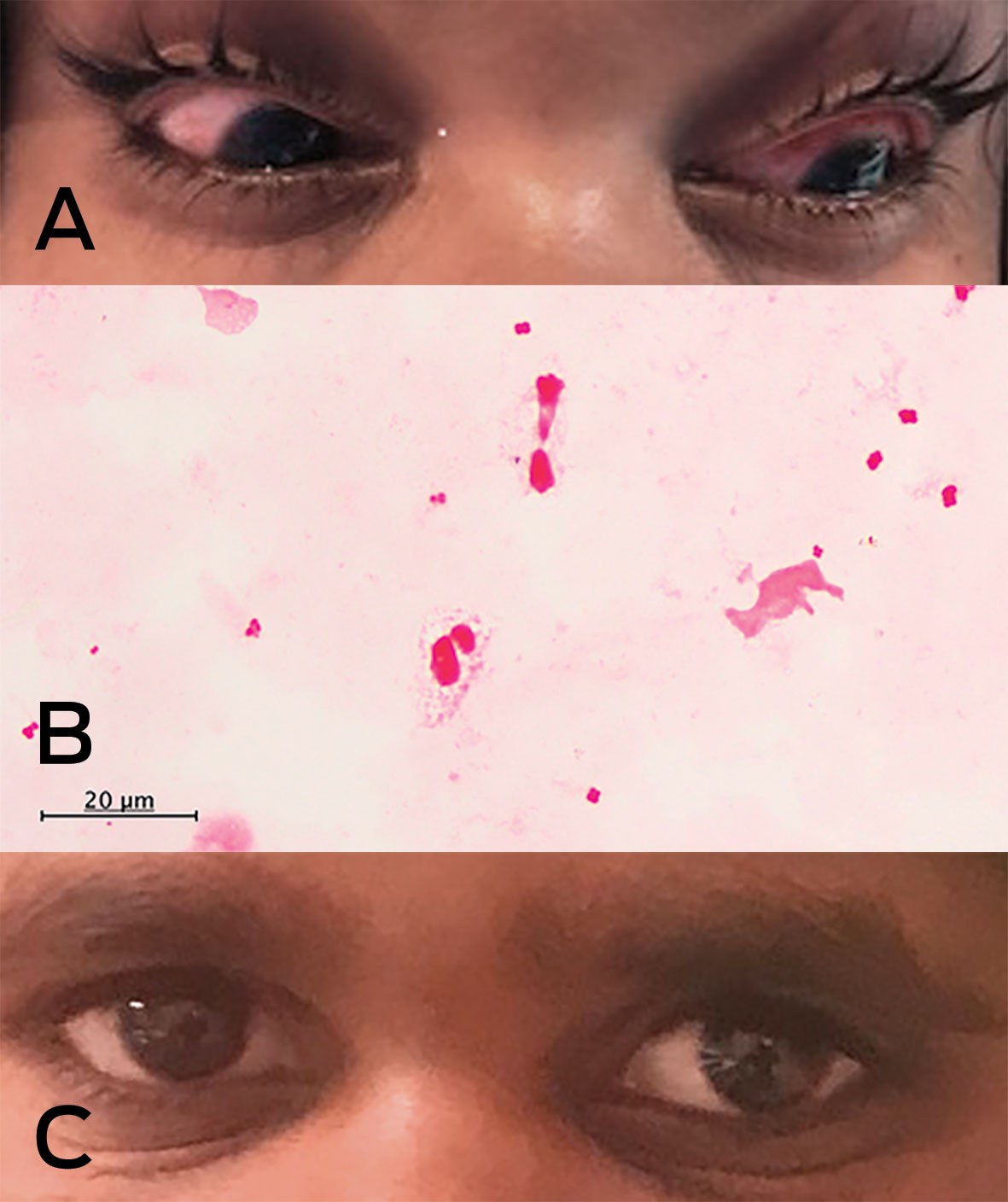
In September 2017, the Northern Territory experienced an outbreak of N. meningitidis serogroup W strain. Presentations were atypical and, consequently, the threshold was low for empirical treatment. We report the case of a 4-year-old girl who presented to a remote clinic with a 24-hour history of rapidly progressive pain, erythema and discharge from both eyes. Her medical history was unremarkable. She had bilateral conjunctival injection with profuse yellow mucopurulent discharge (Box, A). Systemic examination was unremarkable. Considering the meningococcal outbreak, conjunctival swabs were sent for urgent Gram stain, which showed gram-negative diplococci with characteristic N. meningitidis appearance (Box, B). Ceftriaxone and topical ofloxacin were commenced as empirical meningococcal treatment. Ocular culture and polymerase chain reaction (PCR) were positive for N. meningitidis-W. Three blood cultures and serum PCR were negative. After 48 hours, the purulent discharge and eye pain resolved. On Day 4 of treatment, her conjunctivae normalised and she was asymptomatic (Box, C). Her family members received prophylactic treatment with ciprofloxacin. She was discharged from hospital on Day 6 and had an unremarkable follow-up.
To our knowledge, this is the first reported case of N. meningitidis-W PMC. Since presentations of PMC in contemporary society are rare,1,3,4 clinicians may overlook PMC as a differential diagnosis to the patient’s detriment.
Given the highly virulent nature of the N. meningitidis-W, the importance of early treatment and contact tracing is paramount, so that antimicrobial prophylaxis can be offered to close patient contacts, especially direct household members. To preserve vision and prevent systemic infection, a high suspicion of atypical microorganisms must be entertained, especially during an outbreak.
Competing interests
No relevant disclosures.
Acknowledgements
We acknowledge the assistance of the patient’s mother and clinic staff at Engawala. We also thank Brooke Taylor, from the Royal Darwin Hospital Pathology department, for assisting with Gram stain images.
References
- Barquet N, Gasser I, Domingo P, et al. Primary meningococcal conjunctivitis: report of 21 patients and review. Rev Infect Dis 1990; 12: 838-847.
- Lazar NK. Early ocular complications of epidemic meningitis. Arch Ophthalmol 1936; 16: 847-856.
- Odegaard A. Primary meningococcal conjunctivitis followed by meningitis and septicemia. NIPH Ann 1983; 6: 55-57.
- Orden B, Martínez R, Millán R, et al. Primary meningococcal conjunctivitis. Clin Microbiol Infect 2003; 9: 1245-1247.
- Kaye SB, Molyneux EM, Zala D, Hart CA. Meningococcal conjunctivitis. Eye 1990; 4: 861-862.
A Diagnostic Headache
Thomas Glynn, Michelle T. Leech, Stacy K. Goergen, Emily Lin, Nadeem Toodayan, Ralph Junckerstorff
Neisseria meningitidis: an uncommon cause of conjunctivitis
Chloe Story, Tina Marinelli, Simeon Crawford, Amrita Ronnachit
Dismantling barriers to research and clinical care for individuals with a vision impairment
Eden G Robertson, Kate Hetherington, Meredith Prain, Julia Hall, Leighton Boyd AM, Rosemary Boyd OAM, Emily Shepard, Hollie Feller, Sally Karandrews, Fleur O'Hare, Kanae Yamamoto, Matthew P Simunovic, Robyn V Jamieson, Alan Ma, Lauren Ayton AM, Anai Gonzalez‐Cordero
The New South Wales Pharmacy Trial for herpes zoster: on the nose?
Christian P Pappas, Timothy R Holmes, Minas T Coroneo
Skin fragility disorder misdiagnosed as child abuse: a cautionary tale
Heather G Mack, Fred K Chen, John R Grigg
Health economic aspects of inherited retinal diseases: looking for cost‐effective treatments
Benjamin Kamien, Rachael Heath Jeffery, Fred K Chen