




Reflection
Medical history
Volume 209 - Issue 8
Fifty years of RhD immunoglobulin (anti-D) therapy in Australia: celebrating a public health success story
Authors: James Thyer, Janet Wong, Amanda Thomson, Barbara Bell, Catherine Hyland and Daniel Challis
Med J Aust 2018; 209 (8): 336-339. || doi: 10.5694/mja17.01144
Published online: 15 October 2018
Published online: 15 October 2018
In 2017, Australia celebrated the 50th anniversary of the anti-D program, which uses the plasma of special donors to protect the babies of millions of Australian women
In 2017, Australia celebrated the 50th anniversary of the anti-D program, which uses the plasma of special donors to protect the babies of millions of Australian women
At the 11th Congress of the International Society of Blood Transfusion held in Sydney in 1966, researchers from Liverpool1 and New York2 announced the first successful trials of Rhesus (Rh) D immunoglobulin (Ig) — or anti-D — derived from human plasma to prevent the effects of RhD blood group incompatibility between an RhD-negative mother and an RhD-positive baby. Antibodies generated from alloimmunisation may cross the placenta in subsequent pregnancies and cause haemolytic disease of the fetus and newborn (HDFN). The haemolysis of the baby’s red cells may result in anaemia and jaundice, and in severe cases brain damage or death of the baby. The researchers in 1966 had found that the Ig fraction from the plasma of women who had had this reaction, when injected into at-risk mothers immediately after the first birth, acted as a passive vaccine by preventing this immunisation reaction and protecting subsequent births. Attending the conference, Dr Gustav Nossal of the Walter and Elisa Hall Institute said: “We do not often have the privilege to be present at the beginning of one of the revolutions of medicine”.3
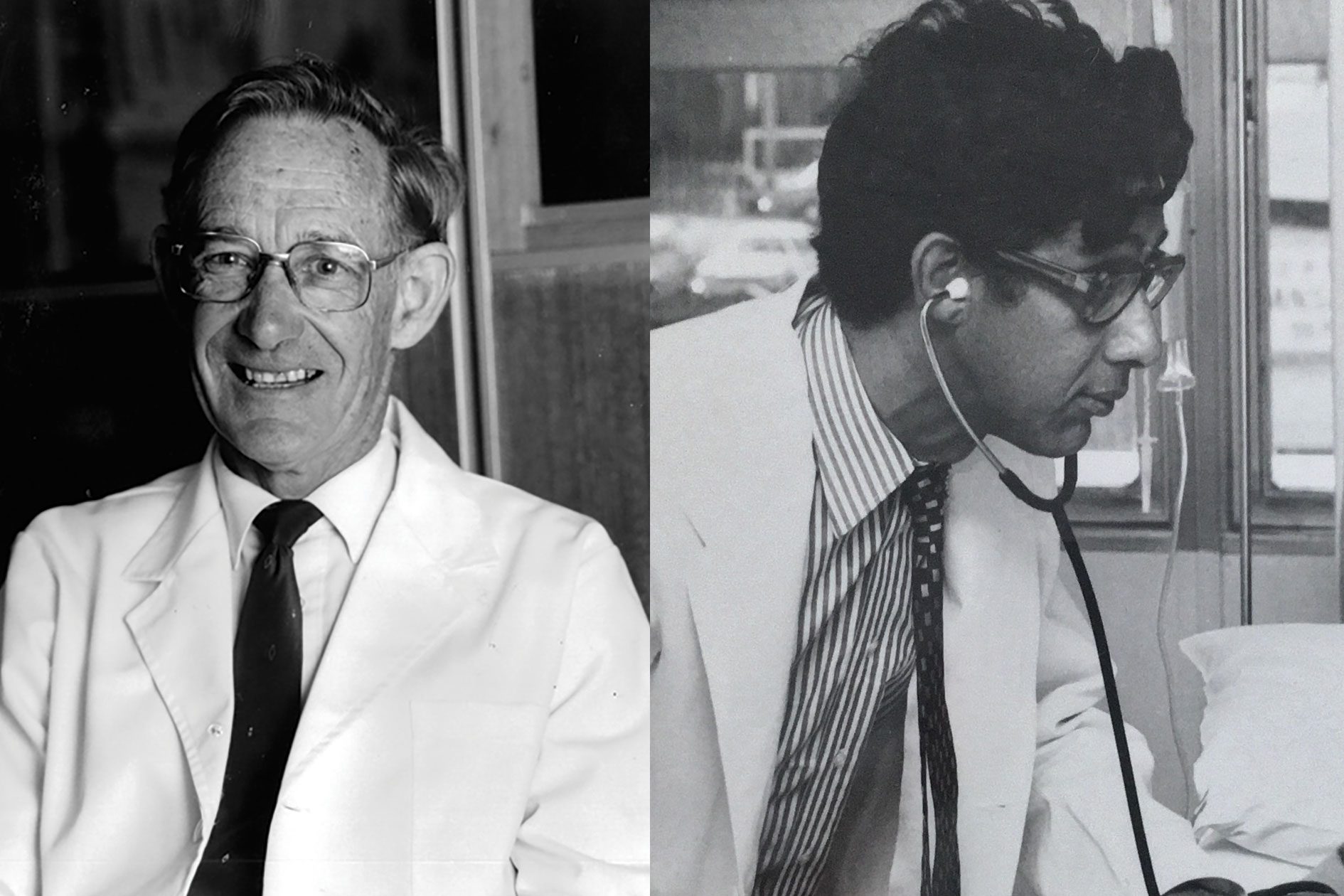
Extrapolating birth rate statistics and data from New South Wales4 and Victoria5 nationally, about 250 stillbirth and neonatal deaths from HDFN would have occurred annually in 1967, with many more babies affected by morbidity. At the time, treatment options were limited to exchange transfusion of RhD-negative blood in affected neonates (Box 1), which had begun in Australia in 1946, and to intrauterine exchange transfusions, which commenced in 1967.6 Soon after the Congress, state-based Red Cross Blood Transfusion Services, first in NSW and then in Western Australia under directors Dr Gordon Archer and Dr Martin Davey respectively (Box 2), began identifying individuals who would be suitable as donors of RhD Ig. Initially, these included RhD-negative women who had been immunised and formed anti-D to their RhD-positive babies, and men who had formed anti-D following RhD-positive transfusion.
Later, RhD-negative men and postmenopausal women were recruited to be deliberately immunised to form anti-D by receiving injections of RhD-positive red cells. To keep their anti-D levels sufficiently high, all the donors received regular “boosting” injections of 1–10 mL of RhD-positive red cells at 5-weekly intervals. The boosting cells were provided by seven RhD-positive red cell donors who were carefully chosen to minimise the risk that they carried serum hepatitis, later known as hepatitis B. Some staff of the NSW Red Cross Blood Transfusion Service, including Dr Archer, voluntarily received injections of these red cells to ensure their safety for immunising donors. Australia’s RhD Ig immunisation program began in August 1967.
RhD Ig was produced from the plasma of the immunised donors by Cohn fractionation at the Commonwealth Serum Laboratories (CSL), initially under the direction of Dr Roy Simmons and later under medical officer and head of research and development Dr Peter Schiff.
In a remarkable achievement, by 1969 Australia became the first country to be self-sufficient in RhD Ig.7 RhD-negative women received a dose of 250 μg following the delivery of an RhD-positive baby.8 This was sourced from a group of 195 donors in NSW and 161 donors in Western Australia; one-third female and two-thirds immunised males, at first using an exacting manual plasmapheresis process which became automated in the early 1980s. Dr Baden Cooke, previously a country general practitioner and obstetrician who had seen the devastating effects of HDFN first hand, became the first medical officer in charge of the Rh program in NSW.
Short supply — the 1980s and 1990s
By 1984, many of the original donors were reaching retirement age, and it became clear that recruitment of new donors was needed. The human immunodeficiency virus crisis saw all boosting of the anti-D plasma donors postponed until after the HIV test was introduced in April 1985. In 1987, a research project commenced under Dr Anne Fletcher with the aim of producing a human monoclonal anti-D, which it was postulated might be able to substitute for plasma-derived RhD Ig. While the research found potentially promising monoclonal antibodies, commercial backers could not be found for the extensive clinical trials needed. Plasma donors would continue to be the only source of RhD Ig. In 1995, Australia began experiencing shortages of RhD Ig because of declining anti-D titres in donated plasma, necessitating the importation of a product to supplement local supply until August 1997.
Australian RhD Ig continues to be produced by CSL and has an excellent safety record. This is likely due to careful donor selection, the good safety record of Cohn fractionation of Igs, and the later introduction of dedicated viral inactivation/reduction steps to the process. All RhD-positive red cells that are used to immunise or boost the RhD-negative plasma donors are frozen for a minimum of 12 months before administration, and the red cell donors undergo infectious disease testing during this time. Extended phenotyping is performed on the red cells to enable careful matching of the red cell donor and plasma donor blood groupings for ABO, Kell and other common clinically significant antigens. Wherever possible, each anti-D plasma donor receives red cells from only a very limited number of donors.
Self-sufficient again — 2006
In 1999, National Health and Medical Research Council guidelines recognised that in addition to a postpartum dose of RhD Ig (625 IU [125 μg]), routine antenatal prophylaxis was regarded as best practice but could not be recommended at the time owing to supply constraints.9 A staged implementation of routine antenatal prophylaxis began in 2002, with 625 IU RhD Ig being given to all RhD-negative pregnant women with no preformed anti-D at 28 and 34 weeks’ gestation. A number of measures made this possible, including short term supply augmentation with imported product from November 2002 until March 2006, expansion of the anti-D plasma collection program and introduction of a 250 IU dose of RhD Ig for sensitising events in the first trimester. Full implementation of routine antenatal prophylaxis was achieved in 2006 when Australia once again became self-sufficient. As the current Australian product is registered only for intramuscular use, a very small quantity of an intravenous formulation of RhD Ig is imported (0.1% of annual usage) for use in the management of large fetomaternal haemorrhage.
Celebrating 50 years — 2017
Many of the anti-D donor panel have made hundreds of donations (Box 3). One donor, James Harrison, donated to the program from inception 50 years ago, until his final, 1173rd donation on 11 May 2018. It is estimated that over the course of the program, about 2 million women have been treated with RhD Ig, and 3 million doses of RhD Ig have been issued. With the success of the RhD Ig program, alloimmunisation to other red cell antigens such as RhE, Rhc and Kell is now more common than RhD alloimmunisation as a cause of HDFN.10 The occasional cases of RhD alloimmunisation in pregnancy that still occur are likely due to chronic transplacental haemorrhage, failure to administer RhD Ig at times of increased risk, or administration of an insufficient dose.
There are now very few deaths due to HDFN recorded in Australian health statistics. Records from Victoria5 during the period 1965 to 2016 show that death from HDFN has declined from 1.1 per 1000 births before the introduction of the RhD program and intrauterine transfusion to an average of 0.01 per 1000 births since the year 2000 (Box 4).
The future
The efficacy of monoclonal anti-D preparations is as yet unproven clinically; however, a French phase 2 safety and efficacy clinical trial of roledumab in RhD-negative women carrying an RhD-positive baby was completed in September 2017, with results yet to be published. We continue to be highly dependent on the dedicated group of anti-D plasma donors, who now number around 130 men and women nationally, to supply Australia’s RhD Ig requirements.
It is now possible to predict the fetal RhD blood group from a maternal blood sample using non-invasive fetal RHD genotyping. The feasibility of routinely introducing this testing within the Australia context is currently under evaluation. It is estimated that this could result in 34–38% of RhD negative women avoiding the need for antenatal RhD Ig prophylaxis, as they are carrying an RhD-negative baby and are therefore not at risk of becoming immunised. This would have a favourable impact on the future supply needs for RhD Ig and improve the utilisation of this valuable “gift of life”.
A great achievement
Australia’s RhD immunisation program is a great tribute to the dedicated donors who have provided plasma for the program and red cells for boosting over the five decades of its history. It is also a credit to the many clinicians, scientists and coordinators who have managed the program. HDFN resulting from RhD alloimmunisation is now rare in Australia. Sir Gustav Nossal was right — Rh immunoprophylaxis truly has been a revolution in medicine.
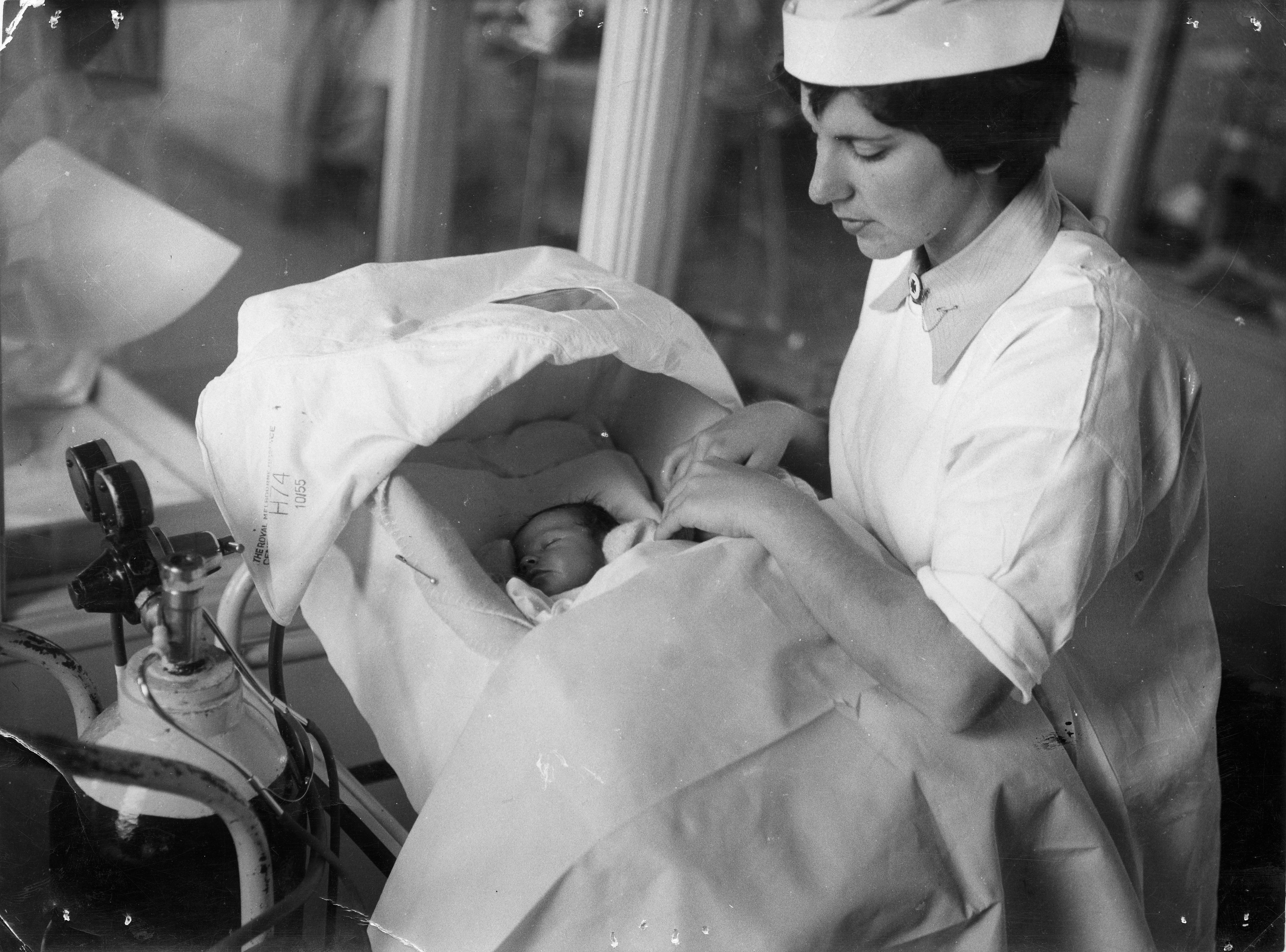
Box 1 – Monitoring an “Rh baby” brought to Queen Victoria Hospital, Melbourne, for a blood transfusion in the 1950s, when neonatal exchange was the only treatment for haemolytic disease of the fetus and newborn
Box 2 – Gordon Archer (left) and Martin Davey, directors of the New South Wales and Western Australian Red Cross Blood Transfusion Services, respectively, began the RhD program in 1967, with Davey becoming the national coordinator
Box 3 – New South Wales-based anti-D donors celebrating the 50th anniversary of the RhD program in August 2017 — Australia’s 130 anti-D donors were invited to events in Sydney, Perth, Adelaide and Brisbane

Box 4 – Rates of death from haemolytic disease of the fetus and newborn (HDFN) and perinatal mortality rate in Victoria, 1965–2016
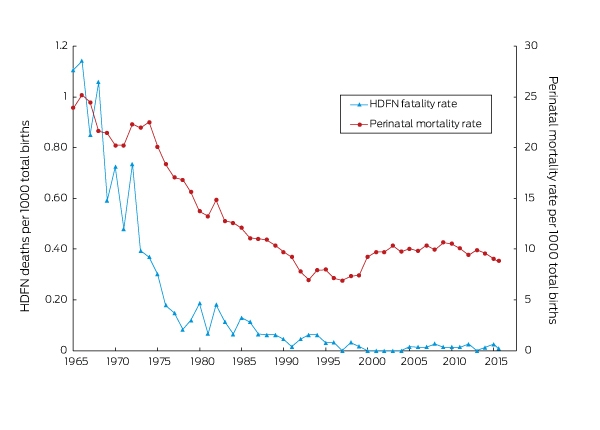
Source: Consultative Council on Obstetric and Paediatric Mortality and Morbidity.5 The anti-D program with post-natal prophylaxis began in Australia in 1967, and intrauterine transfusion was also introduced. A staged implementation of antenatal, in addition to post-natal, prophylaxis occurred from 2002 to 2006.
Competing interests
No relevant disclosures.
Acknowledgements
Australian governments fund the Australian Red Cross Blood Service to provide blood, blood products and services to the Australian community. Dr Sophie Treleaven of the Consultative Council on Obstetric and Paediatric Mortality and Morbidity (Victoria) provided extensive data. Ms Robyn Barlow and Dr Anne Fletcher kindly provided historical advice and materials.
References
- Finn R, Clarke CA. The prevention of Rhesus haemolytic disease. Bibl Haematol 1968; 29: 225-230.
- Gorman JG, Freda VJ, Pollack W. Prevention of Rh isoimmunization with anti-Rh gamma G globulin clinical trial on mothers. Bibl Haematol 1968; 29: 273.
- Nossal G. Prevention of Rh haemolytic disease: a report of a round-table discussion on August 26, 1966, at the XIth Congress of the International Society of Blood Transfusion in Sydney Australia. Bulletin of the Post-Graduate Committee in Medicine, University of Sydney 1967; 23: 47.
- Cortiula M. Banking on blood: a history of the Australian Red Cross New South Wales Transfusion Service. Walcha: Ohio Publications, 2001.
- Consultative Council on Obstetric and Paediatric Mortality and Morbidity. Annual reports 1965–2016. https://www2.health.vic.gov.au/hospitals-and-health-services/quality-safety-service/consultative-councils/council-obstetric-paediatric-mortality/mothers-babies-children-report (viewed Aug 2018).
- Pearn JH. Erythroblastosis fetalis – the discovery and partial elimination of rhesus incompatibility – the origins of exchange transfusion in Australia. Pathology 1994; 26: 176-182.
- Davey MG. Rh Project in Australia since 1967. Tenth Anniversary 1967-1977 Rh Project. NSW Red Cross Blood Transfusion Service, 1977.
- Davey MG. Prevention of rhesus immunization in Australia: the first seven years. Med J Aust 1975; 2: 263-267.
- National Blood Authority. Guidelines on the prophylactic use of Rh D immunoglobulin (anti-D) in obstetrics. Canberra: NBA, 2003. https://www.blood.gov.au/system/files/documents/glines-anti-d.pdf (viewed Aug 2017).
- Pal M, Williams B. Prevalence of maternal red cell alloimmunisation: a population study from Queensland, Australia. Pathology 2015; 47: 151-155.
Provenance: Not commissioned; externally peer reviewed.
Splenic injury in severe cases of the zoonoses Q fever and rickettsial infection: diagnostic challenges
Ashleigh Drury, Philippa Harrison, Aiveen Bannan
Health and economic benefits of improving pre‐hospital identification of stroke in Australian women: a modelling study
Thomas Gadsden, Lei Si, Emily R Atkins, Cheryl Carcel, Xia Wang, Stephen Jan, Mark Woodward, Laura E Downey
Updating the diagnosis and management of elevated serum ferritin levels in the era of routine ferritin testing of blood donors by Australian Red Cross Lifeblood
Gary D Zhang, James Chen, Daniel M Johnstone, Martin B Delatycki, Katie Allen, John K Olynyk
Early cardiovascular collapse after envenoming by snakes in Australia, 2005–2020: an observational study (ASP‐31)
Geoffrey K Isbister, Katherine Z Isoardi, Angela L Chiew, Shane Jenkins, Nicholas A Buckley
Updated recommendations for warfarin reversal in the setting of four‐factor prothrombin complex concentrate
Danielle Robinson, James McFadyen, Eileen Merriman, Chee Wee Tan, Ross Baker, Huyen Tran
Updating the diagnosis and management of iron deficiency in the era of routine ferritin testing of blood donors by Australian Red Cross Lifeblood
Gary D Zhang, Daniel Johnstone, Michael F Leahy, John K Olynyk