




Volume 209 - Issue 8
Australia is responding to the complex challenge of overdiagnosis
Authors: Ray Moynihan, Alexandra L Barratt, Rachelle Buchbinder, Stacy M Carter, Thomas Dakin, Jan Donovan, Adam G Elshaug, Paul P Glasziou, Christopher G Maher, Kirsten J McCaffery and Ian A Scott
Med J Aust 2018; 209 (8): 332-334. || doi: 10.5694/mja17.01138
Published online: 15 October 2018
Published online: 15 October 2018
Effective responses in policy and practice are essential to manage overdiagnosis and the sustainability of the health system
An Australian alliance of clinical, consumer, research and public organisations is emerging to tackle overdiagnosis
Overdiagnosis is now a health challenge recognised across many nations.1 Debates about its definition continue, but in short, overdiagnosis happens when health systems routinely diagnose people in ways that do not benefit them or that even do more harm than good.2 Overdiagnosis is unwarranted diagnosis, leading to harms from unnecessary labels and treatments and to the waste of health care resources that could be better spent dealing with genuine needs. To manage overdiagnosis and the sustainability of the health system more broadly, reversing the harm of too much medicine is becoming a health care priority, demanding effective responses in policy and practice. In Australia, a new alliance is developing a national plan to deal with this problem.
While research on the size of the problem continues, a group convened by the National Cancer Institute in the United States has concluded that “overdiagnosis is common”,3 and it has been described as a “modern epidemic”.4 In 2016, for example, researchers estimated that over 500 000 people may have been overdiagnosed with thyroid cancer across 12 nations over two decades.5 An ongoing series of articles6 has raised concerns about overdiagnosis across a wide range of conditions, including pulmonary embolism, attention deficit/hyperactivity disorder and pre-diabetes. While overdiagnosis is but one driver of the wider problem of too much unsafe, ineffective and inappropriate care,7 early evidence from Australian research suggests that too many people are also receiving diagnoses unlikely to benefit them.8
Internationally, there are growing numbers of initiatives to respond to overdiagnosis. The Overdiagnosis Working Group from the Guidelines International Network is now tackling the problem of inappropriately widened disease definitions — regarded as a key driver of the problem (www.g-i-n.net). In August 2018, Danish general practitioners held the 6th International Scientific Conference on Preventing Overdiagnosis (www.preventingoverdiagnosis.net), while in the United Kingdom, a standing group from the Royal College of General Practitioners is already addressing overdiagnosis.9 In Québec, Canada, a province-wide plan to raise awareness about and reduce overdiagnosis is being driven by the Québec Medical Association.10 Related but separate initiatives include Choosing Wisely, which lists overused interventions in over 20 nations (www.choosingwisely.org), and the Right Care Alliance in the United States (https://rightcarealliance.org), which is working to reduce overuse and is responsible for a landmark series in early 2017.11
In Australia, the evidence base regarding the extent, causes and interventions to deal with overdiagnosis is growing, not least because of recent research funding on the topic from the National Health and Medical Research Council (NHMRC). A Centre for Research Excellence and a Program Grant funded by the NHMRC have joined to form the Wiser Healthcare research collaboration on overdiagnosis to produce and translate evidence (www.wiserhealthcare.org.au). Catalysed by this research and the work of others nationally and globally, there is increasing recognition of the need for some form of coordinated national response to develop evidence-informed strategies that can fairly and safely deal with the problem of overdiagnosis. As a result, new relationships are being built between clinicians, researchers, stakeholders and decision makers around this counter-intuitive health challenge, and a national response is emerging.
In preparation for a national plan of response, a map of the possible drivers of overdiagnosis and its potential solutions was developed from the medical literature across five interrelated domains.12 As the map shows (Box 1), the key drivers include, but are in no way limited to:
-
cultural beliefs that more tests and treatments are better;
-
financial incentives at the health system level;
-
technological change enabling identification of smaller and more minor abnormalities;
-
professional fear of missing disease and cognitive biases in decision making;13 and
-
public expectations that clinicians will “do something”.
The recent analysis of the overdiagnosis literature also identified many potential solutions (Box 1), including:
-
evidence-based public awareness campaigns;
-
reformed system incentives to reward quality rather than quantity;
-
better management of the problem of expanding disease definitions;
-
better evaluation of the accuracy and utility of diagnostic tests;
-
more professional education about overdiagnosis; and
-
greater promotion of shared decision making.
Identifying enablers of, and barriers to, these potential solutions will help meet the inevitable challenges of implementation, as will analysing strategies rolled out elsewhere. For example, in response to evidence of too many diagnoses of small lung nodules with a low probability of being cancer, radiologist guidelines in the US recently raised the minimum threshold size for routine follow-up of incidentally detected nodules.14
A series of preliminary meetings in Australia culminated with a National Summit on Overdiagnosis held at the University of Sydney in July 2017. Sixty invited participants came from leading clinical, consumer, research and public organisations with an interest in overdiagnosis, with widespread agreement that action was needed. A month after the summit, the Wiser Healthcare research collaboration published a short Initial Statement to underpin the development of a National Action Plan to Prevent Overdiagnosis and Overtreatment in Australia (Box 2), which was publicly endorsed by some of Australia’s most influential health care organisations. Asserting that overdiagnosis is causing harm and diverting resources from tackling underdiagnosis and undertreatment, the Initial Statement reads: “There is need in Australia to identify the causes of too much medicine, the extent of the problem, and to develop responses to address it”. The statement calls for robust evaluation of strategies to deal with this challenge, and affirms a commitment “to optimise the Australian health system’s safety, efficiency and equity of access”. Endorsement is open to any organisation via the NHMRC-funded Wiser Healthcare research collaboration on overdiagnosis, which is facilitating this work as part of its commitment to research translation.
As is the case internationally, individual organisations in Australia are already addressing different aspects of the wider problem of too much medicine. Health technology assessment agencies, such as the Health Policy Advisory Committee on Technology (www.inahta.org/members/healthpact), have been engaged with disinvestment strategies, including modifying reimbursement processes. More recently, Choosing Wisely has been working with colleges and consumer organisations, while the Royal Australasian College of Physicians is running its EVOLVE initiative (https://evolve.edu.au) to identify and reduce clinical interventions that “add little or no value to patient care”.15 At the same time, the Atlas of Healthcare Variation of the Australian Commission on Safety and Quality in Health Care is identifying many areas of potential overuse (and underuse), and it is developing clinical care standards to help manage these issues (www.safetyandquality.gov.au). It is clear that translating these initiatives into changes in clinical practice and improvements in health outcomes is a complex challenge that requires multilevel strategies.
After the 2017 National Summit and the subsequent release of the statement on overdiagnosis, and considering the broad range of drivers and potential solutions identified in the mapping process (Box 1), a range of activities are now underway. In the wider cultural domain, responding to the clear need for more information and awareness and in consultation with health consumer groups, a series of accessible information sheets about overdiagnosis, in different formats across several conditions, are being prepared — including, for example, thyroid cancer overdiagnosis. The aim is to help inform a wider national conversation. At the level of the health system, there is bipartisan recognition of the need for a comprehensive initiative to ensure that clinical practice aligns with evidence and delivers health outcomes. The federal government’s Medicare Benefits Schedule Review Taskforce has identified overdiagnosis as both a driver of overuse and a downstream consequence of overtesting, and it is developing a series of responses. In the professional domain, accessible educational curricula for students and professionals are being developed. In addition, the 7th international Preventing Overdiagnosis conference will be hosted in Sydney in December, 2019.
In the research arena in Australia, many projects are now underway to understand overdiagnosis and investigate responses, including:
-
studies to document the magnitude and costs of the problem across different conditions, such as thyroid, breast and prostate cancer;
-
evaluation of new strategies to reduce the use of unnecessary diagnostic tests in musculoskeletal conditions;
-
how health authorities might better pre-empt and manage the emergence of new diagnostic technologies, such as whole genome sequencing, with potential for overdiagnosis;
-
how medical media coverage might enhance understanding and mitigation of overdiagnosis; and
-
how disease terminology and labels may drive unnecessary diagnosis and treatment, and how changes to terminology might deal with this problem.
While concerns about iatrogenic harm date back at least to Hippocrates, the evidence base around overdiagnosis and related overuse is relatively recent and the efforts to respond to the problem are nascent. At this time, the implications of this evidence for clinicians, consumers and the health system remain unclear. However, with public funding for research initiatives, Australian researchers are at the forefront globally in attempts to understand the nature and extent of overdiagnosis and how to effectively deal with it. The emerging alliance of clinical, consumer, public and civil society organisations that are seeking to respond to this problem and develop a world-first national plan is as encouraging as it is timely.
Box 1 – Possible drivers and potential solutions to overdiagnosis and related overuse
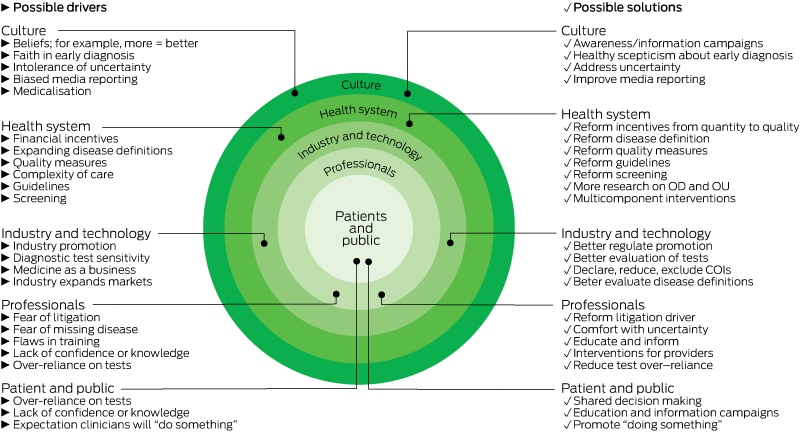
COIs = conflicts of interest. OD = overdiagnosis. OU = overuse. Source: Figure reproduced, with permission, from Pathirana et al.12
Box 2 – Initial statement to underpin the development of a National Action Plan to Prevent Overdiagnosis and Overtreatment in Australia*
- Alongside the undisputed ability of health care to extend human life and ameliorate suffering, there is growing evidence and concern about the problem of too much medicine. Overdiagnosis and the related overuse of medical tests and treatments not only cause harm but also divert resources from addressing underdiagnosis and undertreatment
- There is need in Australia to identify the causes of too much medicine, the extent of the problem, and to develop responses to address it
- There is an urgent need to better inform consumers, clinicians, decision makers and the public about the evidence for, and the consequences of, overdiagnosis and related overtreatment, as part of a broader approach to inform people about the potential harms, as well as the benefits of medical tests and treatments
- Expanding disease definitions and lowering diagnostic thresholds are recognised as one driver of the problem, and the processes for changing definitions require meaningful reform
- We are committed to evaluation, to ensure that attempts to address too much medicine are both safe and fair for health care consumers and their families, and in turn help to optimise the Australian health system’s safety, efficiency and equity of access
* Endorsed by the Australasian College of Sport and Exercise Physicians, the Australian Commission on Safety and Quality in Health Care, the Australian Physiotherapy Association, the Australian Rheumatology Association, Cancer Council Australia, Cochrane Musculoskeletal, the Consumers Health Forum of Australia, the Critical and Ethical Mental Health Research Group, the Robinson Research Institute, the Royal Australasian College of Physicians, the Royal Australasian College of Surgeons, the Royal Australian and New Zealand College of Radiologists and the Royal Australian College of General Practitioners.
Competing interests
All authors were involved in planning the 2017 National Summit on Overdiagnosis.
References
- Welch G, Schwartz L, Woloshin S. Overdiagnosed: making people sick in the pursuit of health. Boston: Beacon; 2012.
- Carter SM, Degeling C, Doust J, Barratt A. A definition and ethical evaluation of overdiagnosis. J Med Ethics 2016; 42: 705-714
- Esserman LJ, Thompson IM, Reid B. Overdiagnosis and overtreatment in cancer: an opportunity for improvement. JAMA 2013; 310: 797-798.
- Hoffman JR, Cooper RJ. Overdiagnosis of disease: a modern epidemic. Arch Intern Med 2012; 172: 1123-1124.
- Vaccarella S, Franceschi S, Bray F, et al. Worldwide thyroid-cancer epidemic? The increasing impact of overdiagnosis. N Engl J Med 2016; 375: 614-617.
- Glasziou P, Moynihan R, Richards T, Godlee F. Too much medicine; too little care. BMJ 2013; 346: f4247.
- Elshaug AG, Watt AM, Mundy L, Willis CD. Over 150 potentially low-value health care practices: an Australian study. Med J Aust 2012; 197: 556-560.
- Maxwell S, O’Leary P, Slevin T, Moorin R. The increase in cancer prevalence and hospital burden in Western Australia 1992–2011. Popul Health Metr 2014; 12: 33.
- Treadwell J, McCartney M. Overdiagnosis and overtreatment. Br J Gen Pract 2016; 66: 116-117.
- Québec Medical Association. Overdiagnosis: findings and action plan. Québec Medical Association; 2014. www.amq.ca/images/stories/documents/m%C3%A9moires/surdiagnostic-plan-action-en.pdf (viewed Jan 2018).
- Saini V, Garcia-Armesto S, Klemperer D, et al. Drivers of poor medical care. Lancet 2017; 358: 178-190.
- Pathirana T, Clark J, Moynihan R. Mapping the drivers of overdiagnosis to potential solutions. BMJ 2017; 358: j3879.
- Scott IA, Soon J, Elshaug A, Lindner R. Countering cognitive biases in minimising low value care. Med J Aust 2017; 206: 407-411.
- MacMahon H, Naidich DP, Goo JM, et al. Guidelines for management of incidental pulmonary nodules detected on CT images: from the Fleischner Society 2017. Radiology 2017; 284: 228-243.
- Soon J, Buchbinder R, Close J, et al. Identifying low-value care: the Royal Australasian College of Physicians’ EVOLVE initiative. Med J Aust 2016; 204: 180-181.
Linked content
-
MJA Letter: Australia is responding to the complex challenge of overdiagnosis
-
MJA Letter: Australia is responding to the complex challenge of overdiagnosis
-
MJA Letter: In reply
Provenance: Not commissioned; externally peer reviewed.
Medical Colleges Have an Obligation to Ensure Full Participation in Clinical Quality Registries
Thomas J. Hugh
Getting on the Same Page: Why Australia Needs a National Maternity Early Warning System (MEWS) Chart
Briony A. Cutts, Lucy Bowyer, Nisha Khot, Sandra Lowe, Stefan C. Kane
Data for Equity: Can Linked Administrative Data Inform Pathways to More Equitable Child Health?
Sarah Gray, Shuaijun Guo, Meredith O'Connor, Elodie O'Connor, Katrina Williams, Hannah Badland, Susan Woolfenden, Josie Dickerson, Gerry Redmond, Marnie Downes, Sharon R. Goldfeld
Specialty College Selection: Why Change is Critical to Support a Future Rural Workforce
Matthew R. McGrail, Jenny May AM, Katherine Logan
Differentiated and simplified oral HIV pre‐exposure prophylaxis (PrEP) models hold the key to virtually eliminating HIV transmission in Australia by 2030
Tyson Arapali, Sarah Warzywoda, Anthony K J Smith, Curtis Chan, Timothy R Broady, Erin Sullivan, Catherine MacPhail, Mohamed A Hammoud, Alexander Dowell‐Day, Benjamin R Bavinton
The number of cancer‐related deaths that could be attributable to spatial disparities in survival in Australia, 2010–2019: a retrospective population‐based cohort study
Charlotte K Bainomugisa, Jessica Cameron, Paramita Dasgupta, Peter Baade