




Volume 209 - Issue 1
Acute medicine for busy physicians
Author: Danielle A Wood
Med J Aust 2018; 209 (1): 13. || doi: 10.5694/mja17.00767
Published online: 2 July 2018
Published online: 2 July 2018
Oxford desk reference: acute medicine
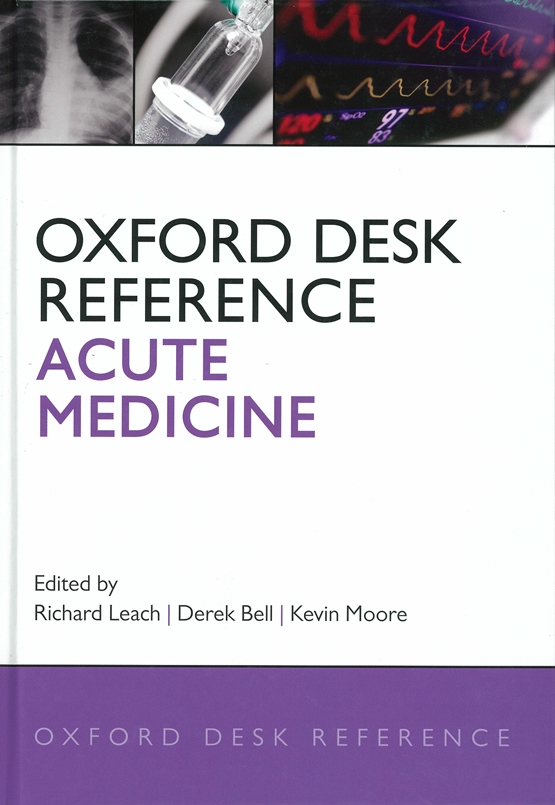
Oxford desk reference: acute medicine. Leach R, Moore K, Bell D, editors. Oxford University Press, 2016 (£60.00; 864 pp). ISBN 9780199565979
Oxford desk reference: acute medicine has been designed as a reference for “trainee physicians participating in ‘unselected’ general medical admission rotas”. In doing so, it covers a staggering array of topics from resuscitation and management of shock to complications of solid organ transplant and haematological malignancies, making it arguably the most comprehensive book on acute medicine to date.
One would struggle to find an acute medical condition that has not been addressed in this extensive text. There is even a chapter on lifestyle modification, covering obesity management and smoking cessation. The necessity of such a topic in an acute care text could be questioned; yet, it is a worthy reflection of a holistic care mindset that is often neglected in rapid turnover clinical environments.
As a reference text for the busy physician or trainee, the Oxford desk reference: acute medicine is very dense, entirely in black and white, with only a smattering of diagrams and tables; it appears more palatable as a study text in a quiet library than a close ally on a busy ward round. Regardless, the editors’ efforts to provide a “simple, guideline-based assistance to the busy clinician” are highlighted in an impressive synthesis of up-to-date literature and consensus guidelines on each topic.
The field of acute medicine in Australia and the United Kingdom is different,1 making the target market for this reference text much broader. The diversity of content would make it useful for physician, emergency and critical care trainees alike. There is also a chapter focusing on practical procedures, with a step-by-step approach to a wide range of emergency airway, vascular and respiratory procedures.
The structure of each topic is in the familiar format of the Oxford reference series, with an introduction discussing the epidemiology of the disease, followed by clinical manifestations and investigations and finishing with treatment modalities. In an era where online medical education resources and podcasts provide ample space for discussion of the controversies of acute care, Oxford desk reference: acute medicine rests as an authoritative and structured reference source.
Competing interests
No relevant disclosures.
References
- Jenkins PF, Barton LL, McNeill GBS. Contrasts in acute medicine: a comparison of the British and Australian systems for managing emergency medical patients. Med J Aust 2010; 193: 227-228.
‘Once Bitten’: A Case of Tetanus Following Snakebite in Australia
Adrian A. S. Doherty, Naomi N. E. Clarke, Sarah Fletcher, Sarah Huffam, Camille V. Awburn, Eugene Athan
Epidemiology and Quality of Care for Aboriginal and Torres Strait Islander Peoples Treated by Emergency Medical Services for Stroke in Victoria, Australia: Retrospective Analysis of Linked Data
Candice Menezes, Ziad Nehme, Luke J. Burchill, Tegwyn McManamny, Angela Dos Santos, Michelle Crilly, Luke P. Dawson, Benjamin Clissold, David Anderson, Emily Nehme
Intranasal Adrenaline Use for the Management of Insect Venom-Induced Anaphylaxis
Thomas J. Young, Wilhelmina R. F. Johnson, Braydon L. Pennington, Troy Wanandy, Wun Y. Lau, Thanh-Thao A. Le
Gabapentinoid Poisoning Presentations to Victorian Emergency Departments: A 15-Year Trend Analysis
Bishaal Tej Gurung, Amy McNeilage, Angus Skeen, Tina Lam, Joanna F. Dipnall, Jane Hayman, Suzanne Nielsen, Ting Xia
They Brought the Hospital to Me
Hugh N. Burrill
Predictors of Ambulance Transport to Hospital for Older People Living in Tasmanian Aged Care Facilities: A Retrospective Cohort Study
Sharon Andrews, Pieter F. Fouche, Belinda Flanagan, Michael McDermott, Melanie Greenwood