




Volume 208 - Issue 2
A novel approach to managing mental health in general practice
Author: Grant A Blashki
Med J Aust 2018; 208 (2): 65. || doi: 10.5694/mja17.00672
Published online: 5 February 2018
Published online: 5 February 2018
Psychiatric presentations in general practice: a guide to holistic management
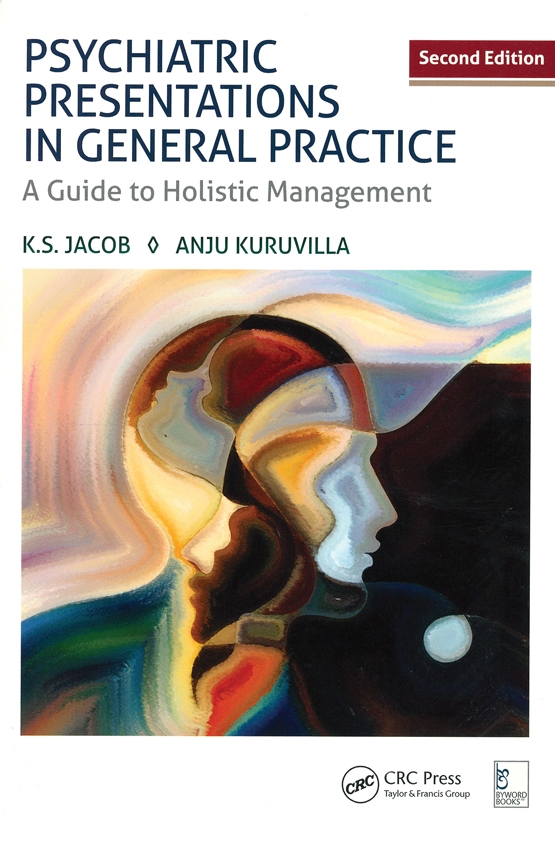
Psychiatric presentations in general practice: a guide to holistic management, 2nd edition. Jacob KS, Kuruvilla A. CRC Press, Taylor and Francis Group; 2017 (£31.99; 258 pp). ISBN 9781498766944
Grounded in their extensive experience of clinical care and teaching mental health skills at India’s Christian Medical College in Vellore, Jacob and Kuruvilla bring a novel approach to primary care psychiatry in Psychiatric presentations in general practice: a guide to holistic management.
The strength of the book is the authors’ appreciation of how general practitioners think about mental health problems. They show a deep understanding of the undifferentiated, often subthreshold, clinical presentations that characterise primary care populations, and display an appreciation that patients who present to general practice often have mixed somatic and psychological symptoms, heavily coloured by their psychosocial and cultural circumstances.
The authors recognise that they are leaving the main highway of psychiatric method to bring to GPs a pragmatic ten-step approach to assess and manage mental health problems. Psychiatric presentations in general practice: a guide to holistic management includes important consulting skills, such as acknowledging the patient’s distress, eliciting the patient’s and family’s perspectives and elaborating on the patient’s coping strategies — steps that will resonate well with GPs.
Although this tailored approach for the general practice setting is admirable, more scientific argument is needed to support the abandonment of more traditional psychiatric assessment. It was disappointing that there was a complete absence of references to support the authors’ arguments; a clinical revolution in GP mental health care needs to be scientifically argued.
Moreover, Jacob and Kuruvilla also dispute traditional psychiatric diagnoses and subcategories. This philosophical position appears to have been taken too far, with common conditions such depression or anxiety not receiving a dedicated chapter or sufficient prominence. As a book designed for GPs, it was strange that the first chapter about common clinical presentations was delirium, which would certainly not be at the top of the list in Australia. Indeed, several elements of the book were not relevant to an Australian audience. A fact sheet on marriage and the law for people with mental health problems, which described the various marriage legal acts in India, was emblematic of this problem.
Apart from these limitations, the book is an authentic attempt to decode the art of managing mental health problems in general practice, and makes suggestions that will resound strongly with GPs who deal with people with mental health problems on a daily basis. My wish would be for a third edition that backs up their proposed innovative assessment and management approach with more evidence.
Competing interests
No relevant disclosures.
Reorienting Allied Health Into Community-Based Care for People Experiencing Trauma and Social Disadvantage
Simon Rosenbaum, Grace McKeon, Gulsah Kurt, Oscar Lederman, Kemi Wright, Sabuj Kanti Mistry, Jackie E. Curtis, Philip B. Ward, Zachary Steel, Hamish Fibbins, Rachel Morell, Melissa C. Eaton, Andrew Watkins, Ben Harris-Roxas, Brendan Goodger, Eleanor Beck, Megan Teychenne, Joseph Firth, Davy Vancampfort, David Burns, Russell Roberts, Tristan Favaloro, Danielle Weber, Rosanna Barbero, Vasili Maroulis, Melissa Holmes, Stefan Mackenzie, Chiara Mastrogiovanni, Afsana Anwar, Uzma Choudhry, Catherine Sherrington, Jane Currie, Thomas Gadsden, Scott Teasdale
Stigmatising Attitudes Towards People With Depression, Bipolar Disorder, Borderline Personality, ADHD and Early and Long-Term/Untreated Schizophrenia: Representative Survey of Australian Adults
Amy J. Morgan, Anna M. Ross, Gayle McNaught, Rachel Green, Nicola J. Reavley
Psychosocial Hazards for Healthcare Workers: Supporting the Second Victim Also Helps the Primary Victims
Sarah Michael
Supporting Population Mental Health in the Wake of Mass Tragedies
Susan J. Rees, Derrick M. Silove
In the Wake of the National Suicide Prevention Strategy 2025–2035: Suicide Prevention in Type 1 Diabetes
Rigel Paciente, Keely Bebbington, Alix Woolard, Helen Milroy