




Volume 207 - Issue 6
Insights into the origin and identity of the discipline of public health
Author: James M Trauer
Med J Aust 2017; 207 (6): 239. || doi: 10.5694/mja16.01446
Published online: 18 September 2017
Published online: 18 September 2017
Public health: a very short introduction
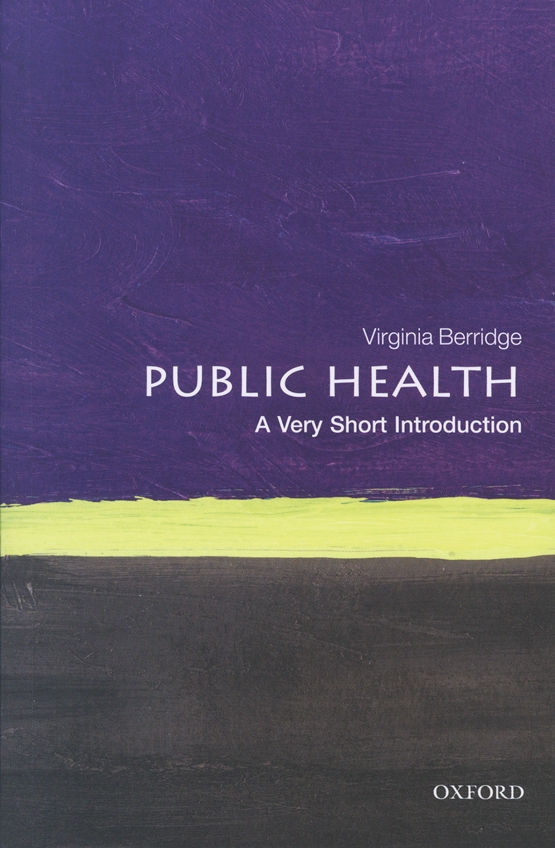
Public health: a very short introduction. Virginia Berridge. Oxford University Press, 2016 (£7.99; 160 pp). ISBN 9780199688463
When I am introduced to non-medical friends as a respiratory physician, there is often a look of confusion, which is resolved with the explanation “lung doctor”. However, even when introduced to other doctors as a public health physician, there is often a similar moment of confusion, which is less easily resolved. In Public health: a very short introduction, Virginia Berridge — who is professor of History and director of the Centre for History in Public Health at the London School of Hygiene and Tropical Medicine, University of London — paints a picture of a discipline that is often uncertain of its own identity. Is it a medical specialty, or should it have a broader professional membership? Is it a single component of our health system, or should public health principles guide all aspects of our approach to health? Should it focus on proven interventions for specific conditions, or should it recognise that equity and social inclusion are fundamental determinants of health?
The book presents a British perspective on public health, and much of the focus is on its historical emergence from origins in Europe and the industrial revolution. This means that areas such as Indigenous health are absent and that references to public health in Australia and non-Western countries are largely confined to comparisons with the United Kingdom. However, it must be acknowledged that the Australian discipline of public health owes much to its British roots and the international comparisons are instructive. For example, it is fascinating that within the past century, public health medicine in the UK has swung from sitting at the pinnacle of the health system to working alongside it, either from local government or the health department.
Moreover, the outsider’s perspective on Australian public health is sobering. Although Australia’s leading role in plain packaging legislation is recognised in the book, the profession of public health medicine in our country is dismissed as “weaker with fewer public health posts in health systems”. With no national equivalent to the public health bodies found in the United States, Europe and the UK, and still relatively few training positions in most states, it is hard to dispute this claim.
Overall, Public health: a very short introduction packs an amazing amount of absorbing content into its 160 pages, but from a distinctly British and historical perspective.
Competing interests
No relevant disclosures.
Designing Housing to Reduce Overcrowding-Related Harms: Rheumatic Heart Disease as the Canary in the Coal Mine
Simon Quilty, Veronica Matthews, Angus Baumann, James Marangou, Bo Remenyi, Gavin Wheaton, Serena Morton Nabanunga, Norman Frank Jupurrurla, Simon Robinson, Steve Mintern, Cary Duffield, Joshua R. Francis, Paul C. Memmott
Australian Climate Leadership in 2026: COP-Out or Step-Up for Health?
Catherine G. A. Pendrey, Angie Bone, Aletha Ward, Francis Nona, Michelle Isles, Paul M. Kelly, Nicholas J. Talley
The impact of the Breast Screen NSW transition from film to digital mammography, 2002–2016: a linked population health data analysis
Rachel Farber, Nehmat Houssami, Katy J L Bell
Shifting focus to adolescent wellbeing and inclusive participation in the digital age
Allyson R Todd, Elena Wang, Stephanie R Partridge
The CURE Asthma roadmap
Gary P Anderson, Anthony Flynn, Phil G Bardin, John D Blakey, Shyamali C Dharmage, Paul Foster, Peter G Gibson, Adam Jaffe, Alan James, Christine R Jenkins, Sundram Sivamalai, Peter D Sly, Guy B Marks, Vanessa M McDonald, Judy Wetttenhall
Protecting public interest journalism as a public health good
Bronwyn Fredericks, Neha Lalchandani, Melissa A Sweet, Alex Cramb, Carmel Williams