




Volume 207 - Issue 6
REM sleep behaviour disorder: not just a bad dream
Authors: Elie Matar and Simon JG Lewis
Med J Aust 2017; 207 (6): 262-268. || doi: 10.5694/mja17.00321
Published online: 18 September 2017
Published online: 18 September 2017
Treatment is effective and involves treatment of underlying causes, modification of the sleep environment, and pharmacotherapy
Summary
- Rapid eye movement (REM) sleep behaviour disorder (RBD) is a parasomnia characterised by the loss of the normal atonia during the REM stage of sleep, resulting in overt motor behaviours that usually represent the enactment of dreams. Patients will seek medical attention due to sleep-related injuries or unpleasant dream content.
- Idiopathic RBD which occurs independently of any other disease occurs in up to 2% of the older population. Meanwhile, secondary RBD is very common in association with certain neurodegenerative conditions. RBD can also occur in the context of antidepressant use, obstructive sleep apnoea and narcolepsy.
- RBD can be diagnosed with a simple screening question followed by confirmation with polysomnography to exclude potential mimics.
- Treatment for RBD is effective and involves treatment of underlying causes, modification of the sleep environment, and pharmacotherapy with either clonazepam or melatonin.
- An important finding in the past decade is the recognition that almost all patients with idiopathic RBD will ultimately go on to develop Parkinson disease or dementia with Lewy bodies. This suggests that idiopathic RBD represents a prodromal phase of these conditions.
- Physicians should be aware of the risk of phenoconversion. They should educate idiopathic RBD patients to recognise the symptoms of these conditions and refer as appropriate for further testing and enrolment into research trials focused on neuroprotective measures.
Rapid eye movement (REM) sleep denotes the stage of sleep most commonly associated with vivid dreaming and is characterised by rapid ballistic eye movements and an electroencephalogram pattern that closely resembles the waking state.1 Several physiological changes occur during REM sleep, the most important of which is a generalised inhibition of skeletal muscle tone (atonia) that allows subjects to remain still despite this phase of heightened brain activity.
REM sleep behaviour disorder (RBD) is a parasomnia that results from the loss of the normal atonia during REM sleep, thus manifesting as overt motor behaviours thought to represent the enactment of dreams or nightmares. These behaviours range from complex violent movements to vocalisations and even simply an elevation of chin or limb muscle tone on electromyography.2
Although idiopathic RBD (iRBD) has a relatively low prevalence in the general population, its relevance must be appreciated, especially in general practice, sleep medicine, neurology and psychiatry.3
This article provides an overview of RBD and explores the link between iRBD and neurodegenerative disease. Citations were derived from a comprehensive search of online databases including MEDLINE, Embase, the Cochrane Database of Systematic Reviews, and BMJ Clinical Evidence using the search terms “REM Sleep Behavio*” and “Rapid Eye Movement Sleep”. A summary of the clinical features, diagnosis, management and follow-up of RBD is shown in Box 1.
Clinical features and diagnosis of RBD
The core characteristics of RBD are abnormal sleep behaviours and unpleasant dreams. A review of the clinical history of 203 consecutive patients with iRBD referred to a tertiary sleep centre found that the most common motor behaviours included punching (88%), kicking (82%), falling out of bed (77%), gesturing (73%), and knocking down the night stand (66%).4 Injury to the bed partner occurred in 21% of patients. Vocalisations such as talking (96%), screaming (90%), moaning (64%), laughing (54%) and crying (44%) were also common. Only about half of the patients were themselves aware of these abnormal behaviours.
These clinical features form the basis of a number of simple screening questionnaires that have been developed to identify potential RBD in the general population.5-8 Postuma and colleagues6 have validated a single-question RBD screening tool (RBD1Q) where a positive response to the question “Have you ever been told, or suspected yourself, that you seem to ‘act out your dreams’ while asleep (for example, punching, flailing your arms in the air, making running movements, etc)?” had a 94% sensitivity and 87% specificity for detecting polysomnography-confirmed RBD. This and other similar questionnaires demonstrate that population-based screening for RBD is tractable and can be effectively performed by any practitioner in the clinic setting.5,7-9
Polysomnography remains the gold standard test for the diagnosis of RBD where excessive muscle activity in the chin (mentalis) or limb muscles must be demonstrated on electromyography during the REM stage of sleep10 (Box 2). Other features of REM sleep, such as REM sleep latency, duration of REM sleep and percentage of REM sleep time are usually normal.11 Synchronised audiovisual recording of sleep is also helpful and often used in conjunction with polysomnography for capturing behaviour.
The sensitivity and specificity of the above diagnostic tools are summarised in Box 3.
Differential diagnosis
Sleep enactment behaviours can occur in healthy, often young individuals in the context of excessive fatigue or alcohol use.12,13 These dream enactment behaviours may even be normal in women in the post-partum period.14 In addition to non-REM parasomnias such as sleepwalking and night terrors, a number of other important RBD mimics need to be excluded on the basis of polysomnography including obstructive sleep apnoea15 (in which dream enactment behaviours may occur during arousals), nocturnal frontal lobe epilepsy16 and periodic limb movements in sleep.17
Epidemiology
Cross-sectional studies estimate the prevalence of RBD to be about 0.5% of the general population and up to 2% in people over the age of 60 years.18-20 The prevalence may be higher in older populations, with one study finding 8.9% of people aged 70–89 years reporting symptoms consistent with RBD.21 Epidemiological studies are thought to underestimate the true prevalence with a bias towards the reporting of violent behaviours while more subtle motor behaviours go undetected.21
A male predominance is generally seen in RBD patients with a male to female ratio ranging from 2:1 and up to 9:1 in some studies.18,22-24 This figure is considered to be similarly skewed by reporting bias, as men tend to have more violent and injurious dream enactment behaviours compared with women.23 The under-representation of RBD in women may also be explained by the reduced tendency among men to seek medical attention and the difficulty of detecting RBD in older women who tend to outlive their spouses.25
The onset of RBD typically occurs in the sixth to seventh decade of life, with a lag time to diagnosis of up to 10 years.23,24,26,27 Young onset RBD (occurring in patients aged younger than 50 years) is less common and as a rule is almost always associated with secondary causes such as antidepressant use, narcolepsy and psychiatric illness.24,27 Unlike in the older population, males and females are represented equally in this group suggesting confounding gender associations with these factors.27 Similarly, RBD in the paediatric population is a distinct entity and usually occurs in the setting of narcolepsy or comorbid malignant or neurodevelopmental abnormalities.28
Secondary RBD and disease associations
We have known for some time that RBD is a prominent feature of neurodegenerative conditions characterised by the histopathological inclusion of α-synuclein (denoted as Lewy bodies and neurites). The primary diseases in this category are Parkinson disease (PD), dementia with Lewy bodies (DLB) and multiple system atrophy (MSA). In PD, 34–47% of patients experience symptoms of RBD,29,30 and up to 58% when including patients with polysomnography-confirmed REM sleep without atonia.30 RBD is even more common in DLB; a clinicopathological study of 172 patients with RBD found that the most common pathological diagnosis was DLB (45% of cases).31 Overall, about 70% of patients with DLB screen positive for symptoms of RBD32 — an association strong enough that it is considered to be a diagnostic feature of the disorder.33 RBD may be even more common in MSA, with a recent study of 19 consecutive patients finding them all to have polysomnography-confirmed RBD irrespective of reported symptoms.34
Although much rarer, there have been occasional reports of RBD in association with other neurological disorders including progressive supranuclear palsy,35 corticobasal degeneration,36 Machado–Joseph disease,37 epilepsy,38 multiple sclerosis,39 Guillain–Barré disease,40 amyotrophic lateral sclerosis41 and Huntington disease.42 There is contention about the role of RBD in Alzheimer’s disease (AD), as the first reported autopsy-proven case of AD and RBD was found to involve a Lewy body variant of AD.43 To date, large clinicopathological series of RBD have found AD pathology to be rare (< 1%).31 RBD has also been reported in neurodevelopmental disorders such as autism44 and Tourette syndrome,45 as well as among a number of paraneoplastic disorders such as limbic encephalitis and cerebellar degeneration.46-48 RBD can also occur in the setting of discrete ischaemic, demyelinating or neoplastic lesions affecting regions of the brain (primarily brainstem pontine structures) involved in the control of REM sleep.49,50
Apart from neurological disease, there is also significant overlap between RBD and narcolepsy. About 50% of patients with narcolepsy have evidence of REM sleep without atonia, and the mechanism thought to underlie this is distinct from the synuclein pathology associated with iRBD.51
RBD can also occur in the context of certain medications. In otherwise healthy controls, REM sleep atonia can be induced by tricyclic and serotonergic antidepressants.52,53 RBD has also been reported with β-blockers, possibly through them binding to central noradrenergic and serotonergic receptors.54 These medications may be more likely to unveil RBD behaviour in patients with a predisposition, such as those with PD and narcolepsy.55 RBD has also been described in association with alcohol withdrawal.40
Idiopathic RBD as a predictor of neurodegeneration
An important message for physicians new to the field is that iRBD is the strongest and most specific predictor of synuclein-mediated neurodegenerative disease. Indeed, in the majority of cases where secondary causes have been eliminated, RBD can be regarded as a prodromal state of PD, DLB or MSA.56
One of the earliest longitudinal series describing this relation was carried out in 1996 by Schenck and colleagues, who found that 38% of older men with iRBD developed a Parkinsonian disease or dementia after a mean interval of 12.7 years from onset of symptoms.57 Sixteen years later, the authors published a follow-up of the same patients after finding that 81% had converted to mainly PD or DLB, and in some cases, Lewy body variant of AD.58 Another recent study followed a large cohort of 174 patients with iRBD referred to a tertiary sleep centre for up to 15 years and demonstrated that the risk of developing a defined neurodegenerative condition was 91% at 14 years.59 The median conversion time from the diagnosis of RBD was 7.5 years (11 years from time of symptom onset). The main neurodegenerative diseases represented at the first follow-up interval were DLB in 29, PD in 22 and MSA in two patients. A large multicentre trial of 279 patients, but with a shorter mean follow-up duration of 3.8 years, affirms the results from the single-centre trials.60
There is emerging evidence showing that neuropsychological, biological and clinical markers of neurodegeneration can be detected in patients with iRBD who are otherwise asymptomatic. Prospective serial dopamine transporter imaging in iRBD can detect progressive nigrostriatal dopaminergic deficiency before onset of any motor symptoms akin to those seen in patients with PD.61,62 Additionally, various magnetic resonance imaging studies have revealed structural and functional brain alterations associated with iRBD, similar to changes seen in PD and DLB.63,64 Electroencephalographic65 and perfusion abnormalities66 consistent with neurodegeneration have also been described.
Early cognitive deficits have been consistently reported in a high proportion of asymptomatic patients with iRBD.67 Comprehensive neuropsychological testing of 112 subjects with polysomnography-confirmed iRBD found that 50% of patients compared with 8% of control subjects had evidence of mild cognitive impairment.68 Further, the pattern of cognitive deficits seen in iRBD is similar to synucleinopathy-associated dementias, frequently involving visuospatial, attention and executive domains.68
The clinical markers of neurodegeneration are not just restricted to cognitive function. A recent Chinese study comparing patients with iRBD to PD and controls found both motor and non-motor deficits in patients with iRBD.69 Involvement of olfaction, gastrointestinal, and cardiovascular functions has been confirmed in other studies of iRBD and found to be predictive of impending conversion to neurodegenerative disease.70,71
Adding to the case that iRBD represents a synucleinopathy are recent in vivo studies that found α-synuclein aggregates in nerve fibres obtained from biopsies of the colon and submandibular glands in patients with iRBD and PD but not in age-matched healthy controls.72,73 Reports of patients with iRBD who have undergone post-mortem examination are scarce but revealing.74 Brainstem-predominant Lewy body disease with some neuronal loss was found in each case and particularly affected key structures known to be associated with REM sleep and PD.
Pathogenesis of RBD
The pathophysiology underlying RBD is not fully understood but presumably can arise from any number of nervous system pathologies that converge primarily on the brainstem structures responsible for inhibition of spinal motor neurons during REM sleep,21 operating via multiple neurotransmitter systems including glutamate, noradrenaline, serotonin, γ−aminobutyric acid, dopamine and orexin.75
These brainstem regions (such as the subcoeruleus complex) have been shown to be affected by α-synuclein disease in post-mortem studies of patients with iRBD, PD, DLB and MSA74,76,77 (Box 4). Interestingly, the timing linking iRBD and the development of other motor and non-motor features of a neurodegenerative disorder are aligned with the neuropathological staging system of Lewy body disease developed by Braak and colleagues.76 Thus, it would seem to fit that RBD, along with other non-motor symptoms resulting from brainstem pathology, would manifest before the onset of the motor and cognitive symptoms mediated by structures affected later in the course of the disease.
RBD in narcolepsy affects younger populations who generally do not go on to develop neurodegenerative conditions and is therefore a different clinical entity subserved by distinct pathomechanisms. Narcolepsy in humans is characterised by loss of orexin-producing cells in the hypothalamus.78 Orexins (or hypocretins) are excitatory neuropeptides produced in the hypothalamus that play a role in regulating a variety of bodily functions such as wakefulness, appetite and energy expenditure. Thus, loss of orexinergic projections to the subcoeruleus and other brainstem regions important in muscle atonia is thought to underlie RBD in narcolepsy.53
Management
The priority in symptomatic RBD is to minimise the likelihood of injury and eliminate unpleasant dreams. This is especially true for patients with more violent dream enactment behaviours, as these have been reported to occasionally result in life-threatening injuries with forensic implications.79 Unfortunately, no published large randomised control trial data exist regarding pharmacological intervention in RBD. Instead, treatment decisions are currently informed by case series and best practice guidelines generated through expert consensus.80
In the first instance, it is generally agreed that any potentially offending medications which may exacerbate RBD (eg, tricyclic antidepressants, selective serotonin reuptake inhibitors, lipophilic β-blockers) should be safely withdrawn whenever possible. Clinicians should be guided by patient history and examination to investigate and treat any of the other potentially secondary causes of RBD mentioned above. In patients with sleep fragmentation disorders such as sleep apnoea, treatment with continuous positive airway ventilation may in some cases relieve dream enactment behaviours.81
In patients with injurious motor behaviours, non-pharmacological measures, particularly the modification of the sleeping environment, is considered essential to minimise risk of injury to the patient and their bed partner. Examples of protective measures include placing a mattress on the floor, sleeping in a separate room from partners, pillow barricades and removal of potentially dangerous objects.19,80 Other restraining measures are occasionally employed, such as padded bed rails and sleeping bags. Clinicians should advocate home modification as an important adjunct to pharmacological therapy, or even as monotherapy if it is shown to be effective.
Pharmacotherapy
Currently, melatonin and clonazepam are the only recommended first-line medications for the treatment of symptomatic RBD. A head-to-head trial has not been performed and information regarding dosing, efficacy and adverse effects are based only on observational studies.82 As in the United States and the United Kingdom, use of these medications in RBD is currently off-label in Australia and can be prescribed by any treating physician provided the patient has undergone the appropriate assessment.
Clonazepam is a long-acting benzodiazepine and was recognised as an effective therapy by Schenck and colleagues in their original series describing RBD.83,84 Clonazepam has been shown in several studies to be effective in reducing RBD behaviours and frequency of unpleasant dreams in most patients.80 The usual starting dose is 0.25–0.50 mg orally at bedtime and slow up-titration as required to a maximum dose of 2 mg, depending on tolerability and response. A response is generally seen within the first week of starting the medication, although it may vary depending on the frequency and severity of RBD at baseline. Dream enactment tends to return if the medication is abruptly stopped. Curiously, despite the reported reduction in overt dream enactment behaviour, polysomnography of patients treated with clonazepam still shows excessive electromyographic activity during REM sleep.85 Based on this finding, the proposed mechanism of action of clonazepam is thought to be via its inhibitory influence on locomotor pattern generators rather than by restoring REM sleep atonia per se.80 Unfortunately, clonazepam is associated with many adverse effects (such as morning sedation, dizziness, confusion), with a retrospective study showing about 58% of patients experiencing moderate to severe side effects sometimes resulting in discontinuation.86 Therefore, clonazepam should be used with caution in older people and those with concomitant neurological conditions. Clonazepam should be avoided in patients with untreated obstructive sleep apnoea due to potential augmentation of apnoeas.
Melatonin is a hormone naturally secreted by the pineal gland to modulate circadian rhythm in humans. A small double-blind randomised cross-over trial and several case series have shown that melatonin may be equally effective for the treatment of symptomatic RBD at doses ranging from 3 to 12 mg taken 30 minutes before sleep.80,87,88 As with clonazepam, it is generally advised to start at the lower dose and increase every 2–4 weeks as required. However, melatonin may be more tolerable than clonazepam, with a recent retrospective comparative study in patients treated pharmacologically for RBD finding that melatonin-treated patients reported fewer adverse effects.87 Reported side effects were dose related and mainly included morning headache and morning somnolence. On a practical note, there is little evidence distinguishing between different preparations of melatonin for this indication, and in Australia the slow release formulation (which can be compounded) is most commonly used. Interestingly, polysomnography recorded from melatonin-treated patients shows a decrease in the proportion of REM sleep without atonia. This suggests that melatonin specifically targets structures associated with REM atonia; however, the mechanism by which this occurs is unknown. More data are required to firmly establish the efficacy of melatonin and enable standardised dosage regimens.
For patients refractory to the above medications, limited and conflicting data exist regarding the efficacy of other agents such as pramipexole, paroxetine and certain acetylcholinesterase inhibitors.82
Prognosis and implications for future neuroprotective measures
Recognising that most patients presenting with iRBD over the age of 50 years proceed to develop a synucleinopathy represents an unprecedented window of opportunity for potential disease prevention. At the same time, in the absence of existing neuroprotective measures, topics such as screening for RBD, disclosure of this information to patients and the nature of their follow-up and assessment are still being debated.
Disclosure of risk to the patient
On the basis of ethical considerations, most physicians support the disclosure of risk of neurodegenerative disease to patients with iRBD.89 It is important to remember that although patients are at an increased risk of developing a neurodegenerative disorder, it is by no means definitive, as current risk estimates are derived from studying selected patient populations. Such open discussions with patients are important for minimising misinformation and encourage the reporting of early symptoms of disease such as motor slowing or cognitive decline. Also, by understanding their condition, patients can give informed consent to participate in local and international research trials aimed at developing neuroprotective strategies.
Neuroprotective trials and research in iRBD
While neuroprotective trials are yet to commence, the International RBD Study Group released a consensus statement outlining a framework for devising such trials.90 In addition, the International Parkinson and Movement Disorder Society has released standardised research criteria for diagnosing prodromal PD and has identified RBD as having the highest predictive value of all the biomarkers.91 Other important research questions pertaining to optimal polysomnographic criteria for RBD and the automation of its detection will also be highly relevant to the methodology for impending neuroprotective studies.
Given the complexities surrounding iRBD, clinicians are encouraged to refer patients with diagnosed iRBD to sleep physicians and neurologists with an interest in the disorder. Such specialists will be able to monitor for the development of Parkinsonism or cognitive decline and arrange ancillary testing including neuroimaging, neuropsychology, and smell and colour vision testing. By this avenue, patients could also be offered the opportunity to enrol in existing research programs and neuroprotective trials once they commence. General practitioners involved in the long term care of such patients will also need to be vigilant regarding the emergence of any cognitive or motor symptoms and to monitor for adverse interactions or side effects of any prescribed medications.
Conclusion
RBD is a treatable parasomnia with significant potential harm for patients and their spouses. Arguably one of the most important developments in neurology and sleep medicine in the last decade is the recognition that RBD may be the earliest symptom of a Lewy body disorder such as PD and DLB. This has created a concerted effort on the part of scientists and clinicians to undertake trials focused on neuroprotection in this cohort of patients. Physicians from a wide range of fields should be aware of this recent discovery and ensure that patients with RBD are appropriately diagnosed, treated, educated and followed up.
Box 1 – Proposed flow diagram for diagnosis, investigation, treatment and follow-up of patients with rapid eye movement (REM) sleep behaviour disorder
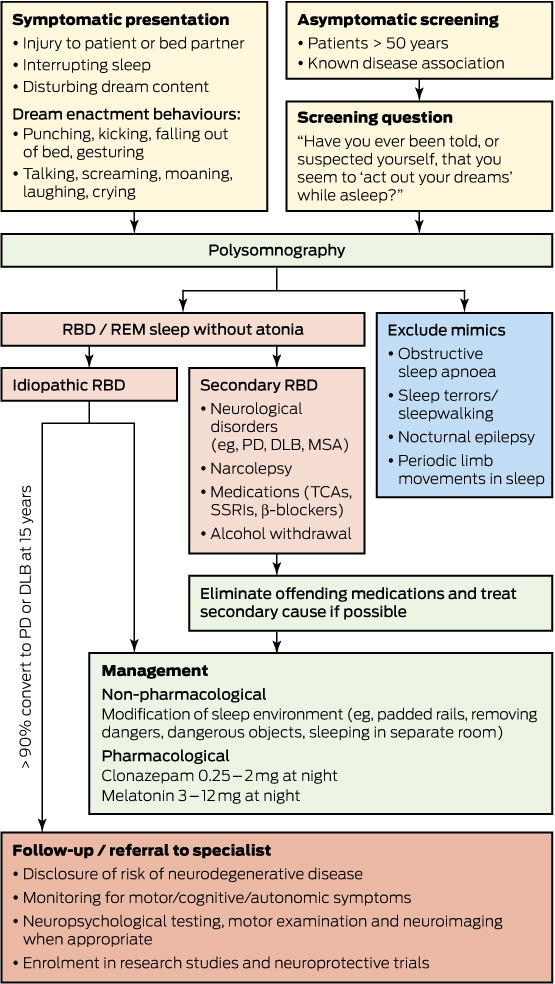
DLB = dementia with Lewy bodies. MSA = multiple system atrophy. PD = Parkinson’s disease. RBD = REM sleep behaviour disorder. SSRI = serotonin selective reuptake inhibitor. TCA = tricyclic antidepressant.
Box 2 – Representative polysomnography showing (A) normal rapid eye movement (REM) sleep in a healthy individual and (B) REM sleep without atonia in an individual with idiopathic REM sleep behaviour disorder
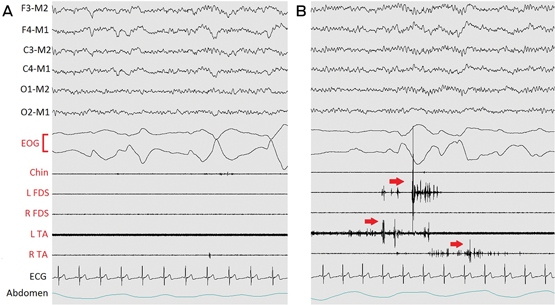
ECG = electrocardiogram. EOG = electro-oculogram. FDS = flexor digitorum superficialis. F3, F4, C3, C4, O1, O2 = electroencephalographic electrode configuration in the frontal, central and occipital scalp according to the International 10–20 system, contralaterally referenced to the mastoid processes (M1, M2). TA = tibialis anterior. EOG channels show bursts of rapid eye movements characteristic of the REM stage of sleep. Chin (mentalis muscle), upper limb (right and left FDS) and lower limb (TA) electromyography recording channels are also shown. Red arrows (B) highlight excessive limb muscle activity in REM sleep in the affected individual.
Box 3 – Sensitivity and specificity of rapid eye movement sleep behaviour disorder (RBD) diagnosis based on screening questionnaire, single-item question screening and video polysomnography
|
|
Sensitivity |
Specificity |
|||||||||||||
|
|
|||||||||||||||
|
RBD screening questionnaire* |
88–98% |
56–95% |
|||||||||||||
|
Single-item RBD screening question† |
94% |
87% |
|||||||||||||
|
Polysomnography‡ |
89–98% |
75–100% |
|||||||||||||
|
|
|||||||||||||||
|
* Note that variation in these measures may be accounted for by differences in the questionnaires used and the populations studied.5-9 † Based on the single-item RBD question: “Have you ever been told, or suspected yourself, that you seem to ‘act out your dreams’ while asleep (for example, punching, flailing your arms in the air, making running movements, etc.)?”6 ‡ Differences in detection by polysomnography depend on detection protocol used (Neikrug AB, Ancoli-Israel S. Diagnostic tools for REM sleep behavior disorder. Sleep Med Rev 2012; 16: 415–429). |
|||||||||||||||
Box 4 – Immunostaining for α-synuclein in the locus coeruleus of a patient with Parkinson disease and rapid eye movement sleep behaviour disorder at autopsy
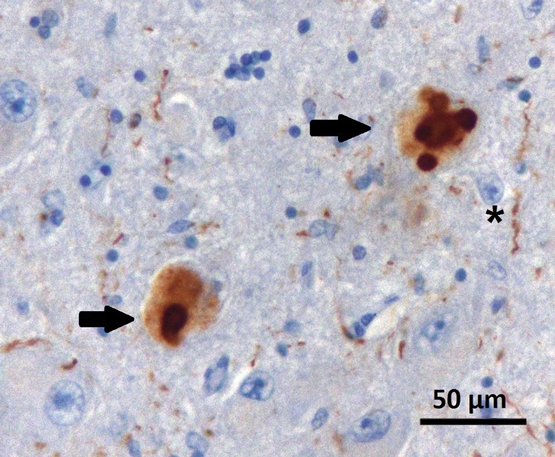
Section shows α-synuclein-positive Lewy bodies (arrows) and Lewy neurites (asterisk) using peroxidase immunohistochemistry. Photograph courtesy of Professor Glenda Halliday, University of Sydney.
Competing interests
No relevant disclosures.
Acknowledgements
This work was conducted by the ForeFront project team and SJGL is supported by an NHMRC–ARC Dementia Research Development Fellowship (1110414). ForeFront is a large collaborative research group dedicated to the study of neurodegenerative diseases and is funded by grants from the National Health and Medical Research Council of Australia (1037746), Dementia Research Team (1095127), NeuroSleep Centre of Research Excellence (1060992), Australian Research Council Centre of Excellence in Cognition and its Disorders Memory Program (CE110001021) and the Sydney Research Excellence Initiative 2020. We thank Dr Negar Memarian for providing the polysomnography recording data shown in Box 2.
References
- Aserinsky E, Kleitman N. Regularly occurring periods of eye motility, and concomitant phenomena, during sleep. Science 1953; 118: 273-274.
- Iranzo A, Santamaria J, Tolosa E. Idiopathic rapid eye movement sleep behaviour disorder: diagnosis, management, and the need for neuroprotective interventions. Lancet Neurol 2016; 15: 405-419.
- Postuma RB, Gagnon JF, Montplaisir J. Rapid eye movement sleep behavior disorder as a biomarker for neurodegeneration: the past 10 years. Sleep Med 2013; 14: 763-767.
- Fernandez-Arcos A, Iranzo A, Serradell M, et al. The clinical phenotype of idiopathic rapid eye movement sleep behavior disorder at presentation: a study in 203 consecutive patients. Sleep 2016; 39: 121-132.
- Boeve BF, Molano JR, Ferman TJ, et al. Validation of the Mayo Sleep Questionnaire to screen for REM sleep behavior disorder in a community-based sample. J Clin Sleep Med 2013; 9: 475-480.
- Postuma RB, Arnulf I, Hogl B, et al. A single-question screen for rapid eye movement sleep behavior disorder: a multicenter validation study. Mov Disord 2012; 27: 913-916.
- Stiasny-Kolster K, Mayer G, Schafer S, et al. The REM sleep behavior disorder screening questionnaire–a new diagnostic instrument. Mov Disord 2007; 22: 2386-2393.
- Li SX, Wing YK, Lam SP, et al. Validation of a new REM sleep behavior disorder questionnaire (RBDQ-HK). Sleep Med 2010; 11: 43-48.
- Boeve BF, Molano JR, Ferman TJ, et al. Validation of the Mayo Sleep Questionnaire to screen for REM sleep behavior disorder in an aging and dementia cohort. Sleep Med 2011; 12: 445-453.
- Montplaisir J, Gagnon JF, Fantini ML, et al. Polysomnographic diagnosis of idiopathic REM sleep behavior disorder. Mov Disord 2010; 25: 2044-2051.
- Frauscher B, Iranzo A, Gaig C, et al. Normative EMG values during REM sleep for the diagnosis of REM sleep behavior disorder. Sleep 2012; 35: 835-847.
- Stefani A, Gabelia D, Mitterling T, et al. A prospective video-polysomnographic analysis of movements during physiological sleep in 100 healthy sleepers. Sleep 2015; 38: 1479-1487.
- Nielsen T, Svob C, Kuiken D. Dream-enacting behaviors in a normal population. Sleep 2009; 32: 1629-1636.
- Nielsen T, Paquette T. Dream-associated behaviors affecting pregnant and postpartum women. Sleep 2007; 30: 1162-1169.
- Iranzo A, Santamaria J. Severe obstructive sleep apnea/hypopnea mimicking REM sleep behavior disorder. Sleep 2005; 28: 203-206.
- Derry C. Nocturnal frontal lobe epilepsy vs parasomnias. Curr Treat Options Neurol 2012; 14: 451-463.
- Avidan AY. Parasomnias and movement disorders of sleep. Semin Neurol 2009; 29: 372-392.
- Kang SH, Yoon IY, Lee SD, et al. REM sleep behavior disorder in the Korean elderly population: prevalence and clinical characteristics. Sleep 2013; 36: 1147-1152.
- Chiu HF, Wing YK, Lam LC, et al. Sleep-related injury in the elderly–an epidemiological study in Hong Kong. Sleep 2000; 23: 513-517.
- Ohayon MM, Caulet M, Priest RG. Violent behavior during sleep. J Clin Psychiatry 1997; 58: 369-376; quiz 377.
- Boeve BF. REM sleep behavior disorder: updated review of the core features, the REM sleep behavior disorder-neurodegenerative disease association, evolving concepts, controversies, and future directions. Ann N Y Acad Sci 2010; 1184: 15-54.
- Schenck CH, Hurwitz TD, Mahowald MW. Symposium: Normal and abnormal REM sleep regulation: REM sleep behaviour disorder: an update on a series of 96 patients and a review of the world literature. J Sleep Res 1993; 2: 224-231.
- Zhou J, Zhang J, Li Y, et al. Gender differences in REM sleep behavior disorder: a clinical and polysomnographic study in China. Sleep Med 2015; 16: 414-418.
- Olson EJ, Boeve BF, Silber MH. Rapid eye movement sleep behaviour disorder: demographic, clinical and laboratory findings in 93 cases. Brain 2000; 123(Pt 2): 331-339.
- Bodkin CL, Schenck CH. Rapid eye movement sleep behavior disorder in women: relevance to general and specialty medical practice. J Womens Health (Larchmt) 2009; 18: 1955-1963.
- Wing YK, Lam SP, Li SX, et al. REM sleep behaviour disorder in Hong Kong Chinese: clinical outcome and gender comparison. J Neurol Neurosurg Psychiatry 2008; 79: 1415-1416.
- Zhou J, Zhang J, Du L, et al. Characteristics of early- and late-onset rapid eye movement sleep behavior disorder in China: a case-control study. Sleep Med 2014; 15: 654-660.
- Kotagal S. Rapid eye movement sleep behavior disorder during childhood. Sleep Med Clin 2015; 10: 163-167.
- Scaglione C, Vignatelli L, Plazzi G, et al. REM sleep behaviour disorder in Parkinson’s disease: a questionnaire-based study. Neurol Sci 2005; 25: 316-321.
- Gagnon JF, Bedard MA, Fantini ML, et al. REM sleep behavior disorder and REM sleep without atonia in Parkinson’s disease. Neurology 2002; 59: 585-589.
- Boeve BF, Silber MH, Ferman TJ, et al. Clinicopathologic correlations in 172 cases of rapid eye movement sleep behavior disorder with or without a coexisting neurologic disorder. Sleep Med 2013; 14: 754-762.
- Boeve BF, Silber MH, Ferman TJ, et al. Association of REM sleep behavior disorder and neurodegenerative disease may reflect an underlying synucleinopathy. Mov Disord 2001; 16: 622-630.
- Ferman TJ, Boeve BF, Smith GE, et al. Inclusion of RBD improves the diagnostic classification of dementia with Lewy bodies. Neurology 2011; 77: 875-882.
- Vetrugno R, Provini F, Cortelli P, et al. Sleep disorders in multiple system atrophy: a correlative video-polysomnographic study. Sleep Med 2004; 5: 21-30.
- Arnulf I, Merino-Andreu M, Bloch F, et al. REM sleep behavior disorder and REM sleep without atonia in patients with progressive supranuclear palsy. Sleep 2005; 28: 349-354.
- Abbott SM, Videnovic A. Sleep disorders in atypical Parkinsonism. Mov Disord Clin Pract 2014; 1: 89-96.
- D’Abreu A, Franca M, Jr, Conz L, et al. Sleep symptoms and their clinical correlates in Machado-Joseph disease. Acta Neurol Scand 2009; 119: 277-280.
- Manni R, Terzaghi M. REM behavior disorder associated with epileptic seizures. Neurology 2005; 64: 883-884.
- Caminero A, Bartolome M. Sleep disturbances in multiple sclerosis. J Neurol Sci 2011; 309: 86-91.
- Manni R, Ratti PL, Terzaghi M. Secondary ‘‘incidental’’ REM sleep behavior disorder: do we ever think of it? Sleep Med 2011; 12 Suppl 2: S50-S53.
- Ebben MR, Shahbazi M, Lange DJ, Krieger AC. REM behavior disorder associated with familial amyotrophic lateral sclerosis. Amyotroph Lateral Scler 2012; 13: 473-474.
- Arnulf I, Nielsen J, Lohmann E, et al. Rapid eye movement sleep disturbances in Huntington disease. Arch Neurol 2008; 65: 482-488.
- Schenck CH, Mahowald MW, Anderson ML, et al. Lewy body variant of Alzheimer’s disease (AD) identified by postmortem ubiquitin staining in a previously reported case of AD associated with REM sleep behavior disorder. Biol Psychiatry 1997; 42: 527-528.
- Thirumalai SS, Shubin RA, Robinson R. Rapid eye movement sleep behavior disorder in children with autism. J Child Neurol 2002; 17: 173-178.
- Trajanovic NN, Voloh I, Shapiro CM, Sandor P. REM sleep behaviour disorder in a child with Tourette’s syndrome. Can J Neurol Sci 2004; 31: 572-575.
- Compta Y, Iranzo A, Santamaria J, et al. REM sleep behavior disorder and narcoleptic features in anti-Ma2-associated encephalitis. Sleep 2007; 30: 767-769.
- Iranzo A, Graus F, Clover L, et al. Rapid eye movement sleep behavior disorder and potassium channel antibody-associated limbic encephalitis. Ann Neurol 2006; 59: 178-181.
- Vale TC, Fernandes do Prado LB, do Prado GF, et al. Rapid eye movement sleep behavior disorder in paraneoplastic cerebellar degeneration: improvement with immunotherapy. Sleep 2016; 39: 117-120.
- Tang WK, Hermann DM, Chen YK, et al. Brainstem infarcts predict REM sleep behavior disorder in acute ischemic stroke. BMC Neurol 2014; 14: 88.
- McCarter SJ, Tippmann-Peikert M, Sandness DJ, et al. Neuroimaging-evident lesional pathology associated with REM sleep behavior disorder. Sleep Med 2015; 16: 1502-1510.
- Dauvilliers Y, Jennum P, Plazzi G. Rapid eye movement sleep behavior disorder and rapid eye movement sleep without atonia in narcolepsy. Sleep Med 2013; 14: 775-781.
- Winkelman JW, James L. Serotonergic antidepressants are associated with REM sleep without atonia. Sleep 2004; 27: 317-321.
- Gagnon JF, Postuma RB, Mazza S, et al. Rapid-eye-movement sleep behaviour disorder and neurodegenerative diseases. Lancet Neurol 2006; 5: 424-432.
- Morrison I, Frangulyan R, Riha RL. Beta-blockers as a cause of violent rapid eye movement sleep behavior disorder: a poorly recognized but common cause of violent parasomnias. Am J Med 2011; 124: e11.
- Schenck CH, Mahowald MW. Motor dyscontrol in narcolepsy: rapid-eye-movement (REM) sleep without atonia and REM sleep behavior disorder. Ann Neurol 1992; 32: 3-10.
- Postuma RB, Berg D. Advances in markers of prodromal Parkinson disease. Nat Rev Neurol 2016; 12: 622-634.
- Schenck CH, Bundlie SR, Mahowald MW. Delayed emergence of a parkinsonian disorder in 38% of 29 older men initially diagnosed with idiopathic rapid eye movement sleep behaviour disorder. Neurology 1996; 46: 388-393.
- Schenck CH, Boeve BF, Mahowald MW. Delayed emergence of a parkinsonian disorder or dementia in 81% of older men initially diagnosed with idiopathic rapid eye movement sleep behavior disorder: a 16-year update on a previously reported series. Sleep Med 2013; 14: 744-748.
- Iranzo A, Fernandez-Arcos A, Tolosa E, et al. Neurodegenerative disorder risk in idiopathic REM sleep behavior disorder: study in 174 patients. PLoS One 2014; 9: e89741.
- Postuma RB, Iranzo A, Hogl B, et al. Risk factors for neurodegeneration in idiopathic rapid eye movement sleep behavior disorder: a multicenter study. Ann Neurol 2015; 77: 830-839.
- Iranzo A, Lomena F, Stockner H, et al. Decreased striatal dopamine transporter uptake and substantia nigra hyperechogenicity as risk markers of synucleinopathy in patients with idiopathic rapid-eye-movement sleep behaviour disorder: a prospective study [corrected]. Lancet Neurol 2010; 9: 1070-1077.
- Iranzo A, Valldeoriola F, Lomena F, et al. Serial dopamine transporter imaging of nigrostriatal function in patients with idiopathic rapid-eye-movement sleep behaviour disorder: a prospective study. Lancet Neurol 2011; 10: 797-805.
- Hanyu H, Inoue Y, Sakurai H, et al. Voxel-based magnetic resonance imaging study of structural brain changes in patients with idiopathic REM sleep behavior disorder. Parkinsonism Relat Disord 2012; 18: 136-139.
- Unger MM, Belke M, Menzler K, et al. Diffusion tensor imaging in idiopathic REM sleep behavior disorder reveals microstructural changes in the brainstem, substantia nigra, olfactory region, and other brain regions. Sleep 2010; 33: 767-773.
- Rodrigues Brazete J, Montplaisir J, Petit D, et al. Electroencephalogram slowing in rapid eye movement sleep behavior disorder is associated with mild cognitive impairment. Sleep Med 2013; 14: 1059-1063.
- Holtbernd F, Gagnon JF, Postuma RB, et al. Abnormal metabolic network activity in REM sleep behavior disorder. Neurology 2014; 82: 620-627.
- Manni R, Sinforiani E, Pacchetti C, et al. Cognitive dysfunction and REM sleep behavior disorder: key findings in the literature and preliminary longitudinal findings. Int J Psychophysiol 2013; 89: 213-217.
- Gagnon JF, Vendette M, Postuma RB, et al. Mild cognitive impairment in rapid eye movement sleep behavior disorder and Parkinson’s disease. Ann Neurol 2009; 66: 39-47.
- Wan Y, Luo Y, Gan J, et al. Clinical markers of neurodegeneration in Chinese patients with idiopathic rapid eye movement sleep behavior disorder. Clin Neurol Neurosurg 2016; 150: 105-109.
- Postuma RB, Gagnon JF, Vendette M, Montplaisir JY. Markers of neurodegeneration in idiopathic rapid eye movement sleep behaviour disorder and Parkinson’s disease. Brain 2009; 132(Pt 12): 3298-3307.
- Li Y, Kang W, Yang Q, et al. Predictive markers for early conversion of iRBD to neurodegenerative synucleinopathy diseases. Neurology 2017; 88: 1493-1500.
- Sprenger FS, Stefanova N, Gelpi E, et al. Enteric nervous system alpha-synuclein immunoreactivity in idiopathic REM sleep behavior disorder. Neurology 2015; 85: 1761-1768.
- Vilas D, Iranzo A, Tolosa E, et al. Assessment of alpha-synuclein in submandibular glands of patients with idiopathic rapid-eye-movement sleep behaviour disorder: a case-control study. Lancet Neurol 2016; 15: 708-718.
- Boeve BF, Dickson DW, Olson EJ, et al. Insights into REM sleep behavior disorder pathophysiology in brainstem-predominant Lewy body disease. Sleep Med 2007; 8: 60-64.
- Peever J, Luppi PH, Montplaisir J. Breakdown in REM sleep circuitry underlies REM sleep behavior disorder. Trends Neurosci 2014; 37: 279-288.
- Braak H, Del Tredici K, Rub U, et al. Staging of brain pathology related to sporadic Parkinson’s disease. Neurobiol Aging 2003; 24: 197-211.
- Iranzo A, Tolosa E, Gelpi E, et al. Neurodegenerative disease status and post-mortem pathology in idiopathic rapid-eye-movement sleep behaviour disorder: an observational cohort study. Lancet Neurol 2013; 12: 443-453.
- Thannickal TC, Moore RY, Nienhuis R, et al. Reduced number of hypocretin neurons in human narcolepsy. Neuron 2000; 27: 469-474.
- Mahowald MW, Bundlie SR, Hurwitz TD, Schenck CH. Sleep violence–forensic science implications: polygraphic and video documentation. J Forensic Sci 1990; 35: 413-432.
- Aurora RN, Zak RS, Maganti RK, et al. Best practice guide for the treatment of REM sleep behavior disorder (RBD). J Clin Sleep Med 2010; 6: 85-95.
- Howell MJ. Parasomnias: an updated review. Neurotherapeutics 2012; 9: 753-775.
- Devnani P, Fernandes R. Management of REM sleep behavior disorder: an evidence based review. Ann Indian Acad Neurol 2015; 18: 1-5.
- Schenck CH, Bundlie SR, Ettinger MG, Mahowald MW. Chronic behavioral disorders of human REM sleep: a new category of parasomnia. Sleep 1986; 9: 293-308.
- Schenck CH, Bundlie SR, Patterson AL, Mahowald MW. Rapid eye movement sleep behavior disorder. A treatable parasomnia affecting older adults. JAMA 1987; 257: 1786-1789.
- Schenck CH, Mahowald MW. REM sleep behavior disorder: clinical, developmental, and neuroscience perspectives 16 years after its formal identification in SLEEP. Sleep 2002; 25: 120-138.
- Anderson KN, Shneerson JM. Drug treatment of REM sleep behavior disorder: the use of drug therapies other than clonazepam. J Clin Sleep Med 2009; 5: 235-239.
- McCarter SJ, Boswell CL, St Louis EK, et al. Treatment outcomes in REM sleep behavior disorder. Sleep Med 2013; 14: 237-242.
- Boeve BF, Silber MH, Ferman TJ. Melatonin for treatment of REM sleep behavior disorder in neurologic disorders: results in 14 patients. Sleep Med 2003; 4: 281-284.
- Vertrees S, Greenough GP. Ethical considerations in REM sleep behavior disorder. Continuum (Minneap Minn) 2013; 19(1 Sleep Disorders): 199-203.
- Schenck CH, Montplaisir JY, Frauscher B, et al. Rapid eye movement sleep behavior disorder: devising controlled active treatment studies for symptomatic and neuroprotective therapy–a consensus statement from the International Rapid Eye Movement Sleep Behavior Disorder Study Group. Sleep Med 2013; 14: 795-806.
- Berg D, Postuma RB, Adler CH, et al. MDS research criteria for prodromal Parkinson’s disease. Mov Disord 2015; 30: 1600-1611.
Linked content
-
MJA InSight: REM sleep behaviour disorder, or the man who mistook his wife’s head for a rugby ball
-
MJA Podcast: Prof Simon Lewis
Provenance: Commissioned; externally peer reviewed.
Barriers and Facilitators to Timely Detection and Optimal Management of Chronic Wet Cough in Aboriginal Children Across Australia From the Perspectives of Carers of Aboriginal Children: A Qualitative Study
Gloria T. Y. Lau, Pam Laird, Robyn Aitken, Melanie Barwick, Liam Bedford, Emily R. Bowden, Jamie Everingham, Angela Fuery, Reece Griffin, Neha Jain, Mina Kinghorn, Renae Knapp, Gabrielle B. McCallum, Peter Morris, Richard Norman, Peter C. Richmond, Aarti Saiganesh, Slade Sibosado, Cameron Taylor, Maree Toombs, Roz Walker, Joan Wilson, Anne B. Chang, André Schultz
Barriers and Facilitators to Timely Detection and Optimal Management of Chronic Wet Cough in Aboriginal Children Across Australia From the Perspective of Health Care Providers: A Qualitative Study
Gloria T. Y. Lau, Pamela Laird, Robyn Aitken, Melanie Barwick, Liam Bedford, Emily R. Bowden, Corey Dalton, Jamie Everingham, Angela Fuery, Reece Griffin, Neha Jain, Mina Kinghorn, Renae Knapp, Gabrielle B. McCallum, Peter Morris, Richard Norman, Peter C. Richmond, Aarti Saiganesh, Slade Sibosado, Maree Toombs, Roz Walker, Joan Wilson, Anne B. Chang, André Schultz
Respiratory Syncytial Virus Disease Burden and Evidence Gaps in Australia Before Immunisation Introduction: A Retrospective Population-Based Study Using 2016–2019 Hospitalisation and 2023 Laboratory Surveillance Data
Chisato Imai-Boulter, Jean Li-Kim-Moy, Clayton Chiu, Sanjay Jayasinghe, Kristine Macartney
Not Gone but Often Forgotten: Action Needed to Address Tuberculosis in Aboriginal and Torres Strait Islander Communities
Nikkita Joshua, Emma L. Smith, Eunice (Cheeky) Love, Christopher P. Lowbridge, Nicole Tukana, Amy Bowden, Megan A. Campbell, Dawn Casey, James Ward
Uneven Ground: Survival Differences Among Victorian Lung Cancer Patients by Location of Residence (2011–2023): A Retrospective Cohort Study
Evangeline Samuel, Eldho Paul, Mike Lloyd, Sanuki Tissera, Craig Underhill, Sagun Parakh, Phillip Parente, Inger Olesen, Javier Torres, Katharine See, Gavin M. Wright, David Langton, Thomas John, Matthew Conron, James Bartlett, Nicola Atkin, Nikolajs Zeps, Susan V. Harden, Wasek Faisal, John R. Zalcberg, Rob G. Stirling
Treatment and Survival Outcomes for Indigenous and Non-Indigenous Australians Within the Victorian Lung Cancer Registry: A Retrospective Cross-Sectional Cohort Study
Melanie Wong, Mike Lloyd, Jessie Zeng, Sanuki Tissera, Kalinda E. Griffiths, Justine Clark, Jonathan Gillies, Lisa Briggs, Jacqueline Lesage, Tom Wood, Craig Underhill, Sagun Parakh, Louis B. Irving, Wasek Faisal, Rob Blum, Gary E. Richardson, Phillip Parente, Michelle Caldecott, Inger Olesen, Javier Torres, Evangeline Samuel, Christopher Lyne, Katharine See, David Langton, Thomas John, Gavin Wright, Matthew Conron, James Bartlett, Golsa Adabi, Maggie Moore, Susan Harden, Zoe K. McQuilten, John R. Zalcberg, Rob Stirling