




Volume 207 - Issue 6
Family violence: an illustrated guide to the terminology
Authors: Debbi Long, Serena Lee and Jan Y Coles
Med J Aust 2017; 207 (6): 270. || doi: 10.5694/mja17.00227
Published online: 18 September 2017
Published online: 18 September 2017
To the Editor:
Recent reports from the World Health Organization1 and from Australian agencies2,3 emphasise the urgency of improving health service response to family violence. Understanding the victim and survivor experience and perpetrator patterns is essential to improving health practitioners’ capacities for recognising and responding appropriately to family violence.1,3
Although there is an increasing awareness of the severity of health consequences of family violence,1,4 there is little standardisation of terminology within the national and international literature. The Royal Australian College of General Practitioners recognises physical, emotional, economic, social, sexual, psychological, verbal and spiritual abuse as forms of family violence.4 Family violence includes any violence or abuse that occurs within a family,4 including between partners, parents, children, siblings, uncles or aunts, cousins, grandparents and in-laws. Complexities arise because of the pervasive nature of violence when trying to differentiate the types of violence and individual victims. For example, studies show that 50% of children who experienced physical abuse and 40% of children who experienced sexual abuse have a mother who experienced intimate partner violence.5
“Domestic violence” emphasises the place of the violence, whereas “family violence” emphasises the relationships between the victim and the perpetrator. “Intimate partner violence” refers to the “behaviour within an intimate relationship” of current or former partners (including same-sex relationships) causing “physical, emotional, sexual, economic and social harm to those in the relationship”.4
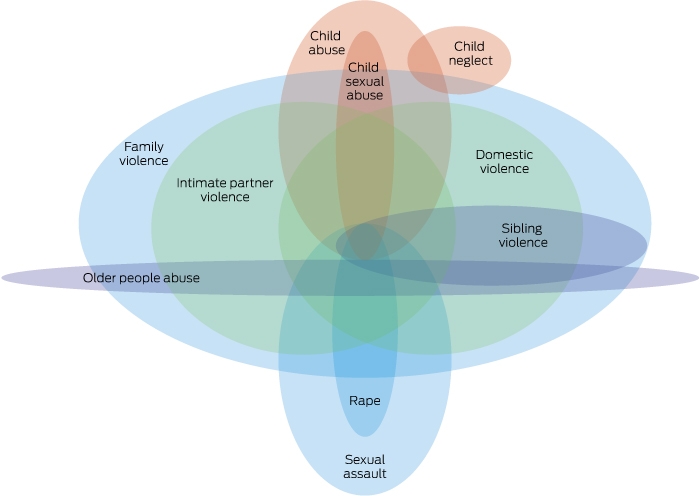
Family violence (Box) encompasses domestic violence, intimate partner violence and sibling violence. Cases of child neglect, child abuse, child sexual abuse, sexual assault and rape may occur in the context of family violence; however, these forms of violence may also occur outside the context of the family, such as institutional abuse or stranger violence. Likewise, older people abuse, which can include sexual abuse and rape, may occur in the context of family violence and also in institutional contexts, in the context of service provision or between people who have no familial or institutional relationships.
An increased understanding of the terminology used in the research literature enhances the capacity for delivering high quality care to women, children and men experiencing the health impacts of family violence.
Competing interests
No relevant disclosures.
Acknowledgements
We thank Riana Samuel for her contribution to this letter.
References
- World Health Organization. Responding to intimate partner violence and sexual violence against women: WHO clinical and policy guidelines. Geneva: WHO; 2013. http://apps.who.int/iris/bitstream/10665/85240/1/9789241548595_eng.pdf (accessed July 2017).
- Webster K. A preventable burden: measuring and addressing the prevalence and health impacts of intimate partner violence in Australian women — key findings and future directions. Sydney: Australia’s National Research Organisation for Women’s Safety; 2016. https://anrows.org.au/publications/compass-0/preventable-burden-measuring-and-addressing-the-prevalence-and-health-impacts (accessed July 2017).
- State of Victoria. Royal Commission into Family Violence. Summary and recommendations. Parl. paper no. 132 (2014–16). Melbourne: Royal Commission into Family Violence (Victoria); 2016. http://www.rcfv.com.au/Report-Recommendations (accessed July 2017).
- Royal Australian College of General Practitioners. Abuse and violence: working with our patients in general practice. 4th ed. Melbourne: RACGP; 2014. http://www.racgp.org.au/whitebook (accessed July 2017).
- Bedi G, Goddard C. Intimate partner violence: what are the impacts on children? Aust Psychol 2007; 42: 66-77.
Pharmaceutical Industry Payments to Patient Groups in Australia: A Longitudinal Analysis of a Decade of Disclosures
Ashleigh Hooimeyer, Annim Mohammad, Alice Fabbri, Lisa Parker, Kellia Chiu, Barbara Mintzes
Not Gone but Often Forgotten: Action Needed to Address Tuberculosis in Aboriginal and Torres Strait Islander Communities
Nikkita Joshua, Emma L. Smith, Eunice (Cheeky) Love, Christopher P. Lowbridge, Nicole Tukana, Amy Bowden, Megan A. Campbell, Dawn Casey, James Ward
Unshrouding Social Determinants: A Case for Standardised Data in Australia's Health Information Ecosystem
Christopher Ryan, Christine T. Shiner, Rebecca J. Harris, Carrie Lethborg, Vijaya Sundararajan
Inequity Is Our Biggest Killer: Looking Upstream to Tackle the Burden of Disease in Australia
Meggan J. Devery, Katie Brooker, Kitty-Rose Foley
Inequity Is Our Biggest Killer: Looking Upstream to Tackle the Burden of Disease in Australia
Lucio Naccarella, Katrina Plamondon, Alison Brown, Alexandra Kent, Sana Shahram, Donya Eghrari, Nicole M. Rankin, Stephanie Best, Marlena Klaic, Zoe Fehlberg, Michelle Lambert, Sue Crengle
Inequity Is Our Biggest Killer: Looking Upstream to Tackle the Burden of Disease in Australia
Saman Khalatbari-Soltani, Edward Jegasothy, Seye Abimbola, Anita van Zwieten