





Volume 207 - Issue 5
A useful additional resource for FRACP candidates
Author: Simon O'Connor
Med J Aust 2017; 207 (5): 192. || doi: 10.5694/mja17.00012
Published online: 4 September 2017
Published online: 4 September 2017
Mayo Clinic internal medicine board review
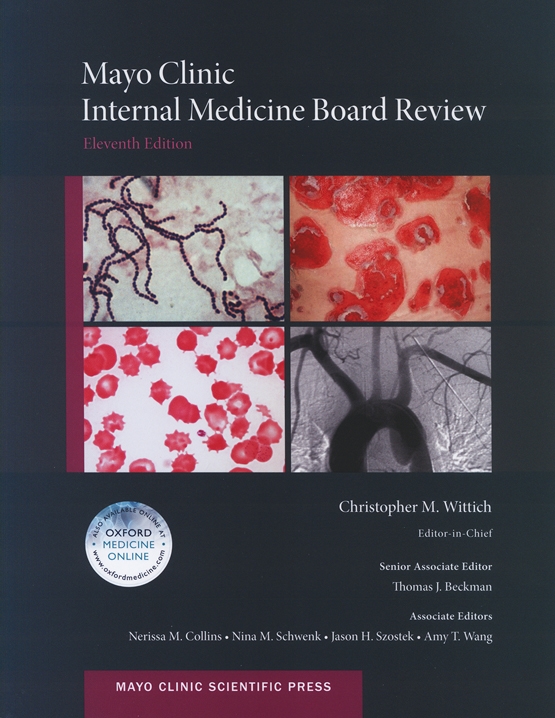
Mayo Clinic internal medicine board review. 11th ed, Christopher M Wittich, editor. Oxford University Press, 2016 (904 pp, £75). ISBN 9780190464868
Mayo Clinic internal medicine board review is aimed at doctors studying for their internal medicine board examinations, the United States equivalent to the Fellowship of the Royal Australasian College of Physicians (FRACP) examinations, and at physicians preparing for recertification exams (not yet required of Australian physicians).
The Mayo Clinic has a proud history of training physicians and providing continuing medical education. All of over 70 contributors to the new edition of its internal medicine board review have clinical and most have academic appointments at the clinic. The editors have managed to maintain a consistency of style throughout the publication. In the manner of a book designed to help with exams, there is a comforting certainty about the information presented; however, no references are given for any of the material, which restricts readers’ ability to pursue certain areas in more detail.
There are useful but not numerous revision questions at the end of each chapter. Important points are set out in coloured boxes and there are x-rays, scans and clinical photographs scattered rather irregularly throughout the text. Of relevance to the FRACP exam are the illustrations of high quality blood films and pathology slides.
Even at about 900 pages, the book is probably not quite detailed enough for the FRACP exam or for subspecialty trainees. It is, however, pitched at an excellent level for physicians wanting to keep themselves up to date in general medicine.
FRACP candidates have a number of choices available for their exam preparation. Harrison’s principles of internal medicine is probably the most popular. Now in its 19th edition, it is well over 2500 pages long and contains the references that are missing from the Mayo Clinic book. The annual Medical Knowledge Self-Assessment Program from the American College of Physicians, which is less detailed than Harrison’s, is also available to FRACP candidates.
It seems unlikely that Mayo Clinic internal medicine board review will replace these other options. However, it would certainly be a useful additional resource for FRACP candidates and a valuable reference for physicians.
Driving Implementation-Focused Change for Gender Equity in Medical Leadership: A Consensus-Based Priority-Setting Approach
Belinda Garth, Jenny Proimos, Thuy Vy Nguyen, Sally Cross, Sarah Whitelaw, Helena J. Teede
Advancing Gender Equality in Australian Healthcare Leadership: Why National Targets Matter and What It Means for Healthcare Employers
Belinda Garth, Nicole Pope, Jenny Proimos, Helena J. Teede
Centring Aboriginal and Torres Strait Islander Voices: A Framework for Culturally Safe and Racism-Free Healthcare
Elissa Elvidge, Roianne West, Karen Nicholls, Kiara Harvey, Yeena Thompson, Geraint B. Rogers, Yin Paradies
Medical Colleges Have an Obligation to Ensure Full Participation in Clinical Quality Registries
Robert J. Aitken, Julian A. Smith, Guy J. Maddern