




Volume 207 - Issue 11
Understanding the function of health protection activities within public health practice
Author: Kudzai N Kanhutu
Med J Aust 2017; 207 (11): 478. || doi: 10.5694/mja17.00887
Published online: 11 December 2017
Published online: 11 December 2017
Health protection: principles and practice
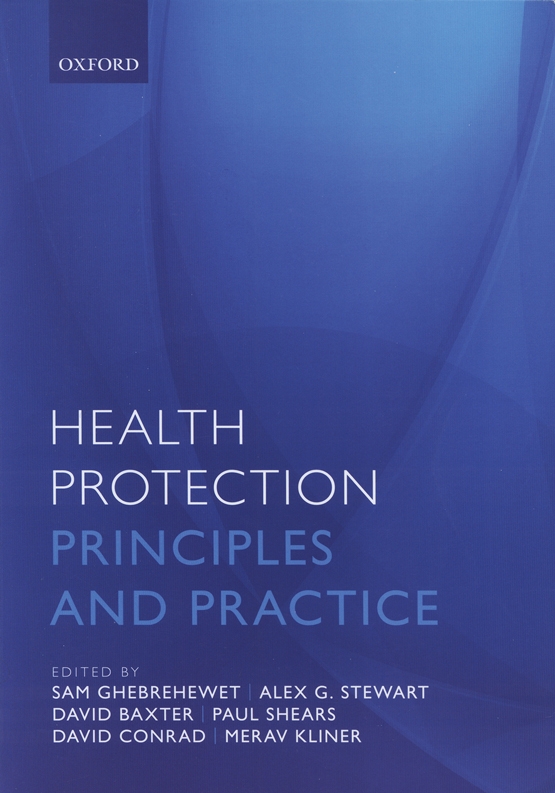
Health protection: principles and practice.
Ghebrehewet S, Stewart AG, Baxter D, et al; editors. Oxford University Press; 2016 (£34.99; 480 pp). ISBN 9780198745471
Health protection: principles and practice aims to provide “an accessible and practical core text” in response to a perceived gap in the literature focused on health protection. The opening chapters clearly explain the positioning of health protection within the public health system in the United Kingdom. Here, health protection is considered a principal domain of public health practice alongside health improvement and health-care public health. Health protection can be further subdivided into its three key functions of communicable disease control, emergency preparedness resilience and response, and environmental hazard protection.
The editorial panel and contributors list features a cross section of academics, National Health Service directors, and eminent public health practitioners. Reflecting the expertise of the group, the sections on communicable disease control are highly evolved. In particular, the use of case-based or situational narratives to explore various health protection topics is applied to excellent effect.
Having set out to give a comprehensive review of all three domains of health protection — communicable disease control, emergency preparedness resilience and response, and environmental hazard protection — the last two are comparatively under-represented both in page numbers and breadth of discussion. By the editors’ own admission, the field of environmental hazard protection is “less well developed”. In light of recent tragic events in the UK (ie, Grenfell tower fires) and major climate change-related adverse events, there will be plenty of scope to add richly instructive content for future editions. Given the emphasis on a UK systems-based approach, readers working in low resource settings or those managing situations with complex multidrug-resistant organism epidemiology will need to supplement their reading further.
In summary, Health protection: principles and practice is successful in providing an insight into the function of health protection activities within public health practice. Students or the non-clinically trained will benefit enormously from the pragmatic rather than technical focus taken. The inclusion of a large appendix of infectious diseases study aids, or “SIMCARDs”, will prove a boon for last-minute exam studying. Moreover, chapters on health protection tools, such as business continuity, surveillance strategies and quality assurance and audit cycles, will have broad appeal for novices and those with advanced public health skills alike.
Competing interests
No relevant disclosures.
Designing Housing to Reduce Overcrowding-Related Harms: Rheumatic Heart Disease as the Canary in the Coal Mine
Simon Quilty, Veronica Matthews, Angus Baumann, James Marangou, Bo Remenyi, Gavin Wheaton, Serena Morton Nabanunga, Norman Frank Jupurrurla, Simon Robinson, Steve Mintern, Cary Duffield, Joshua R. Francis, Paul C. Memmott
Australian Climate Leadership in 2026: COP-Out or Step-Up for Health?
Catherine G. A. Pendrey, Angie Bone, Aletha Ward, Francis Nona, Michelle Isles, Paul M. Kelly, Nicholas J. Talley
The impact of the Breast Screen NSW transition from film to digital mammography, 2002–2016: a linked population health data analysis
Rachel Farber, Nehmat Houssami, Katy J L Bell
Shifting focus to adolescent wellbeing and inclusive participation in the digital age
Allyson R Todd, Elena Wang, Stephanie R Partridge
The CURE Asthma roadmap
Gary P Anderson, Anthony Flynn, Phil G Bardin, John D Blakey, Shyamali C Dharmage, Paul Foster, Peter G Gibson, Adam Jaffe, Alan James, Christine R Jenkins, Sundram Sivamalai, Peter D Sly, Guy B Marks, Vanessa M McDonald, Judy Wetttenhall
Protecting public interest journalism as a public health good
Bronwyn Fredericks, Neha Lalchandani, Melissa A Sweet, Alex Cramb, Carmel Williams