




Volume 206 - Issue 5
The dangers of non-medical laser therapy for pigmented lesions
Authors: Harini Rajgopal Bala, Yan Pan and Rosemary L Nixon
Med J Aust 2017; 206 (5): 229. || doi: 10.5694/mja16.01156
Published online: 20 March 2017
Published online: 20 March 2017
To the Editor:
We present a case that illustrates the need for careful medical evaluation of pigmented lesions, and the potential risks associated with laser treatment by non-medical providers.
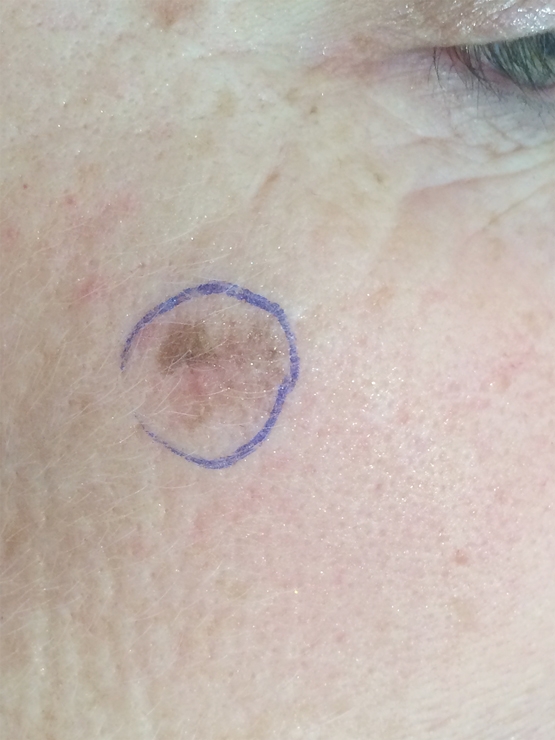
A 56-year-old nurse presented to the Victorian Melanoma Service for management of a biopsy-proven lentigo maligna on her right cheek. The patient described an 18-month history of a growing pigmented lesion that had initially been treated by a non-medical cosmetic clinic using laser. There had been no formal clinical or dermoscopic assessment of the pigmented lesion before the laser treatment. Although initially there was complete clearance of the pigment, the lesion recurred over the following 12 months (Box), prompting the patient to seek medical advice. Relevant melanoma risk factors included a family history of melanoma and significant prior sun exposure.
Pigmented lesions should only be treated by medical experts given that the diagnostic possibilities range from benign to malignant pathologies, including melanoma.1 There is an increasing tendency in the aesthetic industry to treat pigmented lesions with modalities such as laser, as if they were merely a cosmetic problem. The potentially fatal consequences of laser treatment of pigmented lesions performed by untrained providers has been described in the literature.1,2 However, causation of melanoma by laser, with resultant malignant proliferation or transformation, has not been proven.2 Nevertheless, performing laser treatments on undifferentiated pigmented lesions can delay diagnosis and lead to more devastating outcomes, including metastasis.2,3
To maintain patient safety, pigmented lesions should be assessed medically before any cosmetic treatment.2,4 There is a vast array of unregulated, non-medical cosmetic practices that may use destructive treatments, such as laser, for pigmented lesions. It is therefore essential to increase the awareness of the general public in the face of this potential danger.
Competing interests
No relevant disclosures.
References
- Larsen T, Nielsen M, Lindskov R, et al. Metastases from malignant melanoma after laser treatment of undiagnosed pigmented skin lesions. Lasers Med Sci 2013; 28: 1403-1404.
- Delker S, Livingstone E, Schimming T, et al. Melanoma diagnosed in lesions previously treated by laser therapy. J Dermatol 2016; 44: 23-28.
- Zipser MC, Mangana J, Oberholzer PA, et al. Melanoma after laser therapy of pigmented lesions — circumstances and outcome. Eur J Dermatol 2010; 20: 334-338.
- Gottschaller C, Hohenleutner U, Landthaler M. Metastasis of a malignant melanoma 2 years after carbon dioxide laser treatment of a pigmented lesion: case report and review of the literature. Acta Derm Venereol 2006; 86: 44-47.
Diagnosing Acute Kava Dermopathy: A Case Report of a Characteristic Cutaneous Eruption
Ali Abid, Nicholas Allen, Abeer Hagelamin, Christopher Henderson, Artiene Tatian
Localised Herpes Simplex Following Midline Laparotomy
Jessica S. Bulluss, Paul Chee, Matthew J. Verheyden
No silver lining with health misinformation: argyria caused by intentional silver consumption
Luke Collins, Logesh Palanikumar, Stephen Bacchi
Lingual Raynaud phenomenon
Michael Taggart, Mina John
Melasma in the male: a less well recognised entity
Tim Aung, Rowland Noakes
Age group‐specific changes in keratinocyte cancer treatment rates in Australia, 2012–2021: a retrospective cohort study based on MBS claims data
Catherine M Olsen, Nirmala Pandeya, Rachel E Neale, David C Whiteman