




Volume 206 - Issue 2
Crusted scabies in northern and central Australia — now is the time for eradication
Authors: Simon Quilty, Thomas S Kaye and Bart J Currie
Med J Aust 2017; 206 (2): 96. || doi: 10.5694/mja16.00809
Published online: 6 February 2017
Published online: 6 February 2017
n/a
To the Editor:
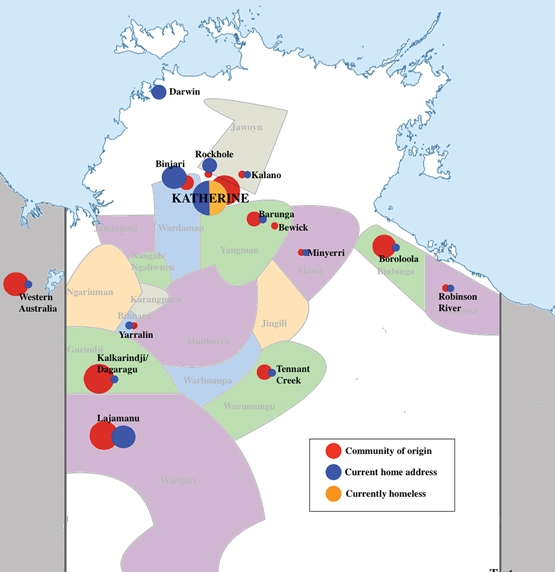
There are very high rates of crusted scabies in remote Indigenous Australian communities, which is an important driver in skin infections and consequent illnesses, such as invasive streptococcal and staphylococcal sepsis, post-streptococcal glomerulonephritis and acute rheumatic fever.1,2 Patients with crusted scabies serve as sentinels that drive ongoing community infection. In order to understand the associated factors and movement patterns of patients with crusted scabies, we audited all the cases of patients presenting to Katherine Hospital.
Over a 5-year period, there were 42 admissions for treatment of crusted scabies, representing 30 patients of whom four presented on multiple (up to six) occasions with re-infection — 14 patients with a diagnosis confirmed by skin scraping and 16 with a presumptive diagnosis. All 30 patients were Indigenous people with comorbidities, including diabetes (n = 13), hazardous alcohol use (n = 13) and chronic renal impairment (n = 5). Moreover, four patients were infected with human T-lymphotropic virus type 1 and 7 patients were antinuclear antibody positive. The 5-year cumulative regional rate of crusted scabies was none for non-Indigenous Australians and 3 per 1000 for Indigenous Australians. By 6 months after the conclusion of the 5-year period, seven patients were deceased.
Six patients were recorded as being homeless at the time of admission; however, this figure is likely to be an underestimation as homelessness is self-reported by patients, many of whom consider a tent in a fringe-dwelling town camp to be home. While 27 patients reported their home to be a remote community, only 14 of them were living in their home community at the time immediately before admission, thus 13 had either previously relocated to Katherine or were at least temporarily homeless (Box).
Rates of homelessness in the region are 31 times higher than the national average,3 and extrapolating to Indigenous status, we estimate that one in four Indigenous people in the Katherine region is homeless.
Crusted scabies has recently been listed as a notifiable disease in the Northern Territory, raising opportunities for eradication. Regional scabies control programs have been successful in reducing the disease burden,4 and they now need to be extended and tailored to cater for extreme burdens of homelessness and inter-regional and interstate population movements. Regional and state health services need to work closely together to overcome these challenges.
Homelessness is a profound problem and needs to be comprehensively managed with long term strategic policies immune from cyclic political interference.
Box – Distribution of patients presenting with crusted scabies
The circle size is proportional to the number of cases from a community. Red indicates the remote town community of origin, and blue shows the town where the patient was living immediately before admission. The map overlays existing Indigenous tribal groups (in watermark) and state boundaries, with town communities of origin in bold.
Competing interests
No relevant disclosures.
References
- Romani L, Steer AC, Whitfeld MJ, Kaldor JM. Prevalence of scabies and impetigo worldwide: a systematic review. Lancet Infect Dis 2015; 15: 960-967.
- Currie BJ. Scabies and global control of neglected tropical diseases. N Engl J Med 2015; 373: 2371-2372.
- Australian Bureau of Statistics [website]. Census of population and housing: estimating homelessness, 2011 (ABS Cat. No. 2049.0). Canberra: ABS, 2012. http://www.abs.gov.au/ausstats/abs@.nsf/mf/2049.0 (accessed Nov 2016).
- Lokuge B, Kopczynski A, Woltmann A, et al. Crusted scabies in remote Australia, a new way forward: lessons and outcomes from the East Arnhem Scabies Control Program. Med J Aust 2014; 200: 644-648.
Diagnosing Acute Kava Dermopathy: A Case Report of a Characteristic Cutaneous Eruption
Ali Abid, Nicholas Allen, Abeer Hagelamin, Christopher Henderson, Artiene Tatian
Localised Herpes Simplex Following Midline Laparotomy
Jessica S. Bulluss, Paul Chee, Matthew J. Verheyden
No silver lining with health misinformation: argyria caused by intentional silver consumption
Luke Collins, Logesh Palanikumar, Stephen Bacchi
Lingual Raynaud phenomenon
Michael Taggart, Mina John
Melasma in the male: a less well recognised entity
Tim Aung, Rowland Noakes
Age group‐specific changes in keratinocyte cancer treatment rates in Australia, 2012–2021: a retrospective cohort study based on MBS claims data
Catherine M Olsen, Nirmala Pandeya, Rachel E Neale, David C Whiteman