




Reflections
Medical history
Volume 205 - Issue 11
The development of vascular surgery in Brisbane: some reminiscences
Author: H Reginald Magee
Med J Aust 2016; 205 (11): 506-508. || doi: 10.5694/mja16.00313
Published online: 12 December 2016
Published online: 12 December 2016
A former senior vascular surgeon remembers the progress of his specialty in Brisbane
A former senior vascular surgeon remembers the progress of his specialty in Brisbane
Today, peripheral vascular surgery is regarded as a routine procedure, but this was not always so. Prior to its development, the description of a patient with arterial disease could sound like this: “… wasted, toxic, sleepless and exhausted, overwhelmed by that intense depression which only the active mind of an old person can suffer, [the patients] wait for the inevitable end — long overdue amputation.”
In the 1950s, surgeons began to take a greater interest in the treatment of arterial disease, as there was a better understanding of the pathology of the condition, a development facilitated by improved radiological procedures.
In Brisbane, general surgeons dealt with arterial conditions that came under their care, including those caused by trauma, as best they could. Sympathectomy and amputation were the usual procedures for ischaemic disease, while Sir Clarence Leggett (1911–2002) told me that he had treated a number of popliteal aneurysms by femoral artery ligation in Hunter’s (adductor) canal.
At the Brisbane General Hospital, patients with diabetes and ischaemic disease of the feet were managed conservatively by physician Otto Hirschfeld (1898–1957). They sat in bed for what seemed like ages with their feet under a bed cradle; the heat of an electric light bulb encouraged the drying process. Dr Hirschfeld would occasionally call for scissors and forceps, and assisted the natural separation process by cutting through a few tendons to complete the amputation.
Aortic aneurysms, ruptured or otherwise, were not treated, although Clem Windsor (1923–2007) told me that his father, Henry Windsor, visiting surgeon at the Mater Hospital, often injected the wall of the aneurysm with a sclerosant in the hope that the fibrosis might prevent rupture.
The people
Brisbane General Hospital/Royal Brisbane Hospital
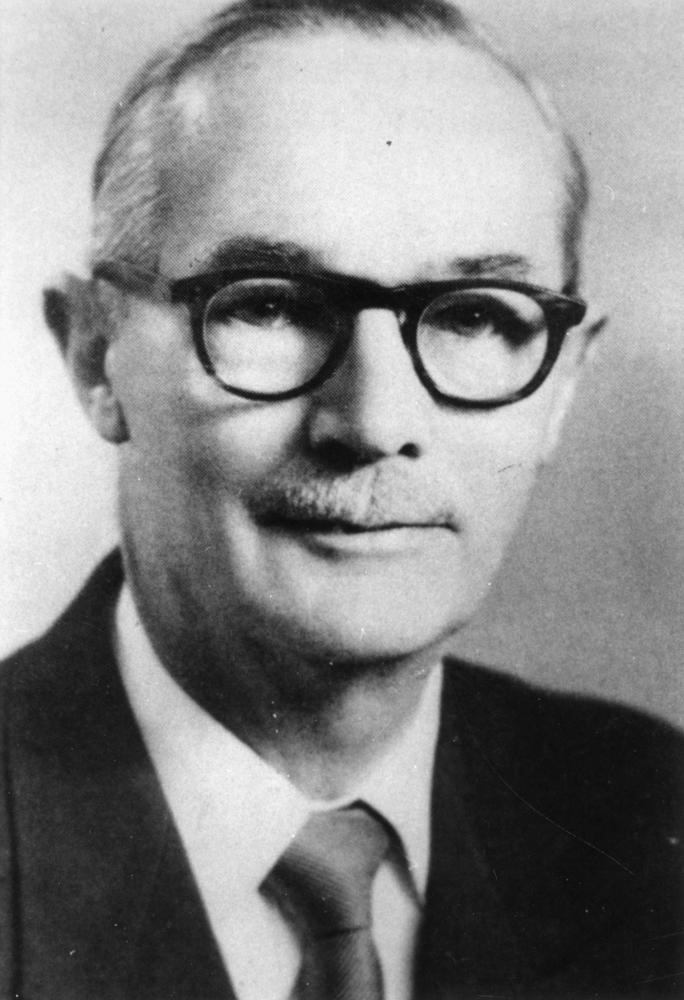
Professor Neville Sutton (1892–1981; Box 1) was a true general surgeon, practising in an era before specialist neurosurgeons, thoracic surgeons, urologists and plastic surgeons were available in Brisbane. He performed repairs of patent ductus arteriosus, ligations of the common or internal carotid artery for subarachnoid haemorrhage, and thoraco-lumbar sympathectomy for hypertension, but did not venture into any peripheral or abdominal vascular procedures.
Doug Friend (1924–1998) returned from the United Kingdom in 1954, and was appointed to the Brisbane General Hospital in 1956. He had worked at Portsmouth, and often visited the prominent vascular surgeons Charles Rob (1913–2001) and Felix Eastcott (1917–2009) at St. Mary’s Hospital in London. During his time in Portsmouth, he harvested aortas and arteries to send up to St Mary’s for their operations. He recounted that a patient with a leaking aneurysm arrived at his hospital, and Eastcott had come down to Portsmouth to perform the operation: with success.
When Doug Friend took up his position at the Brisbane General Hospital, he was keen to establish an artery bank, but the superintendent, Aubrey Pye, was not agreeable. The operations initially performed were endarterectomies and other fairly simple procedures. The first aortic endarterectomy for Leriche syndrome (aorto-iliac occlusive disease) was undertaken in 1957. For aortic grafts, Doug tried sewn polyester material and Ivalon sponge, but, without adequate instruments or proper vascular clamps, the results of operations with these primitive prostheses were disappointing. Hypothermia was used in the earliest operations, which may have contributed to the higher mortality.
Bob Shannon (1928–1991), who had returned from England in 1956, became the surgical supervisor. In this position one had to be interested in vascular surgery, particularly ruptured aneurysms. Bob operated on his first aneurysm in June 1958, using a homemade graft with a good initial result, but the patient had to be explored on the fourth post-operative day for bleeding. Blood was oozing through the front of the shirt material, and control was achieved by wrapping a sleeve of material around the graft. Following this, the patient did well, but when about to be discharged died suddenly from a massive pulmonary embolus. Shannon’s first successful graft was performed on 2 March 1959; the 69-year-old patient, who had a ruptured abdominal aortic aneurysm, was the first with a ruptured aneurysm at the Royal Brisbane Hospital (and probably in Queensland) to survive such an operation.
Princess Alexandra Hospital
Sam Mellick (b. 1925) (Box 2) returned from the UK in 1955, and was appointed to the staff of the Princess Alexandra Hospital as a general surgeon when it opened in August 1956. At the Royal Brisbane Hospital, vascular surgery was handled by the general surgeons.
Neville Davis (1924–2008) and Clem Windsor had attempted the repair of a ruptured aortic aneurysm, but without success. Clem repaired a popliteal aneurysm with a homograft he had taken from the corpse of a man who had fallen from the balcony of Marr’s Boarding House in Brisbane. Clem remembered that the graft was kept in a jar of formalin for a week before being used; it functioned well after the operation, and lasted the life of the patient. However, the patient’s other popliteal aneurysm thrombosed, and an amputation was necessary. Porto-caval shunts, sympathectomies and amputations were also undertaken at the Princess Alexandra.
Sam Mellick was encouraged to undertake vascular surgery, and conducted experimental work, including inserting arterial grafts into dogs. The first aortic aneurysm at the hospital was operated on Good Friday, 4 April 1958, in an operation that lasted 7 hours. The patient survived the procedure, but died a few days later, the suspected cause being a fluid overload.
Mater Hospital
At the Mater Hospital, surgeon Derek Sapsford (1915–2004) took an interest in vascular surgery, and performed the first operation on an aneurysm there in 1959, the operation lasting 8½ hours. Among the difficulties experienced was the lack of proper vascular instruments, and bowel clamps were used to control the vessels. The patient nevertheless survived, dying of a myocardial infarct 25 years later.
The grafts
The French surgeon Charles Dubost (1914–1991) undertook the world’s first successful repair of an aortic aneurysm in 1951, using a homograft. In the UK, homografts, either frozen or freeze-dried, were also used in early operations. In 1947, Dutch-American surgeon Arthur Voorhees (1921–1992) had noticed the deposition of fibrin on a silk thread in the ventricle of a dog, and on the basis of this observation he developed the concept of using cloth as a prosthesis. Numerous materials were tried: vinyon-N cloth, nylon, terylene (Dacron), teflon, and polyvinyl alcohol sponge.
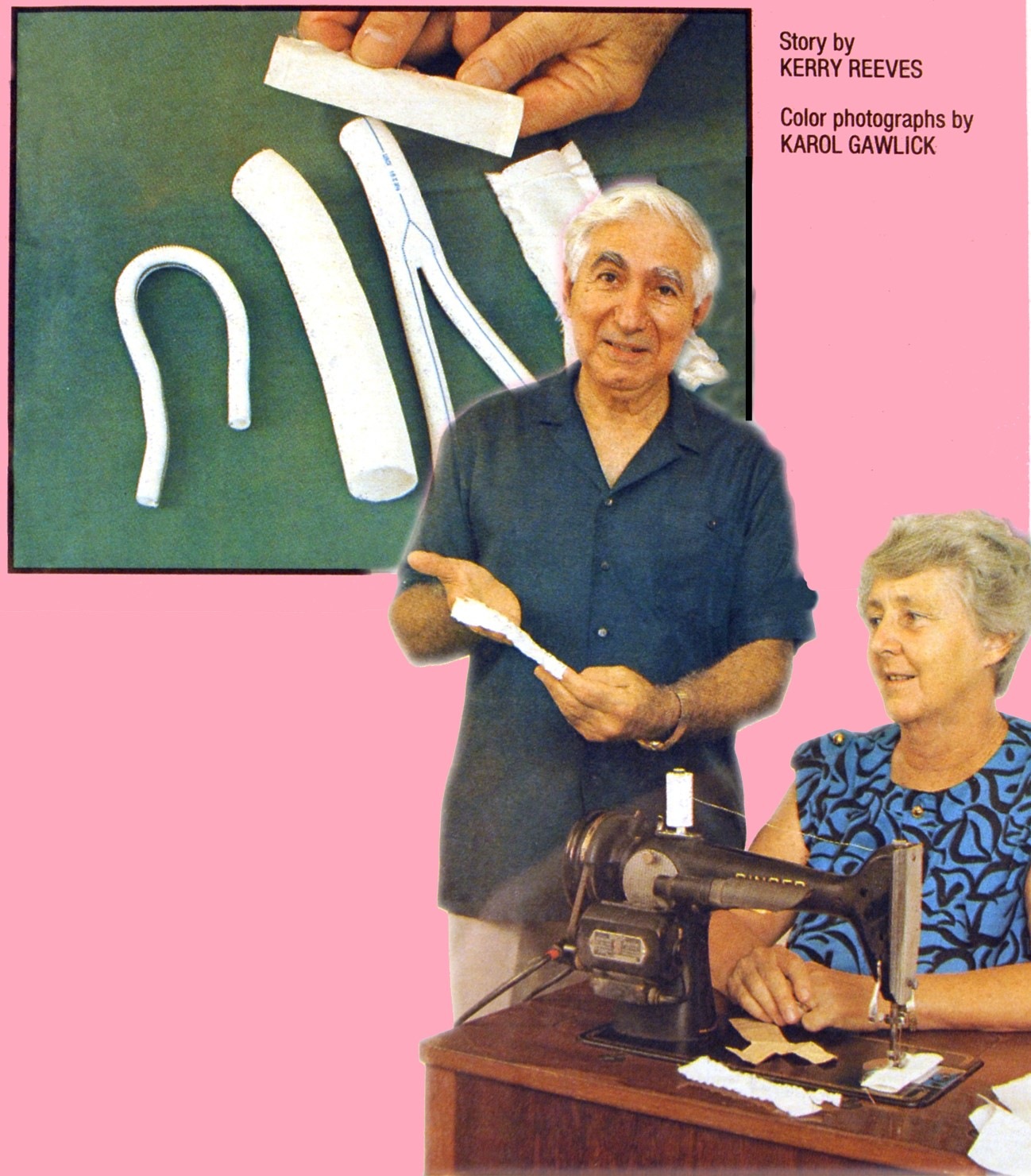
The first grafts used in Brisbane were made from terylene. Doug Friend had brought some terylene shirts back from the UK, and Sam Mellick obtained some material and thread from Harry Guinsberg’s clothing factory in Fortitude Valley (Brisbane). Grafts were prepared on a Singer sewing machine, and care was taken with the stitching to avoid fraying. Ivalon sponge was an alternative basis material; the sponge was wrapped around a mould to form the graft, covered with a bandage, and autoclaved. The resulting graft had the appearance of brown toast, was rather hard, and difficult to sew. The greatest advance in vascular surgery was probably the adoption of textile industry technology for the production of suitable grafts.
The first manufactured grafts brought to Brisbane were star grafts made of crimped nylon. Besides being expensive, they were hard, stiff, and difficult to sew, and also tended to kink. Dacron grafts later became available, and continue to be used to the present day. Teflon cloth as a graft material was not as successful, as the false intima did not adhere to it very well. American vascular surgeon Michael Ellis DeBakey (1908–2008) commented at a meeting in Sydney that “Teflon might be alright for skillets, but it’s no good for grafts.”
The operations
Early operations on aortic aneurysms involved the complete resection of the aorta and common iliac arteries, followed by stitching of the graft with a double layer of sutures. This was later found to be unnecessary, and repair could be achieved with a much simpler re-bore and re-sleeve, reducing the operation time from 8½ hours to about 45 minutes in simpler cases.
Prior to the introduction of the Fogarty catheter in the early 1970s, operating on an embolectomy involved attempting to aspirate the obstructing material. I remember assisting Bob Mitchell (1927–2002) with the removal of a brachial embolus, utilising an endarterectomy ring stripper to successfully remove the thrombus. Aorto-iliac embolectomy in the early days was a major and rather hazardous procedure.
The criteria established at this time for the operation of an embolectomy were simple:
Good leg + good patient: no operation;
Bad leg + good patient: operation;
Good leg + bad patient: no operation;
Bad leg + bad patient: no operation.
The Fogarty catheter offered the greatest advance in the treatment of embolic obstruction, making it into a much simpler procedure, and one that could be done under local anaesthesia.
Thrombo-endarterectomy, either open or using the ring stripper, was a common operation for femoro-popliteal disease, but was later abandoned in favour of bypass grafts, which achieved better long term results.
Some carotid surgery was undertaken in the late 1950s. Claude Mann (1918–2014) conducted a number of these operations at Greenslopes Hospital, and noted that the main difficulty was ensuring blood flow to the brain. At the Princess Alexandra Hospital, early cases used hypothermia. The cooling and re-warming processes added to the operation time, and the overall procedure occupied the entire day. Local anaesthesia was adopted later, but results only improved when the shunting technique improved.
The visit to Brisbane of Charles Rob as the Edwin Tooth Professor in 1962 gave a boost to carotid endarterectomy and to vascular surgery in general.
Such were the beginnings of vascular surgery in Brisbane, and today it is a routine procedure in both the public and private hospitals. The history of any development is interesting, and we should not forget it. Difficulties and problems are made to be solved or to be worked around, and it is the methods employed that provide this interest. In another 50 or 100 years, surgeons may look back at our methods of diagnosis and treatment, and at our efforts in developing endovascular procedures.
Competing interests
No relevant disclosures.
Acknowledgements
This article is based on a lecture I delivered at the Royal Brisbane Hospital festschrift for William Egerton on 8 October 1997. Data for the original lecture were obtained by personal communication with the surgeons mentioned.
Provenance: Not commissioned; externally peer reviewed.
Prisoner of war pathology in Changi, 1942–1945
Kate Ariotti, Elizabeth Roberts‐Pedersen
Should medical eponyms continue to be used in everyday practice?
Leya Nedumannil, Diana Lewis
100 years on: the first use of insulin in Australia
Sophie Templer
Reflections on the life and career of Professor Dame Valerie Beral AC DBE FRS FRCOG FMedSci (1943–2022)
Karen Canfell, Bette Liu, Emily Banks
The Honourable Dr Donald James Grimes AO
Michael Kirby, Patti Warn
From wipeout to drill out: a history of exostosis management and Australian surfing
Alon Taylor, Hannah North, Narinder P Singh, Paul A Fagan