




Volume 205 - Issue 11
Acute coronary syndrome on Friday the 13th: a case for re-organising services?
Authors: Majd B Protty, Mustafa Jaafar, Sahar Hannoodee and Phillip Freeman
Med J Aust 2016; 205 (11): 523-525. || doi: 10.5694/mja16.00870
Published online: 12 December 2016
Published online: 12 December 2016
Superstition and statistics: are some days better than others for heart attacks?
Abstract
Background: Friday the 13th is described as an “unlucky” day that brings misfortune. There are few studies on the question, and none on its effect in cardiovascular patients. The recently misreported “weekend effect” has led to changes in the junior doctor contract in England, providing greater staffing levels on weekends. Should we make similar provisions for Friday the 13th?
Methods: A retrospective analysis of a large database for patients admitted to hospitals in South Wales with an acute coronary syndrome (ACS) during 1999–2014. Mortality rates for 217 admission day number/name combinations and for Friday the 13th were compared in a Cox proportional hazards regression model.
Results: 56 062 ACS patients were identified. There were no significant differences in 13-year mortality between most admission dates (211 of 216) and Friday the 13th. However, a statistically significant reduction in mortality was identified for five dates: Thursday the 15th (HR, 0.77; 95% CI, 0.59–0.999), Wednesday the 18th (HR, 0.76; 95% CI, 0.58–0.99), Monday the 28th (HR, 0.76; 95% CI, 0.57–0.99), Monday the 30th (HR, 0.75; 95% CI, 0.57–0.99) and Tuesday the 31st (HR, 0.71; 95% CI, 0.51–0.99).
Conclusion: On most days, there was no difference in the 13-year mortality rate for patients admitted with their first ACS from that for “unlucky” Friday the 13th. However, patients admitted on five day/number combinations were 20–30% more likely to survive at 13 years. These findings could be explained by subgroup analysis inflation of the type I error, although supernatural causes merit further investigation. Our findings should be taken into account in future junior doctor contract negotiations, and may provide a case for reduced staffing levels on these lucky days.
Friday the 13th has long been associated with misfortune, anecdotal evidence suggesting that it coincides with catastrophes and danger. A handful of investigations published in medical journals have investigated this association. However, these studies were limited by small sample sizes, and they did not investigate the possibility of a “lucky day” corresponding to this fateful “unlucky” day.
Traditionally, scientists have dismissed the misfortune associated with Friday the 13th as an urban legend, a myth, or even an old wives’ tale. However, we feel that there are too few published studies of the effects of superstition and Friday the 13th, despite the anecdotal evidence. Recently misreported data concerning the so-called “weekend effect” — increased hospital mortality associated with weekend admissions1 — has led to changes in the junior doctor contract in England that provide more staff coverage to compensate for the alleged effect. Should we make similar provisions for Friday the 13th?
The history books are unclear about the exact origins of the fear of Friday the 13th, or paraskevidekatriaphobia. In Europe, one theory is that humans initially used their ten fingers and two feet to count, and greeted what came after 12 with suspicion.2 Other theories suggest that this was the fateful day when Adam (believed to be the first human) was tempted with the forbidden fruit.2 Finally, a view widespread in the Western world is that Jesus Christ was crucified on a Friday, after 13 people were present at the Last Supper. Regardless of the origins of the fear of this date, it has certainly become entrenched in Western culture that it is unlucky if the 13th day of the month falls on a Friday. In the United States alone, it is estimated that about US$900 million in business and productivity is lost on Friday the 13th.3
A number of studies have examined correlations between this date and health problems. One study found that there are more road traffic deaths on Friday the 13th than on other days of the year;4,5 US data show an avoidance of caesarean deliveries on Friday the 13th and, among the Chinese population, an increase in the number of planned births on their lucky day, the 8th day of the month.6 Bruce and colleagues, in a wide-ranging study of emergency department admissions, found a significantly greater number of patients attended with penetrating trauma on Friday the 13th.7 Other studies have reported a lack of an effect of Friday the 13th on admissions and mortality.8-12 Nevertheless, there seems to be sufficient anecdotal evidence that superstition can affect our hospitals to justify re-thinking how we provide health care on such dates.
In this study, we sought to compare, in a large sample population of cardiovascular patients, the mortality for patients admitted to hospital with an acute coronary syndrome (ACS) on Friday the 13th with that for other dates in the year.
Methods
Data sources
We conducted a retrospective cohort analysis of data from the ACS database of South Wales, United Kingdom (not to be confused with New South Wales, Australia), linked with secondary care data from the Patient Episode Database for Wales (PEDW), primary care data from general practices in Wales, and mortality data from the Office of National Statistics (ONS).
The South Wales ACS registry is a retrospective registry based on data identified in the PEDW database; it includes data for all patients admitted to a South Wales hospital with their first ACS (non-ST elevation myocardial infarction or unstable angina) during 1999–2014. Mortality data were extracted from ONS statistics, including date and cause of death as documented on the official death certificate.
Data linkage
The data were pseudo-anonymised and linked in the Secure Anonymised Information Linkage (SAIL) databank, a national Welsh database that links the widest possible range of person-based data with robust anonymisation procedures.13,14 It contains over 500 million person-based records, and is operated and administered by the Health Information Research Unit, Swansea University, for the purposes of real world health-related research.
Statistical analysis
Analysis was carried out in SPSS 19.0 (IBM) and Excel (Microsoft). Outcome data for mortality (to 5000 days ≈ 13 years) were extracted for all patients included in the analysis. Missing mortality data resulting from loss to follow-up were right-censored. Records were subgrouped by admission day number and name; for example, “13 Friday”, “12 Friday”, “13 Monday”.
Survival was analysed in a Cox proportional hazards regression model, comparing mortality rates for all 216 combinations of day number and name. Hazard ratios for mortality and survival curves were generated. P < 0.05 was deemed statistically significant.
Ethics approval
Ethics approval was not required, as the data were made available through a data access agreement between SAIL and Cardiff University, complying with both parties’ data access policies for undertaking research.
Results
A total of 56 062 patients who had an ACS in South Wales during 1999–2014 were identified. The distribution of patients by admission day number and name is included in online Appendix 1.
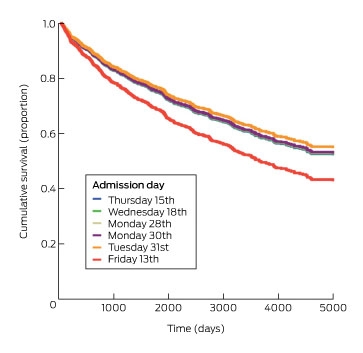
For most admission day/date combinations (211 of 216), there was no statistically significant difference in mortality between admissions on those days and those on Friday the 13th (Appendix 2). However, a statistically significant reduction in mortality was identified for five dates: Thursday the 15th (hazard ratio [HR], 0.77; 95% confidence interval [CI], 0.59–0.999), Wednesday the 18th (HR, 0.76; 95% CI, 0.58–0.99), Monday the 28th (HR, 0.76; 95% CI: 0.57–0.99), Monday the 30th (HR: 0.75; 95% CI, 0.57–0.99), and Tuesday the 31st (HR, 0.71; 95% CI, 0.51–0.99).
The survival function curves for these dates and the comparator (Friday the 13th) are shown in the Box, indicating a favourable outcome for patients admitted on these dates compared with Friday the 13th.
Discussion
We found that 13-year mortality rates for patients admitted with their first ACS on “unlucky” Friday the 13th during 1999–2014 were similar to those for most other calendar dates. Surprisingly, however, we also identified five potentially “lucky” days on which mortality rates were significantly lower, by 20–30%.
Our findings suggest that patient mortality is affected by the date on which they are admitted to hospital. Ours is the first study in any country to identify potentially “lucky” admission days, with reduced mortality at up to 13 years of follow-up, which may be relevant to health care authorities in terms of service planning. Additionally, this is the first study to examine the effect of Friday the 13th in cardiovascular medicine.
It is worth noting that all five “lucky” days were weekdays. It is unclear why, but the “weekend mortality” effect perhaps plays a role. Indeed, the “weekend mortality” study by Freemantle and colleagues1 has been frequently cited in medical literature and in the popular media, and has been the basis of the case for expanding 7-day services. In their study, however, Wednesday was the reference weekday, and the weekend was defined as Friday to Monday. This is not consistent with our findings of two lucky Mondays and the absence of a “weekend mortality” effect. Nevertheless, our findings should be taken into account in future junior doctor contract negotiations, and may support a case for reducing services or staffing levels on the “lucky days”, given the favourable outcomes that can only be explained by a supernatural phenomenon.
The strengths of our study include our using data for large number of patients from real-life national records, reducing the likelihood of selection bias. In addition, by using the SAIL database, we were able to determine patient-specific mortality outcomes with anonymised indices.
The limitations of our study are related to the selective nature of the subgroup analysis. It has been reported in the literature that this approach reduces statistical power, increases variance, and causes overinterpretation of what has been described as a “play of chance”.15 This happens because, even with statistical significance defined as P < 0.05, there is a 1 in 20 chance that a “significant” result is a false positive. Consequently, by dividing our data into 217 subgroups we would expect as many as ten statistically significant results. This has previously been described and observed in the subgroup analysis of the landmark cardiovascular trial, the “International Study of Infarct Survival” (ISIS-2), in which the large, well randomised population was divided into 12 astrological star sign groups, two of which proved to be associated with adverse effects linked to aspirin use.15,16 Clearly, therefore, our findings need to be interpreted with extreme caution, given this inflation of the type I error.
Conclusion
For most calendar days, there was no difference in mortality rates for patients admitted with their first ACS from that of “unlucky” Friday the 13th. However, patients who were admitted on Thursday the 15th, Wednesday the 18th, Monday the 28th, Monday the 30th or Tuesday the 31st were 20–30% more likely to survive at least 13 years, suggesting that these dates are potentially “lucky” dates. Despite this finding, we would advise against delayed hospital presentation for patients who experience chest pain on other dates.

Competing interests
No relevant disclosures.
Acknowledgements
This project received no funding.
References
- Freemantle N, Ray D, McNulty D, et al. Increased mortality associated with weekend hospital admission: a case for expanded seven day services? BMJ 2015; 351: h4596.
- Emery D. Why Is Friday the 13th considered unlucky? About Entertainment [website]. Aug 2016. http://urbanlegends.about.com/cs/historical/a/friday_the_13th.htm (accessed June 2016).
- Handwerk B. Why does Friday the 13th scare us so much? National Geographic [website]. June 2014. http://news.nationalgeographic.com/news/2014/06/140612-friday-superstition-taboo-fear-luck-triskaidekaphobia-phobia/ (accessed June 2016).
- Nayha S. Traffic deaths and superstition on Friday the 13th. Am J Psychiat 2002; 159: 2110-2111.
- Scanlon TJ, Luben RN, Scanlon FL, Singleton N. Is Friday the 13th bad for your health? BMJ 1993; 307: 1584-1586.
- Almond D, Chee CP, Sviatschi MM, Zhong N. Auspicious birth dates among Chinese in California. Econ Human Biol 2015; 18: 153-159.
- Lo BM, Visintainer CM, Best HA, Beydoun HA. Answering the myth: use of emergency services on Friday the 13th. Am J Emerg Med 2012; 30: 886-889.
- Exadaktylos AK, Sclabas G, Siegenthaler A, et al. Friday the 13th and full-moon: the “worst case scenario” or only superstition? Am J Emerg Med 2001; 19: 319-320.
- Kumar VV, Kumar NV, Isaacson G. Superstition and post-tonsillectomy hemorrhage. Laryngoscope 2004; 114: 2031-2033.
- Lester D. Personal violence (suicide and homicide) on Friday the 13th. Psychol Rep 1988; 62: 433.
- Radun I, Summala H. Females do not have more injury road accidents on Friday the 13th. BMC Publ Health 2004; 4: 54.
- Schuld J, Slotta JE, Schuld S, et al. Popular belief meets surgical reality: impact of lunar phases, Friday the 13th and zodiac signs on emergency operations and intraoperative blood loss. World J Surg 2011; 35: 1945-1949.
- Ford DV, Jones KH, Verplancke JP, et al. The SAIL Databank: building a national architecture for e-health research and evaluation. BMC Health Serv Res 2009; 9: 157.
- Lyons RA, Jones KH, John G, et al. The SAIL databank: linking multiple health and social care datasets. BMC Med Inform Decis Mak 2009; 9: 3.
- Sleight P. Debate: Subgroup analyses in clinical trials: fun to look at - but don’t believe them! Curr Control Trials Cardiovasc Med 2000; 1: 25-27.
- Second International Study of Infarct Survival (ISIS-2) Collaborative Group. Randomized trial of intravenous streptokinase, oral aspirin, both, or neither among 17 187 cases of suspected acute myocardial infarction. J Am Coll Cardiol 1988; 12(6 Suppl A): 3A-13A.
Capturing the Benefits of Clinical Quality Registries
Taryn Bessen, Stephen McDonald
Medical Colleges Have an Obligation to Ensure Full Participation in Clinical Quality Registries
Thomas J. Hugh
Getting on the Same Page: Why Australia Needs a National Maternity Early Warning System (MEWS) Chart
Briony A. Cutts, Lucy Bowyer, Nisha Khot, Sandra Lowe, Stefan C. Kane
Data for Equity: Can Linked Administrative Data Inform Pathways to More Equitable Child Health?
Sarah Gray, Shuaijun Guo, Meredith O'Connor, Elodie O'Connor, Katrina Williams, Hannah Badland, Susan Woolfenden, Josie Dickerson, Gerry Redmond, Marnie Downes, Sharon R. Goldfeld
Specialty College Selection: Why Change is Critical to Support a Future Rural Workforce
Matthew R. McGrail, Jenny May AM, Katherine Logan
Differentiated and simplified oral HIV pre‐exposure prophylaxis (PrEP) models hold the key to virtually eliminating HIV transmission in Australia by 2030
Tyson Arapali, Sarah Warzywoda, Anthony K J Smith, Curtis Chan, Timothy R Broady, Erin Sullivan, Catherine MacPhail, Mohamed A Hammoud, Alexander Dowell‐Day, Benjamin R Bavinton