




Third place
Volume 205 - Issue 11
A cheeky diagnosis
Authors: Ludi Ge, Alicia A O'Connor, Margit M Polcz and Deshan F Sebaratnam
Med J Aust 2016; 205 (11): 520. || doi: 10.5694/mja16.01002
Published online: 12 December 2016
Published online: 12 December 2016
Santa’s rosy complexion is charming but is it a sign of disease?
Santa’s rosy complexion is charming but is it a sign of disease?
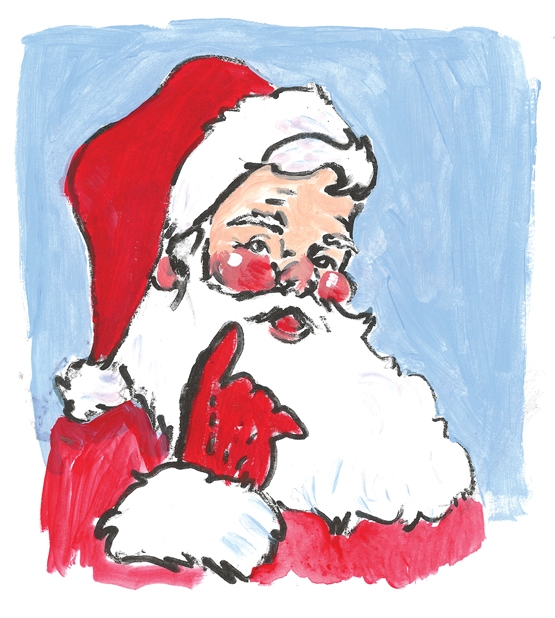
Santa Claus is a central figure in the celebration of the Christmas tradition across the world. Classically depicted as elderly and rotund, with twinkling eyes and sporting a long white beard, one of his other notable physical attributes is his rosy cheeks. Certainly this could be physiological, but there are features of his lifestyle which allude to pathological causes of malar erythema.
His home in the North Pole is suggestive of Scandinavian heritage, and rosacea and sarcoidosis are both more prevalent among this population. Erythematotelangiectatic rosacea, angiolupoid sarcoidosis and lupus pernio are all differential diagnoses for facial erythema. Snow is highly reflective of ultraviolet radiation and may lead to acute phototoxic reactions (sunburn) or exacerbations of systemic connective tissue diseases such as systemic lupus erythematosus and dermatomyositis, or photodermatoses such as polymorphic light eruption and chronic actinic dermatitis.
His beard could be obscuring a goitre which would not only account for his portly body habitus in the setting of hypothyroidism but perhaps also a chronically positive Pemberton sign.
Occupational exposures could also account for his facial erythema. Supervising the elves building toys would expose him to potent contact allergens including acrylates, formaldehyde, methylchloroisothiazolinone, chromate, nickel, thiurams and carbamates, placing him at risk of allergic contact dermatitis.1 His time spent at high altitudes (including aboard his reindeer sleigh) could lead to a reactive polycythaemia. International travel to areas where tuberculosis is still endemic could lead to lupus vulgaris, and exposure to group A streptococci could lead to the malar flush of mitral stenosis from rheumatic heart disease. Finally, consumption of alcoholic beverages, such as eggnog and hot toddies, left out for him during his travels could cause flushing from acetaldehyde.
The differential diagnoses for facial erythema are many, but given Santa Claus has been depicted with this sign for close to a century, the more sinister causes of malar erythema seem less likely. Management options include camouflage with green pigment-based cosmetics, or topical brimonidine, intense pulse light or laser therapy.2 However, given that Santa’s rosy cheeks are part of his charm and familiarity, expectant management would also be a highly viable treatment option.

Competing interests
No relevant disclosures.
Acknowledgements
We thank Catherine Polcz for creating the figure that accompanies this article.
References
- Toholka R, Wang YS, Tate B, et al. The first Australian Baseline Series: recommendations for patch testing in suspected contact dermatitis. Australas J Dermatol 2015; 56: 107-115.
- Sebaratnam DF, Lim AC, Lowe PM, et al. Lasers and laser-like devices: Part II. Australas J Dermatol 2014; 55: 1-14.
Diagnosing Acute Kava Dermopathy: A Case Report of a Characteristic Cutaneous Eruption
Ali Abid, Nicholas Allen, Abeer Hagelamin, Christopher Henderson, Artiene Tatian
Localised Herpes Simplex Following Midline Laparotomy
Jessica S. Bulluss, Paul Chee, Matthew J. Verheyden
No silver lining with health misinformation: argyria caused by intentional silver consumption
Luke Collins, Logesh Palanikumar, Stephen Bacchi
Lingual Raynaud phenomenon
Michael Taggart, Mina John
Melasma in the male: a less well recognised entity
Tim Aung, Rowland Noakes
Age group‐specific changes in keratinocyte cancer treatment rates in Australia, 2012–2021: a retrospective cohort study based on MBS claims data
Catherine M Olsen, Nirmala Pandeya, Rachel E Neale, David C Whiteman