




Reflections
Obituary
Volume 203 - Issue 2
Ronald Lawrie Huckstep CMG, MD, FRCS, FRACS
Author: Jeremy Chapman
Med J Aust 2015; 203 (2): 117. || doi: 10.5694/mja15.00482
Published online: 20 July 2015
Published online: 20 July 2015
Ron Huckstep was known around the world for his work in orthopaedics, trauma and polio
Professor Ron Huckstep was known around the world for his work in orthopaedics, trauma and poliomyelitis, and as an inventor of orthopaedic devices. He was the inaugural professor of traumatic and orthopaedic surgery at the University of New South Wales and the Australian Medical Association representative on the NSW Roads and Traffic Authority road safety committee for 25 years. Ron will be remembered by many medical graduates for his teaching by the rule of three.
Ron was born on 22 July 1926 in Chefoo (Yantai) in northern China, where his parents were on vacation from their teaching posts in Shanghai. He grew up in Shanghai and, during the Japanese occupation, was placed in internment from 1943 to 1945, where he learned the rudiments of medical science under the enthusiastic tutelage of Dr D B Cater. After their release by the American forces, Cater encouraged Ron to apply for medicine at the University of Cambridge, where he was admitted on the strength of his ability to dissect a dogfish, and to Queens' College on the basis that he looked as if he played rugby (which had not been on his Shanghai curriculum). He received his medical degree in record time, and played rugby and rowed for his college.
From 1954 to 1955, Ron served as a medical officer at British detention camps in Kenya during the Mau Mau uprising. Based on his experiences, he wrote a definitive book on typhoid fever and other Salmonella infections, and delivered the 1959 Hunterian Lecture at the Royal College of Surgeons. After orthopaedic training in London, he returned to Africa in 1960 to start the department of orthopaedics at Makerere University Kampala, Uganda, where he developed his lifelong mission to improve the care of people with disabilities in developing countries. He was a key expert adviser to the World Health Organization and the Commonwealth Foundation.
In many ways, he was the role model for the young doctor in the film The last king of Scotland. Only just able to escape the regime of Idi Amin with his family, he moved to Australia in 1972, where his accomplishments included co-founding the Centre for Biomedical Engineering at the University of NSW and developing a series of titanium and ceramic prostheses. His awards were many and included the Companion of the Order of St Michael and St George, the Rotary Paul Harris Fellowship and Medal, and the Arthur Eyre-Brook Medal from World Orthopaedic Concern.
Ron died on 10 April 2015 and is survived by his wife Ann, children Susan, Michael and Nigel, and six grandchildren.
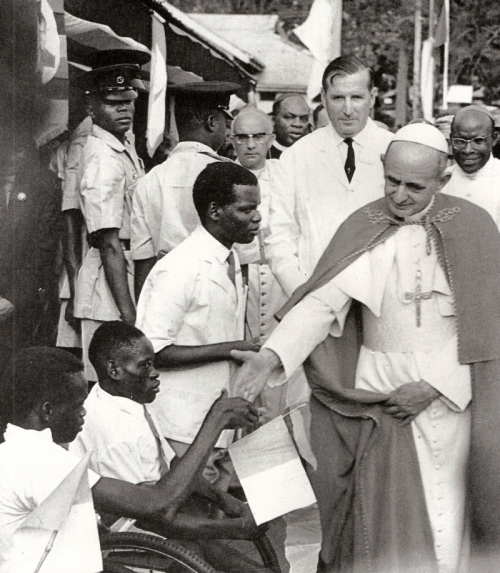
Pope Paul VI blesses polio patients in Kampala, Uganda, under the watchful eye of Professor Huckstep in 1969.
Patterns of Osteoporosis Treatment Initiation Following Low-Trauma Fracture: A Population-Based Retrospective Cohort Study in New South Wales, Australia, Using Linked Administrative Health Data
Mike Lin, Huy Nguyen, Thach Tran, Robert D. Blank, Dana Bliuc, Jacqueline R. Center
Rapid Growth in Diagnostic CT Knee Imaging in Australia: Implications for Imaging Stewardship
Hanwen Chen, Rachelle Buchbinder, Sean Docking, Ian A Harris
Spinal cord stimulation patterns of care, re‐interventions, and costs for private health insurers, Australia, 2011–22: a retrospective observational study
Caitlin MP Jones, Christopher G Maher, Rachelle Buchbinder, Ian A Harris, Chung‐Wei Christine Lin, Christopher Hayes, Alexandra Gorelik
The incidence of and risk factors for hospitalisations and amputations for people with diabetes‐related foot ulcers in Queensland, 2011–19: an observational cohort study
Yuqi Zhang, Susanna M Cramb, Steven M McPhail, Rosana Pacella, Jaap J Netten, Ewan M Kinnear, Peter A Lazzarini
Bone health perspectives among Indigenous people: a qualitative study
Troy Walker (Yorta Yorta), Karan P Singh, Vanessa Gan, Brooke Conley (Ngiyampaa), Jessica Bravo, Nigel Smith (Weilwan), April Clarke (Eastern Maar, Kirrae Whurrung, Djap Wurrung), Jackson Baker, Louise J Maple‐Brown, Robin M Daly, Jennifer Browne, Jesse Zanker, Cat Shore‐Lorenti, David Scott, Peter R Ebeling, Ayse Zengin
I am a Civil War
Jennifer G Mowbray