




Reflections
History
Volume 201 - Issue 11
Colchicine — a short history of an ancient drug
Authors: Nitesh Nerlekar, Anna Beale and Richard W Harper
Med J Aust 2014; 201 (11): 687-688. || doi: 10.5694/mja14.00846
Published online: 15 December 2014
Published online: 15 December 2014
From poisons and potions to promising new therapies for cardiovascular disease
From poisons and potions to promising new therapies for cardiovascular disease
When one considers the drug colchicine, it generally draws thoughts of gout therapy, and its most notorious side effect, diarrhoea. However, colchicine is more than just a treatment for gout; it is a drug rich with centuries of medicinal history, travelling the globe from Asia to America, from its humble beginnings as a poison, to exciting novel therapies for cardiovascular disease. Here we recount a short history of colchicine.
Colchicine has been known by a plethora of names over time, including colchicum, colchicon, hermodactyl, surugen and ephemeron. For the purposes of convenience in this article we will refer to it as colchicine.
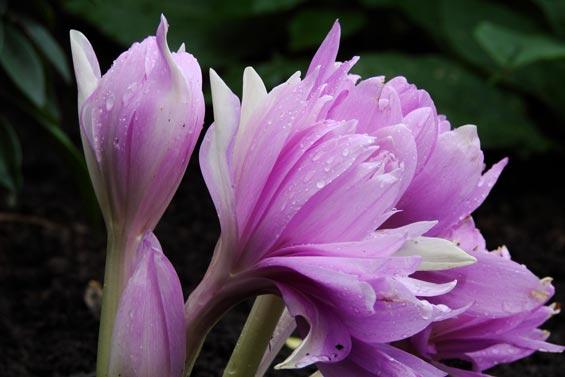
To understand the drug we use today, we need to explore its botanical origins. Colchicine is an alkaloid compound found in a variety of plants, most abundantly in Colchicum autumnale, a beautiful violet flower (Box). It is a perennial plant of the lily family and has been known by a variety of nicknames including wild saffron, autumn crocus and, more exotically, “mort au chien”, (death to dogs), “bulbus agrestis” (the wild bulb), “naked ladies” (because flowers appeared in clusters out of the ground with no associated leaves), and finally “filis ante patrem” (translated “son before the father” due to the curious nature of autumn flowering that subsequently bears seeds for the following spring). Colchicine is contained in the seeds, the flowers and the corms of the plant.
Autumn crocus is one of 700 medicinal plants described in our oldest medical text, the Ebers papyrus of ancient Egypt (circa 1550 BCE).2 It was used as a treatment for pain and swelling. However, early literature about colchicine-based plants mainly refers to their cathartic and poisonous effects. For example, Theophrastus (c. 371–287 BCE), a student of Aristotle and often considered the “father of botany”, in his work Enquiry into plants, describes colchicine as a deadly poison with a delayed onset of action.3 Even today the toxic effects of colchicine are serious. There is no antidote and overdose carries a high mortality.
Nicander (c. 150 BCE), a Greek poet and physician also refers to the deadly effects of colchicine as a poison in his Alexipharmaca, a work on plant poisons.3 He states that colchicine is “that destructive fire of the Colchicon Medea”. The word colchicon is derived from the ancient Greek city of Colchis bordering the Black Sea, an area where C. autumnale grew in abundance. Colchis to the ancient Greek conjures visions of sorcery and figures prominently in Greek mythology — it is where Jason secured the Golden Fleece and where he met and married the sorceress Medea who was famous for her life-giving brews. She rejuvenated his ageing father with a concoction from underground roots, but subsequently poisoned their sons after Jason betrayed her for another woman.
The original pharmaco-botanists of Greece, known as the rhizotomi (root gatherers), used roots to drive away evil spirits. They practised in areas where there was an abundance of colchicine-containing plants and undoubtedly used these plants in their “magic” concoctions.2 The word pharmacy originates from the Greek pharmakon, which in turn is related to the Egyptian pharmagia meaning “the art of making magic”.4
Dioscorides, a 1st century Greek botanist and physician, while serving in the Roman legions, collected plants from across the ancient world for his masterpiece De materia medica (Regarding medical materials) which was to serve as the authoritative reference for the next 15 centuries.2,5 He described the toxic effects of colchicine. His advice “to those who have eaten of the plant” was that “cow's milk offers relief”.
Colchicine is listed as a poison in the medical writings of both Pliny the Elder (23–79 CE), a Roman naturalist and philosopher, and Galen (129 to c. 200 CE), unquestionably the most influential of Greek physicians, whose views on circulation predominated for the next 1500 years. Although Galen describes the use of colchicine as a treatment for gout,5 credit for the systematic use of colchicine-based plants in the treatment of gout goes to the Byzantine physician Alexander of Tralles (525–605 CE).3 In his work Therapeutica he describes the use of colchicine for acute gout and warns of its irritating action on the stomach and intestines. He gave many prescriptions of colchicine and declared that “sufferers get rid of their pain immediately because this medicine eliminates the toxic material with their stool movements and the sick person can walk”.
Alexander's work, at least initially, had more influence in the Islamic sphere than in the Western world. For example, influential Persian physicians such as Rhazes (c. 860–925 CE) and Avicenna (c. 980–1037 CE) used colchicine, a commodity traded with India, to successfully treat gout, exhibiting more bravado and expertise than their Western counterparts.
Since ancient times, gout or podagra (disease of the big toe) has been known as a disease of affluence and high living — “a disease of kings”. Hippocrates (c. 460–370 BCE) called gout “the arthritis of the rich” and rheumatism “the arthritis of the poor”. The narrow therapeutic window of colchicine and the fact that it was used to treat the rich and powerful meant that physicians treating the condition were on a knife edge. While relief of pain could result in rich reward, overenthusiastic use of the drug could result in severe side effects or death, with corresponding punishments to the unfortunate physician. Thomas Sydenham (1624–1689), often regarded as the “father of English medicine” and himself a sufferer of gout and renal disease, was firmly against the use of any form of purgatives to treat the condition. He wrote, “I confidently affirm that the greater part of those who are supposed to have died of gout, have died of the medicine rather than the disease — a statement in which I am supported by observation”.
Credit for the renaissance of colchicine in Western medicine chiefly goes to Baron Anton von Störck (1731–1803), personal physician to the empress of Austria, and Nicolas Husson, military officer to the king of France. Von Störck performed experiments in dogs to establish dosing protocols for colchicine. He prescribed the drug not for the treatment of gout, but for the treatment of dropsy using the mild diuretic effect of colchicine — an effect long known to Islamic physicians. As a commercial exercise, Husson in 1783 developed a secret remedy for gout called “Eau Medicinale” — the main ingredient of which was colchicine. This became a popular treatment for gout and was soon followed by many other quack remedies. Benjamin Franklin (1706–1790), a long-time gout sufferer, used Eau Medicinale to good effect while ambassador to France and is credited with introducing colchicine to America.
In 1820, the French pharmacists Pierre-Joseph Pelletier and Joseph Bienaimé Caventou working together became the first to isolate the alkaloid compound of colchicine.6 In 1848, Sir Alfred Garrod discovered the association of uric acid in the blood and urine with gout. His work, A treatise on gout and rheumatic gout, published in 1859, in which he discussed the role of colchicine, both for prophylaxis against and the treatment of acute gout, forms the modern basis for the use of the drug in this condition.7 Of note, his fourth son Archibald was an eminent physician in his own right. He pioneered the field of inborn errors of metabolism.
In 1899, Biaggio Pernice, a Sicilian pathologist, discovered the antimitotic effect of colchicine.8 Even today this property excites the interests of cancer researchers. Colchicine in its pure form is too toxic to normal cells to be a treatment for cancer, but it is hoped that modification of the molecule may allow the drug to be used for this purpose.
Today, colchicine has an ever-expanding list of uses. It remains staple therapy for gout and familial Mediterranean fever, and is also used off label in the treatment of cutaneous vasculitis, Paget disease and Behçet disease.9 More recently, it has become first-line therapy for acute and relapsing pericarditis, and emerging data have shown benefit for recurrent atrial fibrillation after cardiac surgery and catheter electrode ablation, in-stent restenosis and secondary prevention of coronary artery disease.10
Of the 700 “medicinal plants” listed in Ebers papyrus, only 18 survive to this day.2 Colchicine is one of them. It has survived 40 centuries of medical scrutiny and now has emerged as a leading player in the treatment of a myriad diseases — something that would have been unthinkable 100 years ago. It began as a poison, became a tool for warding off evil spirits, transformed the treatment of gout and now shows promise in the treatment of a wide variety of cardiovascular disorders. Perhaps this serves as a lesson to reflect on other ancient remedies that may hold the answers to some of our incurable diseases of today.
Competing interests
No relevant disclosures.
References
- The poison garden website. Colchicum autumnale, autumn crocus, naked ladies. http://www.thepoisongarden.co.uk/atoz/colchicum_autumnale.htm (accessed May 2014).
- Eigsti OJ, Dustin P Jr. Colchicine in agriculture, medicine, biology, and chemistry. Ames, Iowa: State College Press, 1955. 2
- Hartung EF. History of the use of colchicum and related medicaments in gout: with suggestions for further research. Ann Rheum Dis 1954; 13: 190-200. 3
- Kremers E, Urdang G. History of pharmacy: a guide and a survey. Philadelphia, Pa: JB Lippincott Company, 1940. 4
- Sneader W, editor. Drug discovery: a history. Hoboken, NJ: Wiley, 2005. 5
- Pelletier PJ, Caventou J. Examen chimique des plusieurs végétaux de la famille des colchicées et du principe actif qu'ils renferment. Ann de Chim et de Phy 1820; 14: 69-83. 6
- Garrod AB. Researches on gout. Part I. The urine in the different forms of gout. Part II. The influence of colchicum upon the urine. Med Chir Trans 1858; 41: 325-360. 7
- Goodman LS, Gilman A. The pharmacological basis of therapeutics. 2nd ed. New York: Macmillan, 1831. 8
- Malkinson FD. Colchicine. New uses of an old, old drug. Arch Dermatol 1982; 118: 453-457. 9
- Deftereos S, Giannopoulos G, Papoutsidakis N, et al. Colchicine and the heart: pushing the envelope. J Am Coll Cardiol 2013; 62: 1817-1825. lefthere
Provenance: Not commissioned; externally peer reviewed.
Prisoner of war pathology in Changi, 1942–1945
Kate Ariotti, Elizabeth Roberts‐Pedersen
Should medical eponyms continue to be used in everyday practice?
Leya Nedumannil, Diana Lewis
100 years on: the first use of insulin in Australia
Sophie Templer
Reflections on the life and career of Professor Dame Valerie Beral AC DBE FRS FRCOG FMedSci (1943–2022)
Karen Canfell, Bette Liu, Emily Banks
The Honourable Dr Donald James Grimes AO
Michael Kirby, Patti Warn
From wipeout to drill out: a history of exostosis management and Australian surfing
Alon Taylor, Hannah North, Narinder P Singh, Paul A Fagan