




Reflections
Book reviews
Volume 199 - Issue 11
Practising in PNG: pidgin, rugby and yaws
Author: Robert B Black
Med J Aust 2013; 199 (11): 803. || doi: 10.5694/mja13.10906
Published online: 16 December 2013
Published online: 16 December 2013
Anthony Radford was the inaugural professor of primary care at Flinders University in Adelaide, South Australia. Before and after that appointment, he accumulated a total of 50 years of experience in Papua New Guinea (PNG). Radford first went to that country as a student in 1951; from 1963 to 1972, he was a public health officer there; and later, he consulted on PNG for the World Health ...
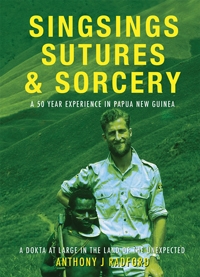
Singings, sutures and sorcery: a 50 year experience in Papua New Guinea: a dokta at large in the land of the unxpected.
Anthony J Radford. Melbourne: Mosaic Press, 2013 (xxv + 371 pp, $45.00). ISBN 9781743240601.
Anthony Radford was the inaugural professor of primary care at Flinders University in Adelaide, South Australia. Before and after that appointment, he accumulated a total of 50 years of experience in Papua New Guinea (PNG). Radford first went to that country as a student in 1951; from 1963 to 1972, he was a public health officer there; and later, he consulted on PNG for the World Health Organization, UNICEF and AusAID. This book records these three phases of his service to Australia’s nearest neighbour.
As a junior doctor in PNG, Radford’s practice was remarkably broad: obstetric emergencies requiring symphysiotomy; surgery for late appendicitis; common medical conditions such as pneumonia and diarrhoea, as well as uncommon ones like yaws and leprosy. Public health was in the mix: sanitation, safe water and immunisation. And he carried out research into infectious diseases and health care delivery. Meanwhile, his colleagues there were solving the riddles of infectious diseases like pig bel (from eating uncooked pork) and kuru (from eating dead relatives).
Radford and his wife Robin embraced the different cultures of the country; all three of their children grew up speaking pidgin and were given tribal names.
Radford acquired fellowships from three Royal Colleges, a diploma in tropical medicine and a Harvard master’s degree and, in 1971, was appointed associate professor to the emerging medical school in Port Moresby.
He was also active in the local sports scene, and found the time to conquer the Kokoda Track and climb Mt Wilhelm. However, the acme of his rugby career, national selection, was scuttled when an aggressive tackle resulted in a dislocated hip.
Radford’s tendency to name-drop might be a bit distracting, but the prominent people named, many of whom are his relatives, help put the events described into context.
I would have liked to have had a few more maps. It would also have helped if Radford had indicated the chronology where contemporaneous diary entries or letters are inserted. These are minor quibbles, however. On the whole, it is a superb life story. And in telling it, Radford reviews the historical, ethnolinguistic and religious origins of the German and British colonies that became PNG. He then goes on to describe the region’s transition to nationhood, and to foresee its problems and lament its failures.
Prisoner of war pathology in Changi, 1942–1945
Kate Ariotti, Elizabeth Roberts‐Pedersen
Should medical eponyms continue to be used in everyday practice?
Leya Nedumannil, Diana Lewis
100 years on: the first use of insulin in Australia
Sophie Templer
Reflections on the life and career of Professor Dame Valerie Beral AC DBE FRS FRCOG FMedSci (1943–2022)
Karen Canfell, Bette Liu, Emily Banks
The Honourable Dr Donald James Grimes AO
Michael Kirby, Patti Warn
From wipeout to drill out: a history of exostosis management and Australian surfing
Alon Taylor, Hannah North, Narinder P Singh, Paul A Fagan