





Volume 195 - Issue 4
How to assess impairment
Author: Dwight K Dowda
Med J Aust 2011; 195 (4): 229. || doi: 10.5694/j.1326-5377.2011.tb03290.x
Published online: 15 August 2011
Published online: 15 August 2011
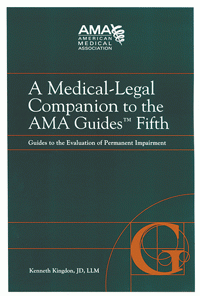
A medical-legal companion to the AMA Guides Fifth. Guides to the evaluation of permanent impairment.
Kenneth Kingdon, JD, LLM. California: American Medical Association, 2011 (xxi + 410 pp, $120.00). ISBN 9781603591980.
This publication by the American Medical Association (AMA) provides a detailed review of the AMA guides to the evaluation of permanent impairment, 5th ed. (AMA5). These guides, which provide a systematic and highly descriptive methodology for rating impairment arising from illness or injury, have been adopted not only in many American states and other countries but also in many Australian compensation jurisdictions as a standard reference upon which state-specific guidelines have been designed. Medical practitioners are increasingly being requested to evaluate impairment for lawyers and insurance claims managers. This companion to the AMA guides is helpful to doctors as well as lawyers and claims managers in bridging the gap between medicine and the law.
The text analyses each chapter of AMA5, and includes an overview of the salient points regarding the impairment-rating procedure. This is particularly useful as it picks the eyes out of the expansive AMA5 and highlights areas that need to be understood to ensure correct impairment-evaluating methodology. Included in the text are comments regarding contentious or ambiguous rating issues, with explanations and definitions of medical terms that make the information more comprehensible to the non-medical reader.
Each chapter has numerous worked examples to help the reader understand the points being made and the correct application of methodology. This is followed by review questions that allow the reader to test whether he or she has completely understood the impairment evaluation principles being discussed.
This book accurately and authoritatively interprets impairment-evaluating methodology (strictly according to AMA5) and addresses various issues in interpretation that are relevant to any user of AMA5 in Australia. For medical assessors who are already trained in using AMA5 (as modified regionally in Australia), this publication provides a useful review of definitions, procedures and methodology. For non-medical readers (eg, lawyers and claims managers), it is a relatively inexpensive and helpful tool for clarifying the sometimes overwhelming content of AMA5.
Mending the Road: A Way Forward From Silence and Silencing
Ayman Hamdan, Anisa J. N. Jafar
Seven Vessel Spontaneous Coronary Artery Dissection and Concurrent Transient Global Amnesia After an Emotional Trigger
Michael J. Stewart, Tom R. Sutherland
Seven Vessel Spontaneous Coronary Artery Dissection and Concurrent Transient Global Amnesia After an Emotional Trigger
Virginia Barbour
Research Priority Setting Is Not Research: A Call for Ethical Clarity in Australia
Bec Jenkinson, Gordon McGurk, Jonathan Quicke, Janelle Bowden, Nadine E. Foster
Organ Donation After Oral Ingestion of a Voluntary Assisted Dying Substance
Joanne Kantianis, Helen I. Opdam, Rohit L. D'Costa
Equity, Diversity and Inclusion From the Start: Reforming Australia's Research Infrastructure for Inclusive Participation
Danielle M. Muscat, Kirsten J. McCaffery, Heather L. Shepherd, Marguerite Tracy