




Volume 195 - Issue 4
Can we trust the PCEHR not to leak?
Authors: Siaw-Teng Liaw and Terry Hannan
Med J Aust 2011; 195 (4): 222. || doi: 10.5694/j.1326-5377.2011.tb03287.x
Published online: 15 August 2011
Published online: 15 August 2011
In April this year, the Federal Minister for Health and Ageing, Nicola Roxon, stated that by July 2012 all Australians will be able to “sign up for a personally controlled e-health record . . . [that] will enable better access to important health information currently held in dispersed records around the country”.1 Laudable aims, but can patients and clinicians trust the reliability and confidentiality of this personally controlled e-health record (PCEHR)?
The National eHealth Transition Authority’s draft concept of operations document proposes that individuals will be able to access a data repository (“My PCEHR”) and tools (“My Access Controls”) to make this dispersed information available to their chosen health care providers.1 The authors failed to give essential details on how the PCEHR will work, but showed insight in their assessment that the scope and extent of information to be shared in the PCEHR is dependent on the readiness of the health care sector to participate.
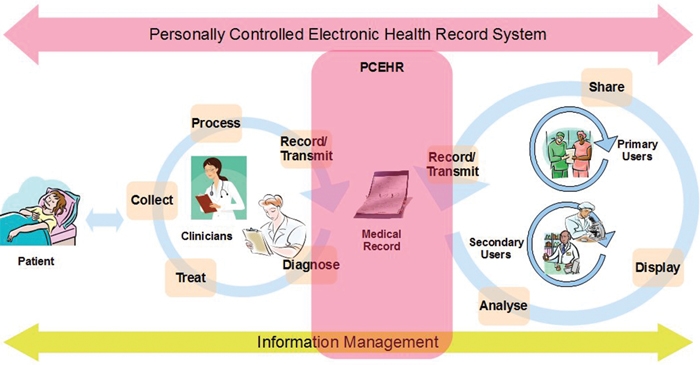
The concept of democratisation of personal health information is central to the PCEHR, reflecting the populist philosophy of the present Web 2.0 and social networking environment where information is freely published and shared.2 This increases the potential for leakage of information, albeit often unintended, from clinician-held electronic health records (EHRs) via the disparate members of the PCEHR network (Box). Information that, if leaked, might have potential adverse impacts includes family history of disease, and information that may reflect negatively on other health professionals, friends or family members.2 Information leakage, along with complex access and provenance arrangements and individuals “hiding” rather than “denying access” to PCEHR information, will discourage clinicians from participating in a system where they are uncertain about the completeness of the information.
Personal health information should stay within a confidential patient–clinician therapeutic relationship, a concept promoted by the patient-centered medical home movement3 and endorsed by the National Health and Hospitals Reform Commission.4 Information exchange within a multidisciplinary care network, no matter who controls it, should be facilitated within the patient–clinician relationship. Ensuring consistency of shared terminology and a method to address misrepresentations will improve the quality of personal health information. Such alignment of patients’ and clinicians’ perceptions and understandings of health concepts and processes will improve health literacy, and this will encourage consumer empowerment, not consumer populism.5
The creation of shared information resources to support collaborative team care must take into account the business, architectural, workflow, provenance and governance requirements from both patients’ and clinicians’ perspectives. However, the success and sustainability of this system also requires careful alignment of the patient’s and the clinician’s EHRs (Box) within a health care home that provides a safe, effective continuum of care within a trusting patient–clinician relationship. This will minimise risks and engender the required confidence to make the PCEHR program work.
Pathways for the collecting, sharing, and possible leakage of information in an individual personally controlled electronic health record
 |
|
Reproduced with permission from: Hannan T. What the hell is a PCEHR and what does it have to do with me anyway? The InformaticsInsider [internet] 2011; Jun (1). http://www.austemrs.com.au/page/informatics_insider.html |
References
- National eHealth Transition Authority. Draft concept of operations: relating to the introduction of a personally controlled electronic health record (PCEHR) system. Canberra: National eHealth Transition Authority, 2011. 0_i1095857
- Liaw ST, Lau A, Dennis S. General practice — engaging the online social networking revolution. Aust Fam Physician 2010; 39: 809-810. 0_i1095859
- Stange KC, Miller WL, Nutting PA, et al. Context for understanding the National Demonstration Project and the patient-centered medical home. Ann Fam Med 2010; 8 (Suppl 1): S2-S8. 0_i1095861
- National Health and Hospitals Reform Commission. A healthier future for all Australians: final report June 2009. Canberra: Department of Health and Ageing, 2009. http://www.health.gov.au/internet/nhhrc/publishing.nsf/Content/nhhrc-report (accessed Jul 2011).
- Simborg D. Consumer empowerment versus consumer populism in healthcare IT. JAMIA 2010; 17: 370-372. 0_i1095866
Medical Colleges Have an Obligation to Ensure Full Participation in Clinical Quality Registries
Thomas J. Hugh
Getting on the Same Page: Why Australia Needs a National Maternity Early Warning System (MEWS) Chart
Briony A. Cutts, Lucy Bowyer, Nisha Khot, Sandra Lowe, Stefan C. Kane
Data for Equity: Can Linked Administrative Data Inform Pathways to More Equitable Child Health?
Sarah Gray, Shuaijun Guo, Meredith O'Connor, Elodie O'Connor, Katrina Williams, Hannah Badland, Susan Woolfenden, Josie Dickerson, Gerry Redmond, Marnie Downes, Sharon R. Goldfeld
Specialty College Selection: Why Change is Critical to Support a Future Rural Workforce
Matthew R. McGrail, Jenny May AM, Katherine Logan
Differentiated and simplified oral HIV pre‐exposure prophylaxis (PrEP) models hold the key to virtually eliminating HIV transmission in Australia by 2030
Tyson Arapali, Sarah Warzywoda, Anthony K J Smith, Curtis Chan, Timothy R Broady, Erin Sullivan, Catherine MacPhail, Mohamed A Hammoud, Alexander Dowell‐Day, Benjamin R Bavinton
The number of cancer‐related deaths that could be attributable to spatial disparities in survival in Australia, 2010–2019: a retrospective population‐based cohort study
Charlotte K Bainomugisa, Jessica Cameron, Paramita Dasgupta, Peter Baade