




Volume 193 - Issue 7
Diagnosis in acute medicine
Author: Campbell Thompson
Med J Aust 2010; 193 (7): 396. || doi: 10.5694/j.1326-5377.2010.tb03966.x
Published online: 4 October 2010
Published online: 4 October 2010
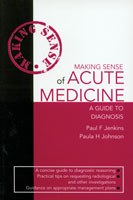
Making sense of acute medicine. A guide to diagnosis.
Paul F Jenkins, Paula H Johnson. London: Hodder Arnold, 2010 (xii + 308 pp). ISBN 9780340984253.
Medical diagnosis is traditionally learnt at the patient’s bedside in the presence of an experienced clinician. Time and workload pressures restrict the teacher–student relationship within a hospital. Sometimes, the clinical signs and wisdom are pieced together independently or, at best, with fractured feedback. Clinical decisions can be delayed by plentiful, irrelevant and risky investigations.
Jenkins and Johnson’s book provides the inexperienced doctor or medical student with memorable material to facilitate clinical decision making. It has competition internationally but is peerless. The authors’ excellent work focuses in a very practical way on history taking and physical examination, and the rational use of investigations.
Both authors have experience in Australian general medicine. Jenkins was also one of the founders of acute medicine — the specialty responsible for diagnosis and initial management of most admissions to hospital — in the United Kingdom. Acute medical units have transformed hospital general medicine overseas and are doing the same in Australia and New Zealand. Such units are a great environment for learning about diagnosis.
The text is structured to cover, in a systematic way, common medical presentations (eg, “dizziness”, “breathlessness” and “weakness”). It is well organised and indexed and has easy-to-read hints and highlights that keep the reader engaged. The lists are not exhaustive but are clinically relevant to an Australian readership. X-rays illustrate common pathological lesions in the differential diagnosis.
The intended readership includes medical students and junior medical trainees rather than senior clinicians. The book has limited scope; it will assist diagnosis of common conditions and prevent unnecessary investigations rather than guide prognosis, inform treatment or detail complicated pathophysiology.
Overall, it is an excellent balance between affordability, portability, readability, erudition and necessary detail. I have difficulty in wresting it away from any student who visits my office.
Shifting focus to adolescent wellbeing and inclusive participation in the digital age
Allyson R Todd, Elena Wang, Stephanie R Partridge
The clinical presentation, investigation, and management of women diagnosed with endometriosis in Australian general practices, 2011–2021: an open cohort study
Danielle Mazza, Kailash Thapaliya, Sharinne B Crawford, Alissia Hui, Maryam Moradi, Luke E Grzeskowiak
The impact of the Breast Screen NSW transition from film to digital mammography, 2002–2016: a linked population health data analysis
Rachel Farber, Nehmat Houssami, Katy J L Bell
Non‐technical errors associated with deaths in surgical care, Australia, 2012–2019, by surgical specialty (Australian and New Zealand Audit of Surgical Mortality): a retrospective cohort study
Jesse Ey, Victoria Kollias, Octavia Lee, Kelly Hou, Matheesha Herath, John B North, Ellie Treloar, Suzanne Edwards, Martin Bruening, Adam J Wells, Guy J Maddern
The CURE Asthma roadmap
Gary P Anderson, Anthony Flynn, Phil G Bardin, John D Blakey, Shyamali C Dharmage, Paul Foster, Peter G Gibson, Adam Jaffe, Alan James, Christine R Jenkins, Sundram Sivamalai, Peter D Sly, Guy B Marks, Vanessa M McDonald, Judy Wetttenhall
Evidence from Australian cohort studies about asthma trajectories and transitions across the life course: a narrative review
Caroline Lodge, Xin Dai, Ingrid A. Laing, Michael P Menden, Anthony Flynn, Gary P Anderson, Sarath Ranganathan, Shyamali C Dharmage