




Volume 193 - Issue 4
South African medico, exile and patriot
Author: Peter C Arnold
Med J Aust 2010; 193 (4): 233. || doi: 10.5694/j.1326-5377.2010.tb03875.x
Published online: 16 August 2010
Published online: 16 August 2010
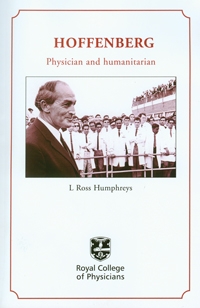
Hoffenberg. Physician and humanitarian.
L Ross Humphreys. London: Royal College of Physicians, 2010 (xi + 174 pp). ISBN 9781860163661.
“Hoffenberg” probably means little to most Australian doctors other than those fortunate Queenslanders who met him during his short tenure as Professor of Medical Ethics from 1993 to 1995. It means a lot, however, to expatriate South African-trained doctors, to Fellows of the Royal College of Physicians, London, and to Queenslander Ross Humphreys.
Humphreys has written an eminently readable biography of one of those stars of the South African medical firmament who, after leaving the country during the apartheid era, distinguished themselves in their field in Britain.
Unlike most of the other expatriate doctors in this group, Hoffenberg was, literally, exiled. Nevertheless, Sir Raymond (Bill) Hoffenberg shone among his fellow ex-South African FRCPs, Fellows of the Royal Society, Knights of the Realm and Nobel prize-winners.
Humphreys, in explaining Hoffenberg’s forced departure from South Africa, provides an excellent introduction to apartheid. He details Hoffenberg’s progress, from his appointment at Birmingham University to his time as President of the Royal College of Physicians and President of Wolfson College, University of Oxford. He describes Hoffenberg’s interest and research in a wide range of diseases, and in teaching and mentoring colleagues, as well as his initiation of medical audit and his overwhelming concern with medical ethics.
Hoffenberg never lost his emotional attachment to South Africa, as evidenced by his continued assistance to other “refugees” from the system and, when apartheid ended, his strong support for medical research and education in that country. His connection with Australia commenced when he came to Brisbane to join his sons.
This little book will appeal to anyone with an interest in South Africa, in British medical history from the late 1960s to the early 1990s, and in medical education, research, clinical audit or ethics. My only criticism is of the proofreading. My friend and colleague is not Patricia but Priscilla Kincaid-Smith; sloppy grammar and punctuation require a double-take of some sentences, and I was saddened to see the need for “Apostrophe Man”.*
Mending the Road: A Way Forward From Silence and Silencing
Ayman Hamdan, Anisa J. N. Jafar
Seven Vessel Spontaneous Coronary Artery Dissection and Concurrent Transient Global Amnesia After an Emotional Trigger
Michael J. Stewart, Tom R. Sutherland
Seven Vessel Spontaneous Coronary Artery Dissection and Concurrent Transient Global Amnesia After an Emotional Trigger
Virginia Barbour
Research Priority Setting Is Not Research: A Call for Ethical Clarity in Australia
Bec Jenkinson, Gordon McGurk, Jonathan Quicke, Janelle Bowden, Nadine E. Foster
Organ Donation After Oral Ingestion of a Voluntary Assisted Dying Substance
Joanne Kantianis, Helen I. Opdam, Rohit L. D'Costa
Equity, Diversity and Inclusion From the Start: Reforming Australia's Research Infrastructure for Inclusive Participation
Danielle M. Muscat, Kirsten J. McCaffery, Heather L. Shepherd, Marguerite Tracy