




Volume 193 - Issue 4
Inferior vena cava filters in trauma patients: who is responsible for their removal?
Authors: Dominik Baschera, Jonathan K Sebunya and René Zellweger
Med J Aust 2010; 193 (4): 245. || doi: 10.5694/j.1326-5377.2010.tb03882.x
Published online: 16 August 2010
Published online: 16 August 2010
To the Editor: The prophylactic use of inferior vena cava filters (IVCFs) in trauma patients for whom anticoagulation is contraindicated has markedly increased over the past few years. Their need for caval filtration is usually only transient, and once the risk of venous thromboembolism is deemed to be minimal, it would seem appropriate that IVCFs be retrieved. However, a large number of IVCFs remain in situ, due to either failure of retrieval or lack of follow-up. We observed a case that touches on both of these two major problems associated with IVCF retrieval.
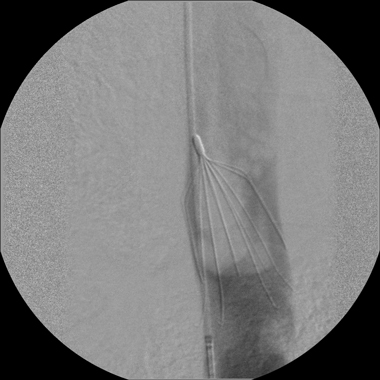
A 34-year-old man received a prophylactic IVCF after he had sustained severe pelvic fractures, several undisplaced spinal fractures and a splenic laceration in a motorbike accident. He was deemed to be at high risk of venous thromboembolism, and immediate prophylactic anticoagulation was contraindicated because of his pelvic and splenic injuries. The scheduled IVCF retrieval, 8 weeks after insertion, failed due to technical difficulties. A large clot between the struts of the IVCF (Figure) meant further withdrawal attempts were deemed too dangerous. The patient was informed that he had two options:
if the filter remained in situ, he would possibly need lifelong oral anticoagulation; or
the IVCF could be surgically removed.
Soon after this, the patient was discharged with instructions to continue oral anticoagulation.
About 5 months later, at a follow-up consultation with the orthopaedic surgeon about his injuries, the patient expressed his concern about the IVCF and especially about the anticoagulation. He was taking it for no other indication than the IVCF. The radiologist who had inserted the IVCF was contacted, and subsequently removed it without any complications.
In the case described here, an initial retrieval attempt was thwarted by filter tilt and a large clot burden. After discharge, the patient was lost to follow-up with respect to the IVCF. Fortunately, this was addressed by one of the specialists involved in management of the patient’s other problems. Without this intervention, the patient may have ended up with the filter permanently in situ, with its attendant risks, and an unwarranted lifetime of anticoagulation. When filters have a significant clot burden, anticoagulation can help dissolve this to the point at which retrieval can be effected safely.1
This case highlights the need for appropriate follow-up after IVCF insertion. Various studies have outlined different follow-up strategies, some using a protocol drawn up in a multidisciplinary team setting,2 others designating a key person (usually the clinician who inserted the filter) to undertake this task.3,4 Both strategies have been shown to reduce the number of patients lost to follow-up.
References
- Ota S, Yamada N, Tsuji A, et al. The Gunther–Tulip retrievable IVC filter: clinical experience in 118 consecutive patients. Circ J 2008; 72: 287-292.
- Ko SH, Reynolds BR, Nicholas DH, et al. Institutional protocol improves retrievable inferior vena cava filter recovery rate. Surgery 2009; 146: 809-814. i1095412
- Karmy-Jones R, Jurkovich GJ, Velmahos GC, et al. Practice patterns and outcomes of retrievable vena cava filters in trauma patients: an AAST multicenter study. J Trauma 2007; 62: 17-24. i1095414
- Kaufman JA, Kinney TB, Streiff MB, et al. Guidelines for the use of retrievable and convertible vena cava filters: report from the Society of Interventional Radiology multidisciplinary consensus conference. J Vasc Interv Radiol 2006; 17: 449-459. i1095418
Decolonising Indigenous Health Research Requires Redefining Sex, Sexuality and Gender
Shakara Liddelow-Hunt, James H. L. Hill, Kate Daglas, Kaiwarr Clancy, Madi Day, Alistair Ott
Reducing Nitrous Oxide Emissions Across the Melbourne Biomedical Precinct
Ross Robertson, Andrew Downey, Daryl Williams, Bjorn Makein, Ben Dunne, Tugce Ozturk, Ying Gu, Rebecca McIntyre
Multimorbidity Clusters Among People Aged 65 Years and Over in Australia: A Nationwide Cross-Sectional Data Linkage Study
Weisi Chen, Christine Y. Lu, Sarah N. Hilmer, Alice A. Gibson, Edwin C. K. Tan
When ‘Liver Enzymes’ Are Not Hepatic: Late-Onset Pompe Disease
Shauna Madigan, Georgina England, Wayne Rankin
West Nile virus Kunjin subtype in rural NSW
Emily Gibson, Megan Whitley, Peter Murray, Linda Hueston, Jane Bennett, Raguharan Kathiresu, David N Durrheim
The impact of the Breast Screen NSW transition from film to digital mammography, 2002–2016: a linked population health data analysis
Rachel Farber, Nehmat Houssami, Katy J L Bell