




Volume 193 - Issue 4
Patient’s eye view of chronic pain
Author: Robert D Helme
Med J Aust 2010; 193 (4): 237. || doi: 10.5694/j.1326-5377.2010.tb03877.x
Published online: 16 August 2010
Published online: 16 August 2010
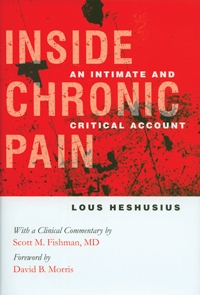
Inside chronic pain. An intimate and critical account
. Lous Heshusius. New York: Cornell University Press, 2009 (xvii + 167 pp). ISBN 978 0 8014 4796 9.
The lessons contained in this concise, personal narrative of an articulate patient crippled by chronic pain present a number of challenges to all who read it.
There is a brief, scholarly foreword by David Morris, Professor of English at the University of Virginia, that sets the scene — conceptually, all chronic illness must be constructed at the crossroads of biology and culture. And there is an excellent coda by Scott Fishman, Professor of Anesthesiology and Pain Medicine at the University of California, Davis, which emphasises that the story you’ve just read is not unique.
We have to ask ourselves, how can we consistently access all the options to put it together for these patients? How often do we even say, “I will go through this journey with you, and be your consultant”? More often than we care to admit, we neglect the social, spiritual and cultural dimensions of our patients’ experience in favour of a medical model of disease.
The patients bear the largest burden on the journey towards recovery. How does one competently advocate for oneself when emotion and dysfunctional cognitions unduly influence the processes? Support systems are needed to negotiate a maze of clinicians, contradictory information and advice, and adversarial bureaucracies, yet time has to be spent alone in the present — not in the past or future — practising individualised coping strategies.
This book will make you annoyed and frustrated — with the writer, her health care professionals, yourself, and with the system. Perhaps, you may also reflect on your management of chronic pain, and open new communication channels with your patients and your colleagues.
Even undergraduates can learn from this little book, but I think it would be best read and digested by experienced clinicians. The only real downside is its North American setting. However, I can assure readers it all happens here too.
Shifting focus to adolescent wellbeing and inclusive participation in the digital age
Allyson R Todd, Elena Wang, Stephanie R Partridge
The clinical presentation, investigation, and management of women diagnosed with endometriosis in Australian general practices, 2011–2021: an open cohort study
Danielle Mazza, Kailash Thapaliya, Sharinne B Crawford, Alissia Hui, Maryam Moradi, Luke E Grzeskowiak
The impact of the Breast Screen NSW transition from film to digital mammography, 2002–2016: a linked population health data analysis
Rachel Farber, Nehmat Houssami, Katy J L Bell
Non‐technical errors associated with deaths in surgical care, Australia, 2012–2019, by surgical specialty (Australian and New Zealand Audit of Surgical Mortality): a retrospective cohort study
Jesse Ey, Victoria Kollias, Octavia Lee, Kelly Hou, Matheesha Herath, John B North, Ellie Treloar, Suzanne Edwards, Martin Bruening, Adam J Wells, Guy J Maddern
The CURE Asthma roadmap
Gary P Anderson, Anthony Flynn, Phil G Bardin, John D Blakey, Shyamali C Dharmage, Paul Foster, Peter G Gibson, Adam Jaffe, Alan James, Christine R Jenkins, Sundram Sivamalai, Peter D Sly, Guy B Marks, Vanessa M McDonald, Judy Wetttenhall
Evidence from Australian cohort studies about asthma trajectories and transitions across the life course: a narrative review
Caroline Lodge, Xin Dai, Ingrid A. Laing, Michael P Menden, Anthony Flynn, Gary P Anderson, Sarath Ranganathan, Shyamali C Dharmage