




Volume 193 - Issue 4
Making psychiatry less daunting
Author: Garry Walter
Med J Aust 2010; 193 (4): 238. || doi: 10.5694/j.1326-5377.2010.tb03878.x
Published online: 16 August 2010
Published online: 16 August 2010
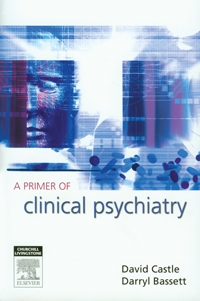
A primer of clinical psychiatry.
David Castle, Darryl Bassett. Sydney: Churchill Livingstone, 2010 (xv + 311 pp). ISBN 9780729539036.
Clinical Psychiatry is a rich and often challenging discipline. Clearly and concisely describing, in book form, the myriad presentations, tools of assessment and methods of treatment is no easy task. Yet Professor David Castle from Melbourne and Darryl Bassett from Perth, assisted by fellow Australian psychiatrists in some of the chapters, have achieved this with their “primer”. Medical students, in particular, and students of other health disciplines as well, will find this book very useful, but it will also appeal to general practitioners wanting a quick refresher or ready resource.
As one might expect, the book covers the psychiatric interview, common investigations, major syndromes, biological and psychological treatments, and issues pertaining to special patient groups (eg, child and adolescent, old age, forensic, “dual disability”).
A problem frequently encountered with introductory texts of this type is that, in attempting to provide a broad overview in limited space, they become “remote”, are reduced to checklists, fail to convey the essence of a field, and lack soul. Such criticisms cannot be levelled reasonably at Castle and Bassett’s book. For instance, the numerous case examples, advocacy for a hierarchical classification, and boxes and tables of practical information (such as “A safe restraint method” in the chapter on psychiatric emergencies) infuse the text with relevance and life.
The book is not without quirks. For example, the only appendix, “Objective Structured Clinical Examinations (OSCEs) in psychiatry” sits oddly, if confirming the book’s utility for students. And the reason for including substance-use disorders among “special patient groups” rather than “psychiatric syndromes” is elusive, given the prevalence of such disorders. Finally, the authors eschew discussion of the ethical dimension of psychiatric practice, which I think is necessary even in the briefest and most basic of primers.
Despite these limitations, this is an excellent text, bound to enhance the psychiatric knowledge and skills of the reader and, thus, render psychiatry less daunting.
Reorienting Allied Health Into Community-Based Care for People Experiencing Trauma and Social Disadvantage
Simon Rosenbaum, Grace McKeon, Gulsah Kurt, Oscar Lederman, Kemi Wright, Sabuj Kanti Mistry, Jackie E. Curtis, Philip B. Ward, Zachary Steel, Hamish Fibbins, Rachel Morell, Melissa C. Eaton, Andrew Watkins, Ben Harris-Roxas, Brendan Goodger, Eleanor Beck, Megan Teychenne, Joseph Firth, Davy Vancampfort, David Burns, Russell Roberts, Tristan Favaloro, Danielle Weber, Rosanna Barbero, Vasili Maroulis, Melissa Holmes, Stefan Mackenzie, Chiara Mastrogiovanni, Afsana Anwar, Uzma Choudhry, Catherine Sherrington, Jane Currie, Thomas Gadsden, Scott Teasdale
Stigmatising Attitudes Towards People With Depression, Bipolar Disorder, Borderline Personality, ADHD and Early and Long-Term/Untreated Schizophrenia: Representative Survey of Australian Adults
Amy J. Morgan, Anna M. Ross, Gayle McNaught, Rachel Green, Nicola J. Reavley
Psychosocial Hazards for Healthcare Workers: Supporting the Second Victim Also Helps the Primary Victims
Sarah Michael
Supporting Population Mental Health in the Wake of Mass Tragedies
Susan J. Rees, Derrick M. Silove
In the Wake of the National Suicide Prevention Strategy 2025–2035: Suicide Prevention in Type 1 Diabetes
Rigel Paciente, Keely Bebbington, Alix Woolard, Helen Milroy