




Volume 193 - Issue 4
From evidence to practice
Author: Mark F Harris
Med J Aust 2010; 193 (4): 238. || doi: 10.5694/j.1326-5377.2010.tb03879.x
Published online: 16 August 2010
Published online: 16 August 2010
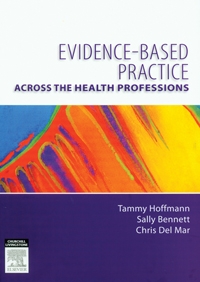
Evidence-based practice. Across the health professions.
Tammy Hoffman, Sally Bennett, Chris Del Mar, editors. Sydney: Churchill Livingstone, 2009 (xiv + 349 pp). ISBN 9780729539029.
Putting evidence into practice is a challenge for all health professionals; not just knowing the evidence, but being able to interpret it and put it into practice in the face of a range of barriers and constraints.
The editors of this book are specialists in evidenced-based practice and have led classes in the subject for students from a range of health professions. Tammy Hoffman and Sally Bennett are both lecturers at University of Queensland’s School of Health and Rehabilitation Sciences, while Chris Del Mar is Professor of Primary Care Research at Bond University and a Coordinating Editor of the international Cochrane Collaboration. Contributors include experts from Australia and overseas, who provide a wealth of examples on how evidence-based clinical decisions are made by different health professionals.
The book takes the reader from formulating the question to finding and evaluating the evidence required to answer it. This is not for the faint-hearted — the various chapters describe in detail how to appraise the validity (and bias) of intervention trials and how to interpret the significance of their findings.
It may be pretty heavy going for many clinicians. However, the book then goes on to work through examples encountered by different health professionals in a wide variety of real-life clinical settings. For example, the questions about the efficacy of interventions range from cognitive behavioural interventions by practice nurses to adjuvant temozolomide with radiation therapy for glioblastoma.
Most of the chapters focus on appraising individual studies. This is a good way to illustrate the use of appraisal skills and avoids the risk of providing simplistic answers to clinical questions. However, much of routine practice may be more appropriately informed by systematic reviews of the literature (such as Cochrane reviews) and systematically developed evidence-based guidelines. These are covered in Chapters 12 and 13, but without the in-depth case study analysis used in the earlier chapters. This is a little disappointing.
Despite these reservations, I found this to be a surprisingly readable and thorough introduction to the appraisal of evidence for multidisciplinary clinical practice.
Shifting focus to adolescent wellbeing and inclusive participation in the digital age
Allyson R Todd, Elena Wang, Stephanie R Partridge
The clinical presentation, investigation, and management of women diagnosed with endometriosis in Australian general practices, 2011–2021: an open cohort study
Danielle Mazza, Kailash Thapaliya, Sharinne B Crawford, Alissia Hui, Maryam Moradi, Luke E Grzeskowiak
The impact of the Breast Screen NSW transition from film to digital mammography, 2002–2016: a linked population health data analysis
Rachel Farber, Nehmat Houssami, Katy J L Bell
Non‐technical errors associated with deaths in surgical care, Australia, 2012–2019, by surgical specialty (Australian and New Zealand Audit of Surgical Mortality): a retrospective cohort study
Jesse Ey, Victoria Kollias, Octavia Lee, Kelly Hou, Matheesha Herath, John B North, Ellie Treloar, Suzanne Edwards, Martin Bruening, Adam J Wells, Guy J Maddern
The CURE Asthma roadmap
Gary P Anderson, Anthony Flynn, Phil G Bardin, John D Blakey, Shyamali C Dharmage, Paul Foster, Peter G Gibson, Adam Jaffe, Alan James, Christine R Jenkins, Sundram Sivamalai, Peter D Sly, Guy B Marks, Vanessa M McDonald, Judy Wetttenhall
Evidence from Australian cohort studies about asthma trajectories and transitions across the life course: a narrative review
Caroline Lodge, Xin Dai, Ingrid A. Laing, Michael P Menden, Anthony Flynn, Gary P Anderson, Sarath Ranganathan, Shyamali C Dharmage