




Volume 192 - Issue 4
Autonomic neuropathy — an uncommon variant of Guillain–Barré syndrome
Authors: Robert D Henderson, Jeyaraj D Pandian, Kaye M Dalton and John M Bradfield
Med J Aust 2010; 192 (4): 232. || doi: 10.5694/j.1326-5377.2010.tb03486.x
Published online: 15 February 2010
Published online: 15 February 2010
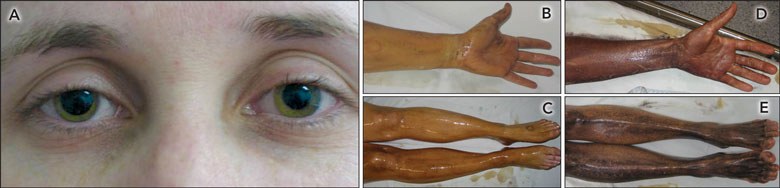
A 29-year-old woman presented with a 19-day history of blurred vision and intolerance to bright light after a presumed viral illness (a sore throat and fever resolved 4 days before the onset of other symptoms). At presentation, she reported a dry mouth, mild constipation, abdominal bloating and hesitancy of micturition. Results of a clinical examination were normal apart from dilated, slightly asymmetric pupils (Figure, A), non-reactive to light and accommodation. The patient’s condition gradually improved over the subsequent 6 months.
Tests of heart rate and blood pressure showed normal cardiovascular autonomic function. Thermoregulatory sweat testing was undertaken by applying a starch and iodine paste to the skin; this changes colour to purple in the presence of sweat. Results showed an absence of sweating in the patient’s arms and legs (Figure, B and C) compared with an age-matched control volunteer (Figure, D and E).
These findings support a diagnosis of a subacute cholinergic neuropathy causing parasympathetic failure, which, in the clinical context, is likely to represent an uncommon variant of Guillain–Barré syndrome.1
References
- Low PA, McLeod JG. Autonomic neuropathies. In: Low PA, editor. Clinical autonomic disorders. 2nd ed. Philadelphia: Lippincott-Raven, 1997: 463-486. 0_BJGFFFAJ
Motor Neuron Disease Mortality Trends in Australia From 1986 to 2023: A Population-Based Study
Carol M. Y. Lee, Rupendra N. Shrestha, Julian Gold, Mark Stevenson, Kelly L. Williams, Lyndal Henden, Sandrine K. K. Chan Moi Fat, Zoe Zussa, Amanda Wright, Martin Jude, Mark A. S. Laidlaw, Willem J. R. Fokkink, Dominic B. Rowe
Mild traumatic brain injury and concussion and persisting post‐concussion symptoms: new guidelines to support evidence‐based assessment and management in Australia and Aotearoa New Zealand
Karen M Barlow, Jennie L Ponsford, Alice Theodom, Gill Cowen, Gavin A Davis, Vicki Anderson, Franz E Babl, David Cole, Jennifer Cullen, Stuart R Dalziel, Melinda Fitzgerald, Howard Flavell, Caroline Yates, Rebecca Kimble, John H Olver, Rhonda Orr, Mark Ralfe, Michael Rose, Nick Rushworth, Julia Treleaven, Gary Browne, Nathan Delang, Sarah Harris, Gary Mitchell, Sean Tweedy
The prevalence of and variation in indicators of the quality and safety of long term aged care in Australia, 2019: a cross‐sectional population‐based study
Tesfahun C Eshetie, Gillian E Caughey, Catherine Lang, Olivia Ryan, Renuka Visvanathan, Craig Whitehead, Keith Evans, Janet K Sluggett, Jyoti Khadka, Carolyn Dawkins, Helena Williams, Miranda Starke, Sara Blunt, Anne Liddell, Megan Corlis, Anna Sheppeard, Penelope Lello, Marilyn Thien, Steven L Wesselingh, Maria C Inacio
Health and economic benefits of improving pre‐hospital identification of stroke in Australian women: a modelling study
Thomas Gadsden, Lei Si, Emily R Atkins, Cheryl Carcel, Xia Wang, Stephen Jan, Mark Woodward, Laura E Downey
Symptom burden, quality of life, and diagnostic journey of people with postural orthostatic tachycardia syndrome, Australia, 2021–24: a descriptive patient registry data study
Marie‐Claire Seeley, Gemma Wilson, Eric Ong, Amy Langdon, Jonathan Chieng, Danielle Bailey, Kristina Comacchio, Amanda Page, Dennis H Lau, Celine Gallagher
The intersection of rurality and dementia prevalence in Australia for Aboriginal and Torres Strait Islander and non‐Indigenous peoples
Antonia J Clarke, Marwan Ahmed, Judith M Katzenellenbogen, John Towney (Wiradjuri), Anna H Balabanski, Adrienne Withall (Dharawal Yuin), Kylie Radford, Amy Brodtmann