




Volume 192 - Issue 4
Encysted seizures: status epilepticus in a recently resettled refugee child
Authors: Juliette M Lucey, James McCarthy and David P Burgner
Med J Aust 2010; 192 (4): 237. || doi: 10.5694/j.1326-5377.2010.tb03490.x
Published online: 15 February 2010
Published online: 15 February 2010
To the Editor: We present this case to highlight the differential diagnosis of afebrile seizures in patients from many asset-poor nations. A 3-year-old Congolese girl presented with sustained loss of consciousness after a prolonged generalised seizure. She had migrated, with her family, 12 months previously after a long period in a Zambian refugee camp.
She was intubated briefly and given intravenous benzodiazepines. She made an uneventful recovery; she was discharged from hospital after 2 days. This was her first seizure and there was no history of fever, trauma or poisoning. The parents declined long-term anticonvulsants. Apart from mild malaria, she had been previously well and showed normal development.
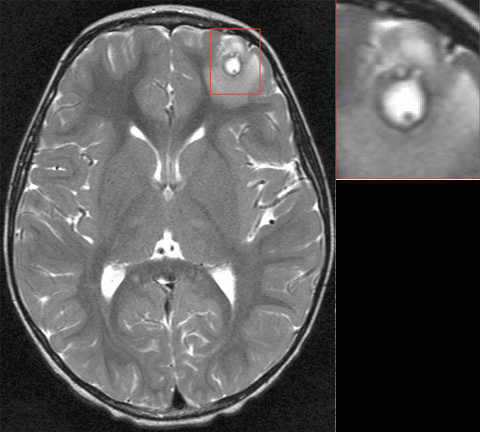
HIV serology and results of blood films for malarial parasites were negative; other blood tests, including an eosinophil count, were normal. Cerebral magnetic resonance imaging (MRI), performed because the diagnosis was unclear and the patient had had a prolonged seizure, revealed a single 8 mm cyst, with an enhancing wall and surrounding oedema, in the left frontal lobe. The cyst contained a scolex, pathognomonic of neurocysticercosis (Box). There were multiple foci throughout the brain, indicating active and resolving cysts. Serology results for Taenia solium were negative at presentation and 3 months later. The child was treated with 8 days of albendazole and 3 days of dexamethasone. Repeat MRI 2 months after presentation showed significant improvement, with a residual 3 mm calcified focus. The child has remained seizure-free for 18 months.
Neurocysticercosis is caused by larvae of the pork tapeworm T. solium, which may encyst in the brain, eye or spinal cord, after ingestion of ova-contaminated food or water.1 In contrast, ingestion of encysted larvae (cysticerci) in undercooked meat results in intestinal infection with the adult tapeworm.1 Neurocysticercosis is common in many asset-poor countries, including those in Asia and sub-Saharan Africa from where many people in humanitarian refugee programs originate.2 In areas where it is endemic, T. solium is a leading cause of epilepsy in children and adults.3
The diagnosis of neurocysticercosis is difficult and the diagnostic differential is broad. Cerebral imaging showing typical lesions containing a scolex is diagnostic. T. solium serology is insensitive, especially in children with few cysts. Anticercal antibodies or cysticercal antigens in the cerebral spinal fluid are helpful, but these investigations are not widely available (they are available from the Centers for Disease Control and Prevention, Atlanta, United States).
Treatment with anthelmintics is controversial; parasites may die spontaneously and treatment may cause local inflammation (reduced by steroids), which potentially exacerbates seizures or causes local tissue damage.4 Ocular cysticercosis should be excluded before anthelmintic treatment as the resultant inflammation may compromise sight; surgical excision should be considered if ocular cysticercosis is present.4 Empirical anthelmintics, often given before departure or following resettlement to people at risk, may potentially precipitate seizures.5 We treated this child with albendazole as there were multiple lesions likely to contain live parasites, and because anticonvulsants were declined.
This case highlights that neurocysticercosis is a possible treatable cause of afebrile seizures in patients migrating from, or with a history of visiting, endemic areas, including resettled refugees. Clinicians in affluent countries are often unfamiliar with the disease, yet are managing increasing numbers of people at risk. Misdiagnosis is of particular concern because brain imaging is not routinely performed in children presenting with their first afebrile seizure.
References
- Schantz PM, Moore AC, Muñoz JL, et al. Neurocysticercosis in an orthodox Jewish community in New York City. N Engl J Med 1992; 327: 692-695.
- Román G, Sotelo J, Del Brutto O, et al. World Federation of Neurology Research Group on Tropical Neurology. A proposal to declare neurocysticercosis an international reportable disease. Bull World Health Organ 2000; 78: 399-406. 0_i1091875
- Singhi P, Ray M, Singhi S, Khandelwal N. Clinical spectrum of 500 children with neurocysticercosis and response to albendazole therapy. J Child Neurol 2000; 15: 207-213. 0_i1091877
- Garcia HH, Evans CA, Nash TE, et al. Current consensus guidelines for treatment of neurocysticercosis. Clin Microbiol Rev 2002; 15: 747-756. 0_i1091879
- Garcia HH, Gonzalez I, Mija L. Neurocysticercosis uncovered by single-dose albendazole. N Engl J Med 2007; 356: 1277-1278. 0_i1091882
Costs of Delivering the Hep B PAST Model of Care in Remote Australia: A Retrospective Pre–Post Study
Hoa Nguyen, Anh Le Tuan Nguyen, Paula Binks, Melita McKinnon, Emily Vintour-Cesar, Karen Wills, Nicola Stephens, Benjamin Cowie, Joshua S. Davis, Yuejen Zhao, Peter Nihill, Julie A. Campbell, Andrew J. Palmer, Jane Davies, Barbara de Graaff
Buruli Ulcer Acquired From Ringtail Possum Rescue
Daniel P. O'Brien, Naomi Clarke, Sara Bonnici, Mohammad A. Hussain
Q Fever Visceral Abscesses After Contact With Native Australian Marsupials
Samantha J. Laws, Enzo Binotto, James Stewart, Jennifer Ho, Trent Yarwood, Josh Hanson, Simon Smith
Hospital-Admitted Injection-Related Infections Among Incarcerated People Who Inject Drugs in Australia: A Retrospective Cohort Study
Andrew Palmer, Matthew Carter, Jeremy Yeo, Cecilia Shim, Jason Connor, Jeremy Hayllar, Gerald Holtmann, Naomi Moy, Elliott G. Playford, Naomi Runnegar, Paul J. Clark
The Live Attenuated Influenza Vaccine in Australia: An Additional Tool for Influenza Prevention
Cyra Patel, Alexis Pillsbury, Tran Nguyen, Xia Wang, Helen E. Quinn, Clayton K. Chiu, Allen C. Cheng, Katie L. Flanagan, Zhicheng Wang
Reflex Testing for Hepatitis D Infection: A Unique Opportunity to Reduce Hepatitis D-Related Chronic Liver Disease Deaths in Australia
Jessica Howell, Lauren Andersson, Miriam T. Levy, James O'Beirne, Leon Adams, Katharine Irvine, Avik Majumdar, Golo Ahlenstiel, Kathy Jackson, Krispin Hajkowicz, Joseph Doyle, Jane Davies, Sarah Cherian, Wayne Dimech, Alexander J. Thompson