




Volume 191 - Issue 4
Med school success tips
Author: Paul A Gatenby
Med J Aust 2009; 191 (4): 219. || doi: 10.5694/j.1326-5377.2009.tb02757.x
Published online: 17 August 2009
Published online: 17 August 2009
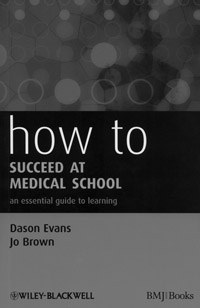
How to succeed at medical school. An essential guide to learning.
Dason Evans, Jo Brown. Chichester: Wiley-Blackwell, 2009 (ix + 179 pp). ISBN 978 1 4051 5139 9.
The authors of this guide both come from St George’s, University of London, where they work in the Centre for Medicine and Healthcare Education. They have long track records in medical and health science education and as examiners and are well placed to co-author a book such as this.
The book endeavours to equip a student to perform well at a British medical school. The curriculum that the hoped-for readers face would be quite familiar to Australian students and faculty, encompassing the spectrum of courses found here. I don’t believe there is another book quite like it. There are similar books from North America, but they are less relevant to this country and tend to concentrate on how to get into medical school and get the residency of your choice, rather than the bit in the middle — the subject matter of this book.
Much of this information would be available in the form of student guides and the like in most Australian medical schools, begging the question: will students see the price for a consolidated source of advice as a good investment? This book is, however, a rich and compact source of advice. A medical teacher of many years, I found myself in agreement with virtually the whole book.
The background to knowledge and learning are sound. That there is a lot to grasp in medicine, requiring something more than pre-exam cramming, the value of working in teams, the necessity of continuous practice to ensure that clinical skills are like riding a bike — these are all concepts of value to students. Information about the different sorts of examinations and assessments is spot on.
The book is easy to read. It is well set out and has good revision points in the form of reflective questions at the end of each chapter. Both teachers and students would benefit from it, although if the publishers seriously want it to sell in Australia they should replace references to the GMC (General Medical Council), and the like, with appropriate Australian ones.
Shifting focus to adolescent wellbeing and inclusive participation in the digital age
Allyson R Todd, Elena Wang, Stephanie R Partridge
The clinical presentation, investigation, and management of women diagnosed with endometriosis in Australian general practices, 2011–2021: an open cohort study
Danielle Mazza, Kailash Thapaliya, Sharinne B Crawford, Alissia Hui, Maryam Moradi, Luke E Grzeskowiak
The impact of the Breast Screen NSW transition from film to digital mammography, 2002–2016: a linked population health data analysis
Rachel Farber, Nehmat Houssami, Katy J L Bell
Non‐technical errors associated with deaths in surgical care, Australia, 2012–2019, by surgical specialty (Australian and New Zealand Audit of Surgical Mortality): a retrospective cohort study
Jesse Ey, Victoria Kollias, Octavia Lee, Kelly Hou, Matheesha Herath, John B North, Ellie Treloar, Suzanne Edwards, Martin Bruening, Adam J Wells, Guy J Maddern
The CURE Asthma roadmap
Gary P Anderson, Anthony Flynn, Phil G Bardin, John D Blakey, Shyamali C Dharmage, Paul Foster, Peter G Gibson, Adam Jaffe, Alan James, Christine R Jenkins, Sundram Sivamalai, Peter D Sly, Guy B Marks, Vanessa M McDonald, Judy Wetttenhall
Evidence from Australian cohort studies about asthma trajectories and transitions across the life course: a narrative review
Caroline Lodge, Xin Dai, Ingrid A. Laing, Michael P Menden, Anthony Flynn, Gary P Anderson, Sarath Ranganathan, Shyamali C Dharmage