




Volume 191 - Issue 4
Challenging respiratory infections in cystic fibrosis
Authors: Abdullah A Yousef and Adam Jaffé
Med J Aust 2009; 191 (4): 236-237. || doi: 10.5694/j.1326-5377.2009.tb02767.x
Published online: 17 August 2009
Published online: 17 August 2009
To the Editor: We report a case of a 13-year-old girl with cystic fibrosis (CF) and chronic Pseudomonas aeruginosa lung infection who developed an unusual infection that was challenging to manage. At a regular review, and with no obvious change in clinical respiratory status, the patient’s forced expiratory volume in 1 second (FEV1) was 70% of the predicted value — a drop from her usual 90%. A subsequent 3-week admission, including treatment with standard antipseudomonal antibiotics, physiotherapy and addition of nebulised dornase alfa, did not significantly improve her lung function. She was discharged home on a trial of azithromycin. One month later, she had a non-productive cough, and a bronchoalveolar lavage specimen showed no growth on culture.
Four months later, the patient presented with increased non-productive cough and sudden further deterioration in FEV1 to 52% of the predicted value. She was admitted and given standard intravenous antipseudomonal antibiotics. Culture of a repeat bronchoalveolar lavage specimen grew Mycobacterium abscessus, sensitive to clarithromycin, imipenem and amikacin; hence, the patient was given intravenous imipenem and amikacin for 3 weeks.
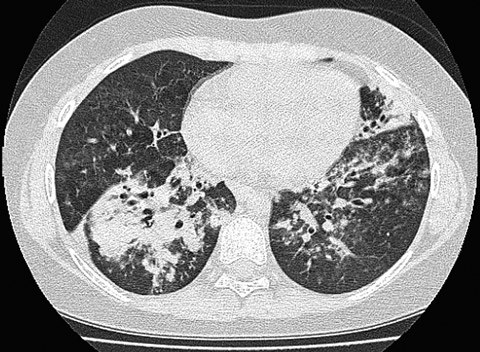
During this period, high-resolution computed tomography (CT) of the patient’s chest showed mucus plugging, marked diffuse parenchymal involvement with typical “tree-in-bud” appearance and, surprisingly, given her poor lung function, only moderate bronchiectasis (Box). Two years earlier, results of a chest CT scan were normal.
The patient was discharged home on long-term nebulised amikacin, oral ciprofloxacin and oral clarithromycin. Her lung function gradually improved after discharge and, 6 months later, her FEV1 was 69% of the predicted value and a sputum culture produced no growth.
CF is a risk factor for non-tuberculous mycobacterial (NTM) lung disease, which is notoriously difficult to eradicate. A recent multicentre prospective study in the United States estimated that, in patients with CF who are older than 10 years, the prevalence of non-tuberculous mycobacterium was around 13%. The most common species were M. avium complex (72%) and M. abscessus (16%).1 Another study suggested that M. abscessus was more common in paediatric patients.2
Clinical signs and symptoms of NTM infections are usually difficult to distinguish from those of chronic respiratory infections that occur during the advanced stages of CF. High-resolution CT often reveals features of parenchymal involvement, as demonstrated in our patient. No guidelines exist for treating NTM infections in the CF population. However, for M. abscessus infection, oral clarithromycin in combination with intravenous amikacin and either cefoxitin or imipenem for 2–4 months has been recommended, with sputum surveillance for at least 12 months after a negative culture result.3 Suppressive maintenance therapy with clarithromycin, intermittent intravenous antibiotics and aerosolised amikacin have all been reported, but not confirmed by controlled studies. Surgical resection may be curative in localised disease.
As the life expectancy of patients with CF improves, the prevalence of NTM infections is likely to increase. The American Thoracic Society recommends that all patients with CF who are on macrolide therapy should be screened annually for atypical mycobacteria.3 Atypical mycobacteria should always be borne in mind when treating patients with CF and an unexplained decline in lung function.
References
- Olivier KN, Weber DJ, Wallace RJ, et al. Nontuberculous mycobacteria. I: Multicenter prevalence study in cystic fibrosis. Am J Respir Crit Care Med 2003; 167: 828-834. 0_CHDFBJFE
- Sermet-Gaudelus I, Le Bourgeois M, Pierre-Audigier C, et al. Mycobacterium abscessus and children with cystic fibrosis. Emerg Infect Dis 2003; 9: 1587-1591. 0_i1091855
- Griffith DE, Aksamit T, Brown-Elliott BA, et al. An official ATS/IDSA statement: diagnosis, treatment, and prevention of nontuberculous mycobacterial diseases. Am J Respir Crit Care Med 2007; 175: 367-416. 0_CBBCBIDH
Costs of Delivering the Hep B PAST Model of Care in Remote Australia: A Retrospective Pre–Post Study
Hoa Nguyen, Anh Le Tuan Nguyen, Paula Binks, Melita McKinnon, Emily Vintour-Cesar, Karen Wills, Nicola Stephens, Benjamin Cowie, Joshua S. Davis, Yuejen Zhao, Peter Nihill, Julie A. Campbell, Andrew J. Palmer, Jane Davies, Barbara de Graaff
Buruli Ulcer Acquired From Ringtail Possum Rescue
Daniel P. O'Brien, Naomi Clarke, Sara Bonnici, Mohammad A. Hussain
Q Fever Visceral Abscesses After Contact With Native Australian Marsupials
Samantha J. Laws, Enzo Binotto, James Stewart, Jennifer Ho, Trent Yarwood, Josh Hanson, Simon Smith
Hospital-Admitted Injection-Related Infections Among Incarcerated People Who Inject Drugs in Australia: A Retrospective Cohort Study
Andrew Palmer, Matthew Carter, Jeremy Yeo, Cecilia Shim, Jason Connor, Jeremy Hayllar, Gerald Holtmann, Naomi Moy, Elliott G. Playford, Naomi Runnegar, Paul J. Clark
The Live Attenuated Influenza Vaccine in Australia: An Additional Tool for Influenza Prevention
Cyra Patel, Alexis Pillsbury, Tran Nguyen, Xia Wang, Helen E. Quinn, Clayton K. Chiu, Allen C. Cheng, Katie L. Flanagan, Zhicheng Wang
Reflex Testing for Hepatitis D Infection: A Unique Opportunity to Reduce Hepatitis D-Related Chronic Liver Disease Deaths in Australia
Jessica Howell, Lauren Andersson, Miriam T. Levy, James O'Beirne, Leon Adams, Katharine Irvine, Avik Majumdar, Golo Ahlenstiel, Kathy Jackson, Krispin Hajkowicz, Joseph Doyle, Jane Davies, Sarah Cherian, Wayne Dimech, Alexander J. Thompson