




Volume 190 - Issue 4
The hidden cost of varicella
Authors: Elizabeth K Nairn, Joshua Wolf and Jim P Buttery
Med J Aust 2009; 190 (4): 223-224. || doi: 10.5694/j.1326-5377.2009.tb02364.x
Published online: 16 February 2009
Published online: 16 February 2009
A 5-month-old boy with known congenital varicella syndrome presented to our hospital emergency department with generalised herpes zoster (shingles).
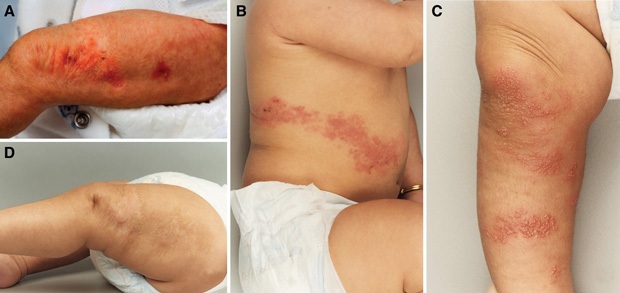
The child was born in Australia. His Sri Lankan-born mother had developed chickenpox in the second trimester of pregnancy. Examination and investigation of the child at birth for complications of congenital varicella syndrome had revealed only skin changes on the left thigh (Box, A).
A new vesicular rash had evolved over 3 days, initially involving right T8 (Box, B) and L4–5 (Box, C) dermatomes, then progressing to cover the entire body. There was no clinical evidence of visceral involvement. Cicatricial scarring had replaced the congenital skin changes (Box, D).
Varicella zoster virus was isolated from vesicular fluid. Oral valaciclovir was prescribed for 7 days because the generalised nature of the rash demonstrated an insufficient immune response to varicella reactivation. The symptoms rapidly resolved, with no new scarring.
A maternal chickenpox infection during pregnancy can be severe and life-threatening, and can also cause in-utero infection, which may be fatal or result in congenital abnormalities.1
Important features of congenital varicella syndrome include:
dermatomal cicatricial scarring (highlighted by this patient);
limb defects;
intrauterine growth restriction;
ophthalmological defects (chorioretinitis, optic atrophy, cataract);
gastrointestinal or genitourinary abnormalities;
neurological defects (developmental delay, seizures, deafness, limb paralysis, microcephaly).1
Shingles is caused by reactivation of varicella zoster virus. Childhood shingles is uncommon (incidence, 0.05%/year), rarely indicates primary immunodeficiency,2 and occurs more frequently following congenital infection (4.4%/year)2 or chickenpox infection during infancy (0.4%/year).2 Antiviral treatment of shingles in immunocompetent young children is not usually recommended, as complications (including post-herpetic neuralgia) are rare.3
Chickenpox has been mainly a childhood disease in Australia, but in many tropical countries it predominantly affects adults. Immigrants to Australia from these regions (including the mother of our patient) may remain susceptible to varicella infection.4 At least 5% of Australian women of childbearing age were born in tropical countries.5
Varicella vaccine is highly effective and is listed on the National Immunisation Program Schedule6 for childhood immunisation. Lowering the community prevalence of varicella infection by routine childhood immunisation can help protect non-immune adults and immunocompromised patients.1 Opportunistic, proactive identification and immunisation of non-immune adults, particularly for both prospective parents before pregnancy, could help prevent serious consequences.
References
- Tan MP, Koren G. Chickenpox in pregnancy: revisited. Reprod Toxicol 2006; 21: 410-420. 0_CBBGHJBG
- Feder HM Jr, Hoss DM. Herpes zoster in otherwise healthy children. Pediatr Infect Dis J 2004; 23: 451-457. 0_i1091880
- Pickering LK, editor. Red book: 2006 report of the Committee on Infectious Diseases. 27th ed. Elk Grove, Ill: American Academy of Pediatrics, 2006. 0_i1091882
- MacMahon E, Brown LJ, Bexley S, et al. Identification of potential candidates for varicella vaccination by history: questionnaire and seroprevalence study. BMJ 2004; 329: 551-552. 0_i1091884
- Australian Bureau of Statistics. 2006 census of population and housing: country of birth of person by age and sex. http://www.censusdata.abs.gov.au (accessed Nov 2008).
- Australian Department of Health and Ageing. National Immunisation Program (NIP) Schedule. http://www.health.gov.au/internet/immunise/publishing.nsf/content/nips (accessed Jan 2009).
Barriers and Facilitators to Timely Detection and Optimal Management of Chronic Wet Cough in Aboriginal Children Across Australia From the Perspectives of Carers of Aboriginal Children: A Qualitative Study
Gloria T. Y. Lau, Pam Laird, Robyn Aitken, Melanie Barwick, Liam Bedford, Emily R. Bowden, Jamie Everingham, Angela Fuery, Reece Griffin, Neha Jain, Mina Kinghorn, Renae Knapp, Gabrielle B. McCallum, Peter Morris, Richard Norman, Peter C. Richmond, Aarti Saiganesh, Slade Sibosado, Cameron Taylor, Maree Toombs, Roz Walker, Joan Wilson, Anne B. Chang, André Schultz
Barriers and Facilitators to Timely Detection and Optimal Management of Chronic Wet Cough in Aboriginal Children Across Australia From the Perspective of Health Care Providers: A Qualitative Study
Gloria T. Y. Lau, Pamela Laird, Robyn Aitken, Melanie Barwick, Liam Bedford, Emily R. Bowden, Corey Dalton, Jamie Everingham, Angela Fuery, Reece Griffin, Neha Jain, Mina Kinghorn, Renae Knapp, Gabrielle B. McCallum, Peter Morris, Richard Norman, Peter C. Richmond, Aarti Saiganesh, Slade Sibosado, Maree Toombs, Roz Walker, Joan Wilson, Anne B. Chang, André Schultz
Short-Term Safety of Concomitant Meningococcal B and National Immunisation Program Vaccines in Infants Aged < 15 Months: A Survey-Based Surveillance Study
Thuy Nguyen, Evelyn C. S. Tay, Michael Dymock, Thomas L. Snelling, Lucy Dawes, Julie Marsh, Yue Wu, Alan Leeb, Nicholas Wood, Lucy Deng
The GenV Biobank: Enabling Biological Research in a Large Longitudinal Population-Representative Cohort of Australian Newborns and Their Parents
Katherine Lange, Kim L. Powell, Yeukai Mangwiro, Tony Frugier, Donna T. Geddes, Melissa Wake, Richard Saffery
Watchful Waiting Compared With Immediate Antibiotics for Urban Aboriginal and Torres Strait Islander Children With Uncomplicated Acute Otitis Media (WATCH): A Non-Inferiority Randomised Controlled Trial
Jennifer S. Reath, Hasantha Gunasekera, Sanja Lujic, Amanda J. Leach, Letitia Campbell, Robyn Walsh, Tim Usherwood, Geoffrey K. Spurling, Claudette A. Tyson, Deborah A. Askew, Kelvin Kong, Chelsea J. Watego, Peter Morris, Wendy Hu, Penelope A. Abbott
A Rare Case of Storage Mite Anaphylaxis in Infancy
Eliza Kluckow, Katie Frith