




Volume 188 - Issue 1
Exposing Bundaberg’s Dr Death
Author: David Molloy
Med J Aust 2008; 188 (1): 25. || doi: 10.5694/j.1326-5377.2008.tb01499.x
Published online: 7 January 2008
Published online: 7 January 2008
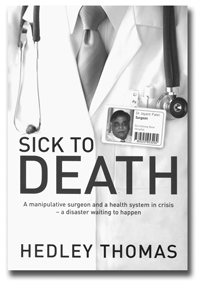
Sick to death.
Hedley Thomas. Sydney: Allen & Unwin, 2007 (ix + 427 pp). ISBN 978 1 74114 881 7.
Typically, journalists write readable books; even journalism textbooks are easy to follow. So it is with Hedley Thomas’ story of Bundaberg Hospital’s saga with Dr Jayant Patel. The journalist credited with publicly exposing the discredited surgeon (and more importantly, the terrible deficiencies of the Queensland public health system) leads us on a trail of discovery, ineptitude, political chicanery and tragedy.
The tragedy lies with the patients who put their trust in both their local hospital and Patel, then Director of Surgery, a trust that was shattered and will take a generation to repair. There is a terrible poignancy in the level of personal harm suffered and documented in the book.
The ineptitude is staggering: from the local hospital administration up to the highest levels of Queensland Health. In retrospect, how easy it would have been to avoid much of the scandal by conducting a proper investigation into Patel rather than trying to cover up the truth. Instead, here is a tale which harmed almost everyone who came in contact with it. Thomas chronicles rather than analyses as he exposes how a thriving department of surgery was destroyed by an appalling administrative culture and turned into Patel’s fiefdom.
Thomas is mostly, but not always, accurate. He relies a little too much on National Party gossip instead of checking facts. Gastroenterologists would no doubt be astonished to learn that they are the most qualified practitioners to perform oesophagectomies, Patel’s signature procedure.
At the end of 427 pages, one has to reflect on whether there are any winners. Many Bundaberg patients are still waiting for compensation, surgical waiting lists are no better, and institutional reform of Queensland Health is still required. Burdensome legislation makes medical registration and quality assurance in Queensland inefficient and insidious. There were no political winners, except, perhaps, the incumbent state government. Plus ça change, plus c’est la même chose...
Medical Colleges Have an Obligation to Ensure Full Participation in Clinical Quality Registries
Thomas J. Hugh
Getting on the Same Page: Why Australia Needs a National Maternity Early Warning System (MEWS) Chart
Briony A. Cutts, Lucy Bowyer, Nisha Khot, Sandra Lowe, Stefan C. Kane
Data for Equity: Can Linked Administrative Data Inform Pathways to More Equitable Child Health?
Sarah Gray, Shuaijun Guo, Meredith O'Connor, Elodie O'Connor, Katrina Williams, Hannah Badland, Susan Woolfenden, Josie Dickerson, Gerry Redmond, Marnie Downes, Sharon R. Goldfeld
Specialty College Selection: Why Change is Critical to Support a Future Rural Workforce
Matthew R. McGrail, Jenny May AM, Katherine Logan
Differentiated and simplified oral HIV pre‐exposure prophylaxis (PrEP) models hold the key to virtually eliminating HIV transmission in Australia by 2030
Tyson Arapali, Sarah Warzywoda, Anthony K J Smith, Curtis Chan, Timothy R Broady, Erin Sullivan, Catherine MacPhail, Mohamed A Hammoud, Alexander Dowell‐Day, Benjamin R Bavinton
The number of cancer‐related deaths that could be attributable to spatial disparities in survival in Australia, 2010–2019: a retrospective population‐based cohort study
Charlotte K Bainomugisa, Jessica Cameron, Paramita Dasgupta, Peter Baade