




Volume 187 - Issue 2
Menopause — it’s not just hormones
Author: Sheila O’Neill
Med J Aust 2007; 187 (2): 132. || doi: 10.5694/j.1326-5377.2007.tb01163.x
Published online: 16 July 2007
Published online: 16 July 2007
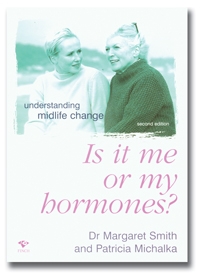
Is it me or my hormones? Understanding midlife change. 2nd ed.
Margaret Smith, Patricia Michalka. Sydney: Finch Publishing, 2006 (278 pp). ISBN 187645174 2.
Hot flushes, night sweats and mood swings may have taken them by surprise. The loss of sexual desire or the experience of discomfort during intercourse may be evoking confused responses, ranging from self-doubt (“Am I still an attractive woman?”), to worry about the state of the relationship with their partner.
For some women, patient listening and an assessment of their physical state (including, in appropriate cases, hormone therapy) may provide all the reassurance they need. For others, though, something more comprehensive is called for.
For women who need detailed information — physical, emotional, sexual, social and even spiritual — about the menopause transition, this book is a godsend. Margaret Smith, a gynaecologist specialising in the menopause, and Patricia Michalka, a psychotherapist, have distilled their combined wisdom into a book that addresses one of the most fundamental questions raised by menopausal women: “Is it me or my hormones?”
In a genuinely holistic approach, the authors explore the many symptoms and issues that sometimes confuse menopausal women to the point of despair. The case-study approach is handled warmly and with compassion: worried women will find it easy to identify with the stories in this book.
We all know that the “one size fits all” approach flies in the face of common sense and our experience of the uniqueness of each patient’s situation. Is it me or my hormones? emphasises the need to take an individual approach, and to recognise that symptoms are rarely a sign of only one thing.
Shifting focus to adolescent wellbeing and inclusive participation in the digital age
Allyson R Todd, Elena Wang, Stephanie R Partridge
The clinical presentation, investigation, and management of women diagnosed with endometriosis in Australian general practices, 2011–2021: an open cohort study
Danielle Mazza, Kailash Thapaliya, Sharinne B Crawford, Alissia Hui, Maryam Moradi, Luke E Grzeskowiak
The impact of the Breast Screen NSW transition from film to digital mammography, 2002–2016: a linked population health data analysis
Rachel Farber, Nehmat Houssami, Katy J L Bell
Non‐technical errors associated with deaths in surgical care, Australia, 2012–2019, by surgical specialty (Australian and New Zealand Audit of Surgical Mortality): a retrospective cohort study
Jesse Ey, Victoria Kollias, Octavia Lee, Kelly Hou, Matheesha Herath, John B North, Ellie Treloar, Suzanne Edwards, Martin Bruening, Adam J Wells, Guy J Maddern
The CURE Asthma roadmap
Gary P Anderson, Anthony Flynn, Phil G Bardin, John D Blakey, Shyamali C Dharmage, Paul Foster, Peter G Gibson, Adam Jaffe, Alan James, Christine R Jenkins, Sundram Sivamalai, Peter D Sly, Guy B Marks, Vanessa M McDonald, Judy Wetttenhall
Evidence from Australian cohort studies about asthma trajectories and transitions across the life course: a narrative review
Caroline Lodge, Xin Dai, Ingrid A. Laing, Michael P Menden, Anthony Flynn, Gary P Anderson, Sarath Ranganathan, Shyamali C Dharmage