




Volume 185 - Issue 2
GPs: acting the part
Author: Max Kamien
Med J Aust 2006 || doi: 10.5694/j.1326-5377.2006.tb00465.x
Published online: 8 May 2006
Published online: 8 May 2006
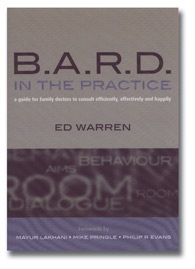
BARD in the practice. A guide for family doctors to consult efficiently, effectively and happily.
Ed Warren. Oxford: Radcliffe Publishing, 2006 (xi + 136 pp). ISBN 1 85775 665 7.
B is for behaviour, with an emphasis on the non-verbal kind through which over 50 per cent of interpersonal communication occurs.
A is for aims the broad direction in which a GP wishes to progress the patient and other stakeholders in the achievement of said aims. Here Warren introduces the concept of the good enough consultation. The essential components are securing the patients safety and ensuring that both patient and doctor are proceeding in the direction of their aims. The doctor/actor doesnt have to compress the whole play into one 12-minute scene. There will be more scenes and acts to follow.
R is for room and is equivalent to the theatre in which the action takes place. This includes the approaches to the building, the interior layout and the costume of reception, nursing and medical staff.
D is for dialogue the process by which doctor and patient try to adjust their transmitters and receivers to the same frequency. A novel suggestion is the use of voice lessons.
The last two chapters in this book are on training for, and the ethics of, becoming a BARD GP. But this is not a syrupy How to win friends and influence people book. At no stage does the author suggest readers adopt behaviour incongruent with their beliefs and personality. Rather, the author wishes to transpose elements of Stanislavskis be yourself method acting to the medical consultation.
This book is an innovative addition to the literature on improving ones consultation skills. Actors and sportspeople train to optimise their performances, as do spokespeople for the Australian Medical Association. So why not GPs? Reading this book is guaranteed to improve the consultation skills of even the most accomplished GPs. It has particular relevance for registrars and their mentors.
Max KamienEmeritus Professor of General Practice, University of Western Australia, Perth, WA
Prisoner of war pathology in Changi, 1942–1945
Kate Ariotti, Elizabeth Roberts‐Pedersen
Should medical eponyms continue to be used in everyday practice?
Leya Nedumannil, Diana Lewis
100 years on: the first use of insulin in Australia
Sophie Templer
Reflections on the life and career of Professor Dame Valerie Beral AC DBE FRS FRCOG FMedSci (1943–2022)
Karen Canfell, Bette Liu, Emily Banks
The Honourable Dr Donald James Grimes AO
Michael Kirby, Patti Warn
From wipeout to drill out: a history of exostosis management and Australian surfing
Alon Taylor, Hannah North, Narinder P Singh, Paul A Fagan