




Volume 184 - Issue 12
Guide to paediatric trauma
Author: Andrew J A Holland
Med J Aust 2006 || doi: 10.5694/j.1326-5377.2006.tb00404.x
Published online: 16 June 2006
Published online: 16 June 2006
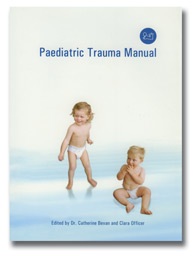
Paediatric trauma manual.
Catherine Bevan, Clara Officer (editors). Melbourne: Royal Childrens Hospital, 2004 (336 pp + CD-ROM). ISBN 192082431.
Trauma continues to be the most common cause of death in children after the first six months of life, accounting for many paediatric hospital admissions in both Australia and overseas. Few would dispute the importance of this topic to the health of children, yet it is an area beyond the comfort zone of many doctors and allied health professionals, even those experienced in dealing with adult trauma patients or children with other diseases. Armed with appropriate information, many clinicians will at least feel better able to face a challenging situation when it arises.
This manual and CD-ROM represent a collaboration between the Royal Childrens Hospital in Melbourne and the Victorian Trauma Foundation. The text has been edited by the hospitals Trauma Fellow and Trauma Service Education Co-ordinator, and the majority of the authors are clinicians at that institution.
The text centres on trauma management guidelines for the various body systems, with short sections on practical trauma procedures and the Victorian State Trauma System. In general, the text is clearly and simply written in a style that would be familiar to those who have read the manuals for the Emergency Management of Severe Trauma or Advanced Paediatric Life Support courses. In addition to the text of the manual, the CD-ROM contains a number of scenarios with multiple choice questions, as well as video demonstrations of practical procedures.
In a style common to many manuals, I found the text dry and not immediately engaging. Although there were a number of illustrations, many in colour, most were far too small and several were duplicated in different chapters. The use of references was curiously sporadic throughout the book, with some chapters containing several useful review articles and others none at all. I did not agree with everything in the book. For example, I would challenge the authors recommendation restricting mobility after splenic trauma for three months, as there are considerable data from the United States confirming the safety of a much earlier return to normal activities.
Overall, given the manuals price, style and content, I would only see a place for it in the library and emergency department of hospitals dealing with paediatric trauma patients. Its price would preclude purchase by most junior clinical staff and general practitioners dealing with the occasional paediatric trauma patient.
Andrew J A HollandAssociate Professor of Paediatric Surgery and UrologyThe Childrens Hospital at Westmead, NSW
Barriers and Facilitators to Timely Detection and Optimal Management of Chronic Wet Cough in Aboriginal Children Across Australia From the Perspectives of Carers of Aboriginal Children: A Qualitative Study
Gloria T. Y. Lau, Pam Laird, Robyn Aitken, Melanie Barwick, Liam Bedford, Emily R. Bowden, Jamie Everingham, Angela Fuery, Reece Griffin, Neha Jain, Mina Kinghorn, Renae Knapp, Gabrielle B. McCallum, Peter Morris, Richard Norman, Peter C. Richmond, Aarti Saiganesh, Slade Sibosado, Cameron Taylor, Maree Toombs, Roz Walker, Joan Wilson, Anne B. Chang, André Schultz
Barriers and Facilitators to Timely Detection and Optimal Management of Chronic Wet Cough in Aboriginal Children Across Australia From the Perspective of Health Care Providers: A Qualitative Study
Gloria T. Y. Lau, Pamela Laird, Robyn Aitken, Melanie Barwick, Liam Bedford, Emily R. Bowden, Corey Dalton, Jamie Everingham, Angela Fuery, Reece Griffin, Neha Jain, Mina Kinghorn, Renae Knapp, Gabrielle B. McCallum, Peter Morris, Richard Norman, Peter C. Richmond, Aarti Saiganesh, Slade Sibosado, Maree Toombs, Roz Walker, Joan Wilson, Anne B. Chang, André Schultz
Short-Term Safety of Concomitant Meningococcal B and National Immunisation Program Vaccines in Infants Aged < 15 Months: A Survey-Based Surveillance Study
Thuy Nguyen, Evelyn C. S. Tay, Michael Dymock, Thomas L. Snelling, Lucy Dawes, Julie Marsh, Yue Wu, Alan Leeb, Nicholas Wood, Lucy Deng
The GenV Biobank: Enabling Biological Research in a Large Longitudinal Population-Representative Cohort of Australian Newborns and Their Parents
Katherine Lange, Kim L. Powell, Yeukai Mangwiro, Tony Frugier, Donna T. Geddes, Melissa Wake, Richard Saffery
Watchful Waiting Compared With Immediate Antibiotics for Urban Aboriginal and Torres Strait Islander Children With Uncomplicated Acute Otitis Media (WATCH): A Non-Inferiority Randomised Controlled Trial
Jennifer S. Reath, Hasantha Gunasekera, Sanja Lujic, Amanda J. Leach, Letitia Campbell, Robyn Walsh, Tim Usherwood, Geoffrey K. Spurling, Claudette A. Tyson, Deborah A. Askew, Kelvin Kong, Chelsea J. Watego, Peter Morris, Wendy Hu, Penelope A. Abbott
A Rare Case of Storage Mite Anaphylaxis in Infancy
Eliza Kluckow, Katie Frith