Volume 184 - Issue 12
Lower-back pain, intervertebral-disc calcification and scleral pigmentation
Authors: Aman Sharma, Shefali K Sharma, Ajay Wanchu, Manish Kumar, Surjit Singh and Pradeep Bambery
Med J Aust 2006; 184 (12): 643. || doi: 10.5694/j.1326-5377.2006.tb00424.x
Published online: 19 June 2006
Published online: 19 June 2006
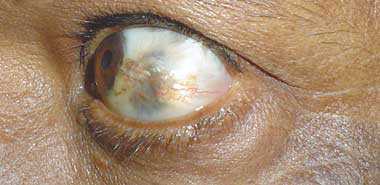
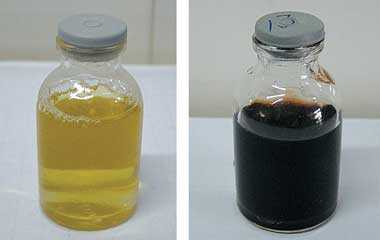
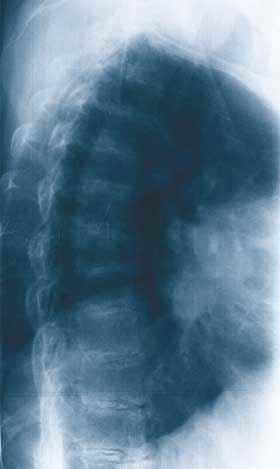
A 54-year-old man presented with a 3-year history of non-inflammatory pain in his lower back, and his hip and knee joints. He also had black discolouration of the palms, cheeks and sclerae (Box 1A) and his urine turned black on alkalinisation (Box 1B). Spinal x-rays showed intervertebral disc calcification (Box 1C). A diagnosis of alkaptonuria (ochronosis) was made.
The calcification of intervertebral discs is caused by calcium hydroxyapatite. Knee, shoulder and hip joints may also be affected, but small joints of the hands and feet are spared. This condition differs from ankylosing spondylitis in that there is no annular ossification. Sacroiliac joint changes differ — patients with ochronosis have narrowing and extensive sclerosis, while those with ankylosing spondylitis have erosive changes followed by ankylosis. The diagnosis of ochronosis can be confirmed by detection of urinary homogentisic acid.