




Volume 181 - Issue 8
Thyroid testing 10 years on
Author: Richard X Davey
Med J Aust 2004; 181 (8): 462-464. || doi: 10.5694/j.1326-5377.2004.tb06392.x
Published online: 18 October 2004
Published online: 18 October 2004
Richard X Davey
Chemical Pathologist, Melbourne Health Shared Pathology Service, Western Hospital, Gordon Street, Footscray, VIC 3011. richard.daveyATwh.org.au
To the Editor: In 1996, the Journal published my assessment of the scientific validity of a 1994 decision by the Australian Health Insurance Commission (HIC) to limit the Medicare rebate payment for assessment of thyroid function to thyroid-stimulating hormone level (TSH), except in certain more complex clinical conditions.1 For these, levels of TSH and of other indicators of thyroid function, such as thyroxine, are tested simultaneously and a rebate given for the group of tests. Although discussion concerning this diagnostic strategy persists,2 nearly a decade later it is appropriate to assess the outcome of this initiative.
Publicly accessible HIC data3 on privately ordered, then publicly refunded, thyroid function tests in Australia for the fiscal years 1994–2002 were retrieved and are presented graphically (Box).
Figure A shows the change in thyroid function test ordering sought by the HIC occurring in 1997 through to 2000 and probably now consolidating. Overall, before the initiative, there were 1.55 TSH tests ordered for each thyroid function group test, and in 2002 this increased to 2.65. The outcome in the elderly is similar, but the change is even more noticeable for thyroid testing in young women and men (with ratios of about 5 to 1 and 7 to 1, respectively).
Clinicians have presumably come to accept the high negative predictive value of a normal TSH result for ruling out primary thyroid disease as both necessary and sufficient to finalise thyroid diagnoses in the young. By contrast, thyroid disorders are more common among the elderly, who thus more readily satisfy the HIC requirements for thyroid function group tests.
The approximately fourfold increase in absolute terms in the number of single TSH tests performed over 9 years (from 2731 per 100 000 persons per annum in 1994 to 10 763 in 2002) can also be seen as vindicating the HIC’s decision to run with a “TSH first” testing protocol. The same pattern is seen in the age and sex groups illustrated (15–24 years and 75–84 years). The present speed, ease and relative economy of obtaining a TSH test, and the reliability, particularly at low TSH levels, of using this measure for thyroid disease case finding, make ordering a TSH test no longer an indulgence,4 but a clinical necessity.
The national cost-of-living index for 30 June of each fiscal year5 was used to standardise the annual expenditure on thyroid function tests to 1994 dollar values, thus allowing comparison across the decade (Figure B). From 1995 to 2002, the HIC has contained annual expenditure to under $20 million for thyroid function group testing. This is both desirable and appropriate. That this has been sustained for 7 years in the face of increasing numbers of first-line TSH tests is both astonishing and commendable.
Most of the increase in costs of TSH testing is probably explained by the acceptance of its use as a first-line test. Between the 1996 and 2001 censuses, the population grew from 17.9 to 18.8 million, and the proportion over 65 years also increased (from 12% to 12.5%). Both these trends are continuing,5 and both also explain some of the increase in ordering of TSH tests. It is unclear if any of this change is also due to testing moving from the totally public, hospital sector, not funded by the HIC, to the HIC-funded sector.
Effect of changes to the Health Insurance Commission rebate for thyroid function testing
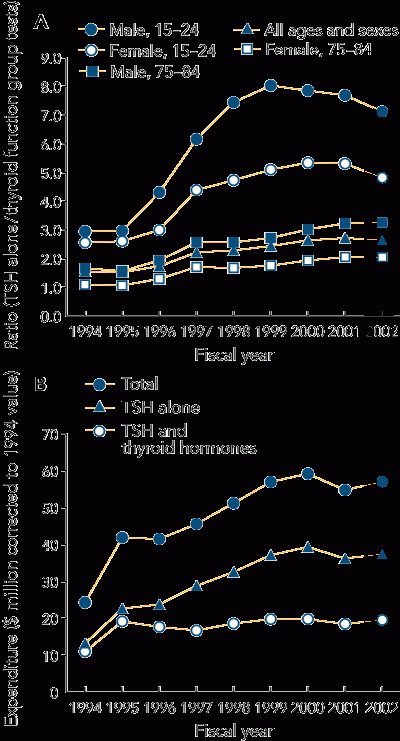
A: Ratio of the number of single tests ordered (thyroid-stimulating hormone [TSH]) to the number of thyroid function group tests ordered (TSH and thyroid hormones). Data are tests per 100 000 persons per annum.
B: Annual expenditure on thyroid function testing in Australia.
References
- Davey RX, Clarke MI, Webster AR. Thyroid function testing based on assay of thyroid stimulating hormone: assessing an algorithm’s reliability. Med J Aust 1996; 164: 329-332. CHDFJGJC
- Beckett GJ, Toft AD. First-line thyroid function tests — TSH alone is not enough [commentary]. Clin Endocrinol 2003; 58: 20-21. CHDDHFHI
- Health Insurance Commission. Medicare Benefits Schedule (MBS) Item Statistics Reports. Available at: www.hic.gov.au/statistics/dyn_mbs/forms/mbs_tab4.shtml (accessed Nov 2003).
- White GH, Walmsley RN. Can the initial clinical assessment of thyroid function be improved? Lancet 1978; 2: 933-935. i1085602
- Australian Bureau of Statistics. 6401.0 Consumer Price Index, Australia; 2001 Census Basic Community Profile; and 1996 Census of Population: Basic Community Profile. Available at: www.abs.gov.au (accessed Nov 2003).
Rapid Growth in Diagnostic CT Knee Imaging in Australia: Implications for Imaging Stewardship
Hanwen Chen, Rachelle Buchbinder, Sean Docking, Ian A Harris
Disease‐specific survival for people with chronic myeloid leukaemia, South Australia, 1980–2020: a retrospective cohort study
Kerri Beckmann, Brendon J Kearney, Naranie Shanmuganathan, David Yeung, Tim Hughes
Technological advances in the search for a CURE for asthma
Sara Quon, Timothy M Johanson, Ridhima Wadhwa, Alen Faiz, Anthony Flynn, Gary P Anderson, Amanda J Cox, Nicholas P West, Michael P Menden, Rhys S Allan
Who gets asthma, and why?
Denby J Evans, Peter D Sly, Paul Foster, Chantal Donovan
The first Australian evidence‐based guidelines on male infertility
Darren J Katz, Liza O’Donnell, Robert I McLachlan, Tim J Moss, Clare V Boothroyd, Veena Jayadev, Sarah R Catford
Sex differences in management and outcomes of people with ST‐elevation myocardial infarction, New South Wales, 2011–2020: a retrospective cohort study
Samia Kazi, Simone Marschner, Haeri Min, Desi Quintans, James JH Chong, Ehsan Khan, David B Brieger, Clara K Chow